
Does Pre-Survey Training Impact Knowledge of Survey Administrators and Survey Outcomes in Developing Countries? Evaluation Findings of a Training of Trainers Workshop for National AIDS and Reproductive Health Survey-Plus in Nigeria
DOI:
https://doi.org/10.21106/ijma.18Keywords:
- Training,
- Survey,
- NARHS-Plus,
- State AIDS Program Coordinators,
- Reproductive Health Coordinators,
- State Laboratory Scientists,
- Lead Supervisors and Counselor Testers,
- Abuja,
- Nigeria
Abstract
Although, Nigeria had conducted various national surveys followed by central and state level trainings for survey administrators, prior pre-survey trainings have not been systematically evaluated to assess their impact on knowledge gain and final outcome of the survey. A central training of trainers' session was organized for master trainers on the conduct of the 2012 National AIDS and Reproductive Health Survey.
Objectives:To evaluate the impact of training on the quality of conduct of a national research survey in the 36 states and the Federal Capital Territory in Nigeria.
Method:A total of 185 participants consisting of State AIDS Program Coordinators, Reproductive Health Coordinators, State Laboratory Scientists, Lead Supervisors and Counselor Testers were invited from the 36 states in Nigeria and the FCT for the central training of trainers in Abuja. The training lasted 5 days and the trainees were grouped into two on the basis of behavioral epidemiology and laboratory components. Training tools such as the developed protocol, training power point slides, practical sessions such as role plays, and usage of HIV rapid test kits were utilized during the training. The facilitators were drawn from Federal Ministry of Health (FMoH), universities and research Institutions as well as Non-Governmental Organizations (NGOs). The facilitators prepared and administered 25 structured questions for the behavioral group and 28 questions for the laboratory group at the beginning of the training to assess the participants' knowledge of HIV and the survey. The same questions answered by Trainees responded to the same questions prior to the commencement and at the end of the trainings. Scores were aggregated to 100 for each test. We conducted paired t-test to determine statistically significant differences between pre-test and post-test results at 0.05 significance level and ANOVA to determine if there were differences in knowledge level among different groups.
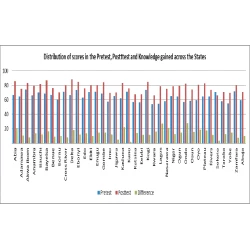
Result:The overall mean pre-test and post-test scores were 64.0% and 77.4% respectively indicating a 13.4% knowledge gain above what it was at the beginning of the training. The mean pre-test score and post-test score for the Southern states (SN) were 64.7% and 80.3% while that of the Northern states (NN) were 63.5% and 75.3% representing a knowledge gain of 15.6% and 11.8% respectively. There was statistical significant difference in the post-test scores between the two regions (p=0.001) and in knowledge gained after the training (p=0.017).
Conclusions and Public Health Implications:Comparison between the pre test and post test scores at the 5-day training showed a significant gain in knowledge of participants. The survey training contributed positively to the preparation and building of knowledge needed for the conduct of 2012 NARHS-plus.
Downloads
Similar Articles
- Romuladus Emeka Azuine, Gopal K Singh, Sussan E Ekejiuba, Eta Ashu, Magnus A Azuine, Global Health Donor Presence, Variations in HIV/AIDS Prevalence, and External Resources for Health in Developing Countries in Africa and Asia , Vol. 2 No. 2 (2014): International Journal of Maternal and Child Health and AIDS
- Elizabeth Armstrong-Mensah, Damilola Dada, Amber Bowers, Aruba Muhammad, Chisom Nnoli, Geographic, Health Care Access, Racial Discrimination, and Socioeconomic Determinants of Maternal Mortality in Georgia, United States , Vol. 10 No. 2 (2021): International Journal of Maternal and Child Health and AIDS
- Elizabeth Armstrong, Priya Srinivasan, Dawood Azeemy, Fayja Habib, Ernest Alema-Mensah, COVID-19 Stressors and Maternal Mental Health in Georgia, United States: Sources, Effects, and Recommendations , Vol. 14 No. Continuous (2025): International Journal of Maternal and Child Health and AIDS
- Chaw Hay Thar, Young Hwa Lee, Young June Choe, Human Immunodeficiency Virus/Acquired Immunodeficiency Syndrome Knowledge and Attitude among Myanmar Women , Vol. 13 No. Continuous (2024): International Journal of Maternal and Child Health and AIDS
- Armand Duclaire Kemo, Bruno Kenfack, Jérôme Ateudjieu, Partograph Utilization and its Determinant Factors among Healthcare Providers during Childbirth in West Cameroon , Vol. 14 No. Continuous (2025): International Journal of Maternal and Child Health and AIDS
- Hasiya Tijjani Ismail, Taiwo G Amole, Fatima I Tsiga-Ahmed, Rabiu I Jalo, Aishatu L Adamu, Mahmoud U Sani, Hamisu M Salihu, William Wester, Muktar H Aliyu, Factors Associated with Utilization of Sexual and Reproductive Health Services among Married Adolescent Girls in Kano, Northern Nigeria , Vol. 13 No. Continuous (2024): International Journal of Maternal and Child Health and AIDS
- Abubakar Sadiq Umar, Samuel Bitrus Bawa, Antenatal Care Services Utilization in Yobe State, Nigeria: Examining Predictors and Barriers , Vol. 4 No. 1 (2015): International Journal of Maternal and Child Health and AIDS
- Gopal K. Singh, Hyunjung Lee, Lyoung Hee Kim, Shanita D. Williams, Social Determinants of Health Among American Indians and Alaska Natives and Tribal Communities: Comparison with Other Major Racial and Ethnic Groups in the United States, 1990–2022 , Vol. 13 No. Continuous (2024): International Journal of Maternal and Child Health and AIDS
- Jaleah D. Rutledge, Alexis Kiyanda, Christina Jean-Louis, Elizabeth Raskin, Joanne Gaillard, Morgan Maxwell, Tynetta Smith, Trace Kershaw, Jasmine Abrams, Recommendations for Integrating Traditional Birth Attendants to Improve Maternal Health Outcomes in Low- and Middle-Income Countries , Vol. 13 No. Continuous (2024): International Journal of Maternal and Child Health and AIDS
- Abdul-Wahab Inusa, Nana Asha Alhassan, Ana Maria Simono Charadan, Roy Rillera Marzo, Shamsu-Deen Ziblim, Influence of Sociodemographic Factors and Obstetric History on Choice of Place of Delivery: A Retrospective Study Among Post-Natal Women in Ghana , Vol. 12 No. 2 (2023): International Journal of Maternal and Child Health and AIDS
<< < 1 2 3 4 5 6 7 8 9 10 > >>
You may also start an advanced similarity search for this article.
Published
How to Cite
Issue
Section
License
Copyright © 2015 Kolawole Solomon Oyedeji, Adeniyi Francis Fagbamigbe, Johnbull Sonny Ogboi, Adebobola Toluwalashe Bashorun, Kawu Bolakale Issa, Perpetua Amida, Adeniyi Ogundiran, Ezire Onoriode. Published by Global Health and Education Projects, Inc., USA.

This is an open-access article distributed under the terms of the Creative Commons Attribution-NonCommercial-ShareAlike 4.0 International License , which permits others to remix, transform, and build upon the work non-commercially, provided the original author is credited and the new creations are licensed under the same terms.