
Does Pre-Survey Training Impact Knowledge of Survey Administrators and Survey Outcomes in Developing Countries? Evaluation Findings of a Training of Trainers Workshop for National AIDS and Reproductive Health Survey-Plus in Nigeria
DOI:
https://doi.org/10.21106/ijma.18Keywords:
- Training,
- Survey,
- NARHS-Plus,
- State AIDS Program Coordinators,
- Reproductive Health Coordinators,
- State Laboratory Scientists,
- Lead Supervisors and Counselor Testers,
- Abuja,
- Nigeria
Abstract
Although, Nigeria had conducted various national surveys followed by central and state level trainings for survey administrators, prior pre-survey trainings have not been systematically evaluated to assess their impact on knowledge gain and final outcome of the survey. A central training of trainers' session was organized for master trainers on the conduct of the 2012 National AIDS and Reproductive Health Survey.
Objectives:To evaluate the impact of training on the quality of conduct of a national research survey in the 36 states and the Federal Capital Territory in Nigeria.
Method:A total of 185 participants consisting of State AIDS Program Coordinators, Reproductive Health Coordinators, State Laboratory Scientists, Lead Supervisors and Counselor Testers were invited from the 36 states in Nigeria and the FCT for the central training of trainers in Abuja. The training lasted 5 days and the trainees were grouped into two on the basis of behavioral epidemiology and laboratory components. Training tools such as the developed protocol, training power point slides, practical sessions such as role plays, and usage of HIV rapid test kits were utilized during the training. The facilitators were drawn from Federal Ministry of Health (FMoH), universities and research Institutions as well as Non-Governmental Organizations (NGOs). The facilitators prepared and administered 25 structured questions for the behavioral group and 28 questions for the laboratory group at the beginning of the training to assess the participants' knowledge of HIV and the survey. The same questions answered by Trainees responded to the same questions prior to the commencement and at the end of the trainings. Scores were aggregated to 100 for each test. We conducted paired t-test to determine statistically significant differences between pre-test and post-test results at 0.05 significance level and ANOVA to determine if there were differences in knowledge level among different groups.
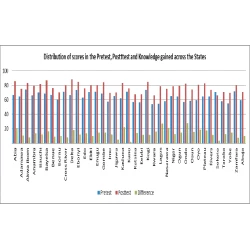
Result:The overall mean pre-test and post-test scores were 64.0% and 77.4% respectively indicating a 13.4% knowledge gain above what it was at the beginning of the training. The mean pre-test score and post-test score for the Southern states (SN) were 64.7% and 80.3% while that of the Northern states (NN) were 63.5% and 75.3% representing a knowledge gain of 15.6% and 11.8% respectively. There was statistical significant difference in the post-test scores between the two regions (p=0.001) and in knowledge gained after the training (p=0.017).
Conclusions and Public Health Implications:Comparison between the pre test and post test scores at the 5-day training showed a significant gain in knowledge of participants. The survey training contributed positively to the preparation and building of knowledge needed for the conduct of 2012 NARHS-plus.
Downloads
Similar Articles
- Zubairu Iliyasu, Fatimah Hassan-Hanga, Sadiq Isah Ajuji, Musa M. Bello, Safiyya S. Abdulkadir, Nafisa S. Nass, Hamisu M. Salihu, Muktar H. Aliyu, Correlates of Health Care Workers’ Knowledge and HIV-Exposed Infant Immunization Counseling Practice in Northern Nigeria , Vol. 10 No. 1 (2021): International Journal of Maternal and Child Health and AIDS
- Michelle Berlacher, Timothy Mercer, Edith O. Apondi, Winfred Mwangi, Edwin Were, Megan S. McHenry, Integrating Prevention of Mother-to-Child Transmission of HIV Care into General Maternal Child Health Care in Western Kenya , Vol. 10 No. 1 (2021): International Journal of Maternal and Child Health and AIDS
- Khadija Kofoworola Adeleye, Margaret Omowaleola Akinwaare, Prisca Olabisi Adejumo, Reproductive Plans And Utilization of Contraceptives Among Women Living With HIV , Vol. 8 No. 2 (2019): International Journal of Maternal and Child Health and AIDS
- Phillips Edomwonyi Obasohan, Religion, Ethnicity and Contraceptive Use among Reproductive age Women in Nigeria , Vol. 3 No. 1 (2015): International Journal of Maternal and Child Health and AIDS
- Gopal K. Singh, Jihong Liu, Health Improvements Have Been More Rapid and Widespread in China than in India: A Comparative Analysis of Health and Socioeconomic Trends from 1960 to 2011 , Vol. 1 No. 1 (2012): International Journal of Maternal and Child Health and AIDS
- Gerald J. Makuka, Moses M. Sango, Ayubu E. Mashambo, Abednego E. Mashambo, Sia E. Msuya, Sabina P. Mtweve, Clients’ Perspectives on Quality of Delivery Services in a Rural Setting in Tanzania: Findings from a Qualitative Action-Oriented Research , Vol. 6 No. 1 (2017): International Journal of Maternal and Child Health and AIDS
- Nnennaya N. Kalu-Umeh, Mohammed N. Sambo N. Sambo, Suleiman H. Idris, Abubakar M. Kurfi, Costs and Patterns of Financing Maternal Health Care Services in Rural Communities in Northern Nigeria: Evidence for Designing National Fee Exemption Policy , Vol. 2 No. 1 (2013): International Journal of Maternal and Child Health and AIDS
- Godwin Omokhagbo Emmanuel, Olaniyi Felix Sanni, Abang Roger, Paul Umoh, Ochonye Bartholomew Boniface, Amechi Paul, Ismaeel Mohammed Yahaya, Agie Muhmmad Auwal, Improving HIV Prevention for Key Populations in Nigeria: Insights on Access, Barriers, Stigma, and Service Utilization , Vol. 14 No. Continuous (2025): International Journal of Maternal and Child Health and AIDS
- Wah Myint, Aishatu Yusuf, Angela Nguyen, Elfreda Samman, HIV Testing, Household and Reproductive Health Decision-Making: The Role of Women Autonomy in a Nationally Representative Study in Cambodia , Vol. 14 No. Continuous (2025): International Journal of Maternal and Child Health and AIDS
- May Soe Aung, Myint Moh Soe, Hla Hla Win, Kyaw Swa Mya, Assessing the Impact of an Intervention on Caregivers’ Awareness and Completion of Continuum of Care Among Pregnant Women , Vol. 13 No. Continuous (2024): International Journal of Maternal and Child Health and AIDS
<< < 1 2 3 4 5 6 7 8 9 10 > >>
You may also start an advanced similarity search for this article.
Published
How to Cite
Issue
Section
License
Copyright © 2015 Kolawole Solomon Oyedeji, Adeniyi Francis Fagbamigbe, Johnbull Sonny Ogboi, Adebobola Toluwalashe Bashorun, Kawu Bolakale Issa, Perpetua Amida, Adeniyi Ogundiran, Ezire Onoriode. Published by Global Health and Education Projects, Inc., USA.

This is an open-access article distributed under the terms of the Creative Commons Attribution-NonCommercial-ShareAlike 4.0 International License , which permits others to remix, transform, and build upon the work non-commercially, provided the original author is credited and the new creations are licensed under the same terms.