
Individual and Community Perspectives, Attitudes, and Practices to Mother-to-Child-Transmission and Infant Feeding among HIV-Positive Mothers in Sub-Saharan Africa: A Systematic Literature Review
DOI:
https://doi.org/10.21106/ijma.20Keywords:
- mother-to-child-transmission,
- PMTC and infant feeding,
- Cultural and social norms,
- HIV/AIDS,
- Sub-Saharan Africa,
- Ghana
Abstract
International guidelines on infant feeding for HIV- positive mothers promote Exclusive Replacement Feeding (ERF) (infant formula or animal milk) or exclusive breastfeeding (with no supplements of any kind). A mixed feeding pattern, where breastfeeding is combined with other milks, liquid foods or solids, has been shown to increase the risk of transmission of HIV and is strongly discouraged. However, little is known about the ability of women to adhere to recommended feeding strategies to prevent mother-to-child transmission (MTCT) of HIV from breast milk. The objective of this study was to assess the individual and community-level factors that affect perspectives, attitudes and practices of HIV-positive mothers on MTCT and infant feeding in sub-Saharan Africa as documented in peer-reviewed and grey literature.
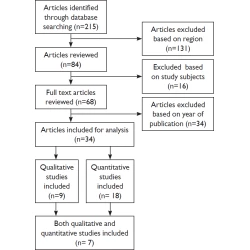
Methods:This work is based on an extensive review of peer-reviewed articles and grey literature from the period 2000-2012. The literature search was carried out using electronic databases like Medline Ovid, Google Scholar, PubMed and EBSCOhost. Both quantitative and qualitative studies written in English language on HIV and infant feeding with particular emphasis on Sub-Saharan Africa were included.
Results:The review found low adherence to the chosen infant feeding method by HIV-positive mothers. The following factors emerged as influencing infant feeding decisions: cultural and social norms; economic conditions; inadequate counselling; and mother's level of education.
Conclusions and Public Health Implications:Unless local beliefs and customs surrounding infant feeding is understood by policy makers and program implementers, Prevention of Mother-to-Child Transmission (PMTCT) programs will only be partially successful in influencing feeding practices of HIV-positive women. Hence programs should provide affordable, acceptable, feasible, safe and sustainable feeding recommendations that do not erode strong cultural practices. Advice to HIV-positive mothers should be based on local conditions that are acceptable to the community.
Downloads
Similar Articles
- Anays Murillo, Mary Bachman DeSilva, Lora L. Sabin, Nafisa Halim, Harriet Chemusto, Philip Aroda, Julia Gasuza, Davidson H. Hamer, Anna Larson Williams, Barbara Mukasa, Lisa J. Messersmith, Rachael Bonawitz, Impact of a Maternal Prevention of Mother-to-child Transmission of HIV (PMTCT) Intervention on HIV-exposed Infants in Uganda , Vol. 9 No. 3 (2020): International Journal of Maternal and Child Health and AIDS
- Isaac Oludare Oluwayemi, Simeon Oladele Olatunya, Ezra Olatunde Ogundare, PCR Results and PMTCT Treatment Outcomes among HIV-Exposed Infants in a Tertiary Hospital in Nigeria, 2010-2014 , Vol. 3 No. 2 (2015): International Journal of Maternal and Child Health and AIDS
- Abhiruchi Galhotra, Sanjana Agrawal, Aditi Chandrakar, Effectiveness of Human Immunodeficiency Virus Index Testing: A Global Scoping Review , Vol. 14 No. Continuous (2025): International Journal of Maternal and Child Health and AIDS
- Wah Myint, Aishatu Yusuf, Angela Nguyen, Elfreda Samman, HIV Testing, Household and Reproductive Health Decision-Making: The Role of Women Autonomy in a Nationally Representative Study in Cambodia , Vol. 14 No. Continuous (2025): International Journal of Maternal and Child Health and AIDS
- Foluke Adenike Olatona, Jesupelumi Oreoluwa Adenihun, Sunday Adedeji Aderibigbe, Oluwafunmilayo Funke Adeniyi, Complementary Feeding Knowledge, Practices, and Dietary Diversity among Mothers of Under-Five Children in an Urban Community in Lagos State, Nigeria , Vol. 6 No. 1 (2017): International Journal of Maternal and Child Health and AIDS
- Cedrina L. Calder, Heather O’Hara, Mohammad Tabatabai, Celia J. Maxwell, Salisha Marryshow, Aima A. Ahonkhai, Carolyn M. Audet, C. William Wester, Muktar H. Aliyu, Adherence to Combination Antiretroviral Therapy among Pregnant Women Enrolled in a HIV Prevention Program in Rural North-central Nigeria , Vol. 9 No. 1 (2020): International Journal of Maternal and Child Health and AIDS
- Isabel Hernandez, Vinita Sharma, Miguel Reina-Ortiz, Carlos Rosas, Tatiana Ochoa, Ricardo Izurieta, Enrique Teran, HIV/AIDS-related Knowledge and Behavior among School-attending Afro-Descendant Youths in Ecuador , Vol. 9 No. 3 (2020): International Journal of Maternal and Child Health and AIDS
- Amos Kankponang Laar, Belynda Amankwa, Charlotte Asiedu, Prevention-of-Mother-To-Child-Transmission of HIV Services in Sub-Saharan Africa: A Qualitative Analysis of Healthcare Providers and Clients Challenges in Ghana , Vol. 2 No. 2 (2014): International Journal of Maternal and Child Health and AIDS
- Rachael Bonawitz, Kathleen Lucy McGlasson, Jeanette L. Kaiser, Thandiwe Ngoma, Jody Lori, Carol Boyd, Godfrey Biemba, Davidson H. Hamer, Nancy A. Scott, Maternity Waiting Home Use by HIV-positive Pregnant Women in Zambia: Opportunity for Improved Prevention of Maternal to Child Transmission of HIV , Vol. 8 No. 1 (2019): International Journal of Maternal and Child Health and AIDS
- Margaret Omowaleola Akinwaare, Funmilayo A. Okanlawon, Monisola A. Popoola, Omotayo O. Adetunji, Birth Preparedness Plans and Status Disclosure Among Pregnant Women Living with HIV Who are Receiving Antiretroviral Therapy in Ibadan, Southwest, Nigeria , Vol. 12 No. 1 (2023): International Journal of Maternal and Child Health and AIDS
<< < 1 2 3 4 5 6 7 8 9 10 > >>
You may also start an advanced similarity search for this article.
Published
How to Cite
Issue
Section
License
Copyright © 2015 Alexander Suuk Laar, Veioshnee Govender. Published by Global Health and Education Projects, Inc., USA.

This is an open-access article distributed under the terms of the Creative Commons Attribution-NonCommercial-ShareAlike 4.0 International License , which permits others to remix, transform, and build upon the work non-commercially, provided the original author is credited and the new creations are licensed under the same terms.