
Human Immunodeficiency Virus (HIV) Knowledge and Stigma: Findings from a Cross-sectional Survey
DOI:
https://doi.org/10.21106/IJMA_7_2025Keywords:
- Antiretroviral Drugs,
- Human Immunodeficiency Virus Stigma,
- Human Immunodeficiency Virus Test Kits,
- Human Immunodeficiency Virus Transmission and Risk Reduction,
- The Philippines
Abstract
Background and Objective: People living with human immunodeficiency virus (HIV) encounter HIV stigma that hinders HIV testing and subsequently linkage to care. This study evaluates the relationship between HIV stigma and awareness of HIV testing, drugs to prevent mother-to-child transmission (MTCT), antiretroviral (ARV) drugs, and HIV knowledge score among Filipino women.
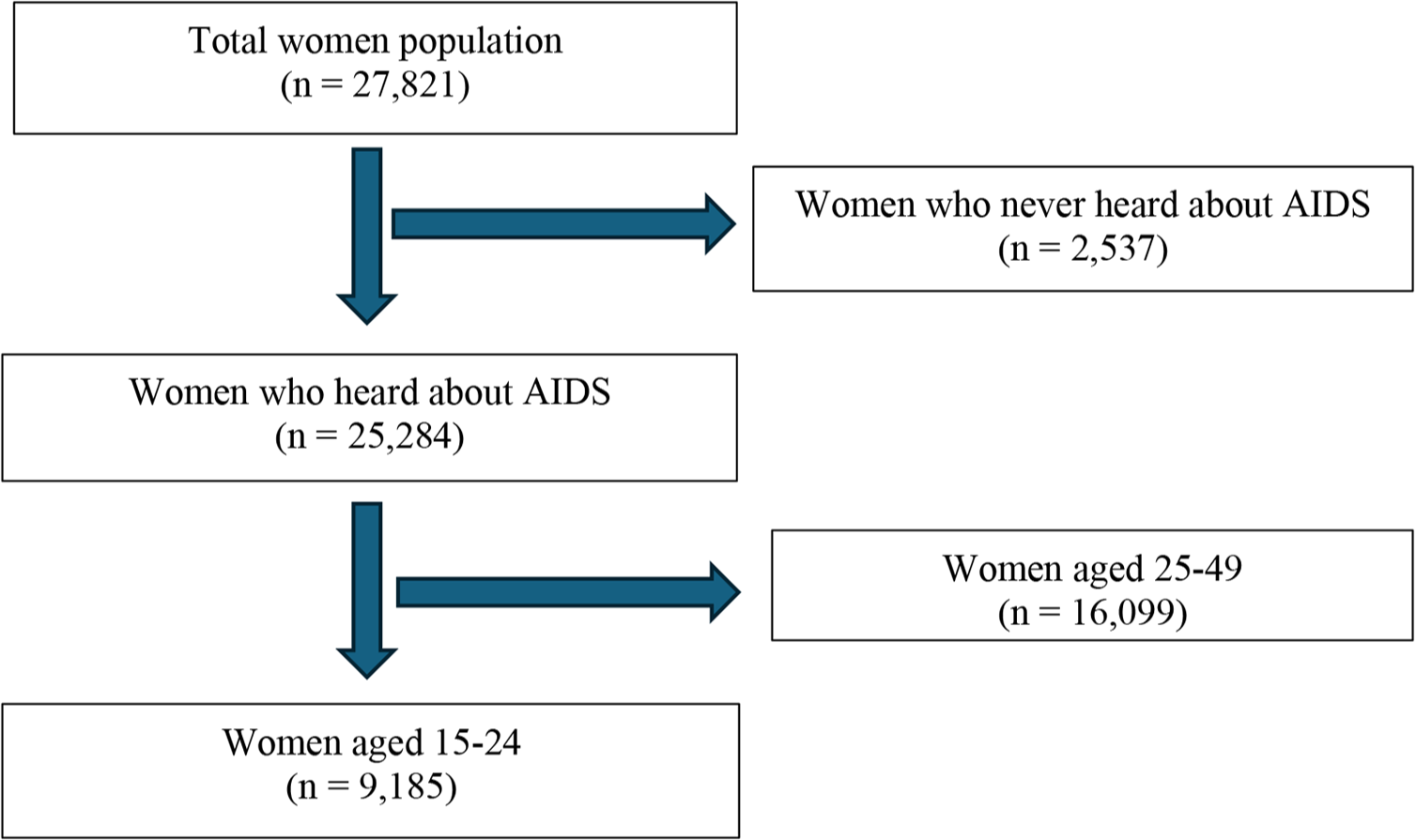
Methods: We utilized data of women aged 15–49 (n = 25,284) who heard about HIV from the Philippines’ 2022 Demographic and Health Survey. The dependent variable was HIV stigma. The covariates were sociodemographic characteristics (i.e., age, urban/rural, education level, wealth quintile, current employment status, and marital status), knowledge regarding HIV test kits, drugs to prevent MTCT, and ARV drugs. We calculated descriptive statistics, Pearson’s Chi-square test of independence, and multivariable binary logistic regression, fitting covariates. Subgroup analysis was performed to understand the relationship between HIV stigma and HIV knowledge score among individuals aged 15–24 years. All analyses were performed using Stata 18.5.
Results: Approximately 65.7% of women reported HIV stigma. The logistic regression results indicated lower odds of HIV stigma among women who know test kits but never tested for HIV with test kits (adjusted odds ratio [aOR] = 0.87), those who heard about drugs to prevent MTCT (aOR = 0.75), and those who heard about ARV drugs (aOR = 0.85) compared to their counterparts. Higher odds of HIV stigma were observed among women currently in union (aOR = 1.46) and rural residents (aOR = 1.54) compared to their counterparts. Among women aged 15–24, having a higher HIV knowledge score, especially among those who scored 5, had lower odds of having HIV stigma (aOR = 0.04) than those who achieved a zero knowledge score. All p-values ≤ 0.05.
Conclusion and Global Health Implications: Findings suggest an urgent need to address stigma among women, especially those who lack knowledge of HIV test kits and ARV drugs. Further research should explore strategies to reduce HIV stigma, especially among young married rural women.
Downloads
Similar Articles
- Claude Ngwayu Nkfusai, Claude Ngwayu Nkfusai, Samuel Nambile Cumber, Fala Bede, Emerson Njokah Wepngong Wepngong, Tabe Armstrong Tambe, Frankline Sevidzem Wirsiy, Jacintha Rebang Achu, Bih Moki Suh, Frankline Che Anyang, Joyce Mahlako Tsoka-Gwegweni, Barriers towards the Prevention and Treatment of Malaria among Pregnant Women at the Nkwen Health Center Bamenda, Cameroon , Vol. 11 No. 1 (2022): International Journal of Maternal and Child Health and AIDS
- Gopal K. Singh, Hyunjung Lee, Romuladus E. Azuine, Marked Disparities in COVID-19 Vaccination among US Children and Adolescents by Racial/Ethnic, Socioeconomic, Geographic, and Health Characteristics, United States, December 2021 – April 2022 , Vol. 11 No. 2 (2022): International Journal of Maternal and Child Health and AIDS
- Chidimma Ezenwa Anyanwu, Kwasi Torpey, Olaiya Paul Abiodun, Olaniyi Felix Sanni, Ifeanyi Donald Anyanwu, Variations in the Prevalence of Female Genital Mutilation Among Reproductive-aged Women in Nigeria Across Three Generations , Vol. 11 No. 2 (2022): International Journal of Maternal and Child Health and AIDS
- Trevor D. Hadley, Rowland W. Pettit, Tahir Malik, Amelia A. Khoei, Hamisu M. Salihu, Artificial Intelligence in Global Health —A Framework and Strategy for Adoption and Sustainability , Vol. 9 No. 1 (2020): International Journal of Maternal and Child Health and AIDS
- Gerald J. Makuka, Moses M. Sango, Ayubu E. Mashambo, Abednego E. Mashambo, Sia E. Msuya, Sabina P. Mtweve, Clients’ Perspectives on Quality of Delivery Services in a Rural Setting in Tanzania: Findings from a Qualitative Action-Oriented Research , Vol. 6 No. 1 (2017): International Journal of Maternal and Child Health and AIDS
- Nnennaya N. Kalu-Umeh, Mohammed N. Sambo N. Sambo, Suleiman H. Idris, Abubakar M. Kurfi, Costs and Patterns of Financing Maternal Health Care Services in Rural Communities in Northern Nigeria: Evidence for Designing National Fee Exemption Policy , Vol. 2 No. 1 (2013): International Journal of Maternal and Child Health and AIDS
- Sharaf Sheik-Ali, Sergio M. Navarro, Hashim Shaikh, Evan J. Keil, Walter Johnson, Chris Lavy, The Health Determinants of Accessibility to Clubfoot Treatment in LMICs: A Global Exploration of Barriers and Solutions , Vol. 10 No. 2 (2021): International Journal of Maternal and Child Health and AIDS
- Océane J. Parker, Duc Minh Duong, Thuy Thu Nguyen, Vui Thi Le, Utilization of Sexual and Reproductive Healthcare Services Among Young Women in Two Districts of Hanoi, Vietnam , Vol. 15 (2026): International Journal of Maternal and Child Health and AIDS
- Ashu Michael Agbor, Loyick Nguafack Zencha, Henri Essome, Che Bleck Ndikum, Pascal Foumane, Oral Health Status of Pregnant Women Attending Antenatal Clinic in Cameroon , Vol. 14 No. Continuous (2025): International Journal of Maternal and Child Health and AIDS
- Deepa Dongarwar, Hamisu M. Salihu, Place of Residence and Inequities in Adverse Pregnancy and Birth Outcomes in India , Vol. 9 No. 1 (2020): International Journal of Maternal and Child Health and AIDS
<< < 21 22 23 24 25 26 27 28 29 30 > >>
You may also start an advanced similarity search for this article.
Published
How to Cite
Issue
Section
License
Copyright © 2026 Wah Wah Myint. Published by Global Health and Education Projects, Inc., USA.

This is an open-access article distributed under the terms of the Creative Commons Attribution-NonCommercial-ShareAlike 4.0 International License , which permits others to remix, transform, and build upon the work non-commercially, provided the original author is credited and the new creations are licensed under the same terms.