
Human Immunodeficiency Virus (HIV) Knowledge and Stigma: Findings from a Cross-sectional Survey
DOI:
https://doi.org/10.21106/IJMA_7_2025Keywords:
- Antiretroviral Drugs,
- Human Immunodeficiency Virus Stigma,
- Human Immunodeficiency Virus Test Kits,
- Human Immunodeficiency Virus Transmission and Risk Reduction,
- The Philippines
Abstract
Background and Objective: People living with human immunodeficiency virus (HIV) encounter HIV stigma that hinders HIV testing and subsequently linkage to care. This study evaluates the relationship between HIV stigma and awareness of HIV testing, drugs to prevent mother-to-child transmission (MTCT), antiretroviral (ARV) drugs, and HIV knowledge score among Filipino women.
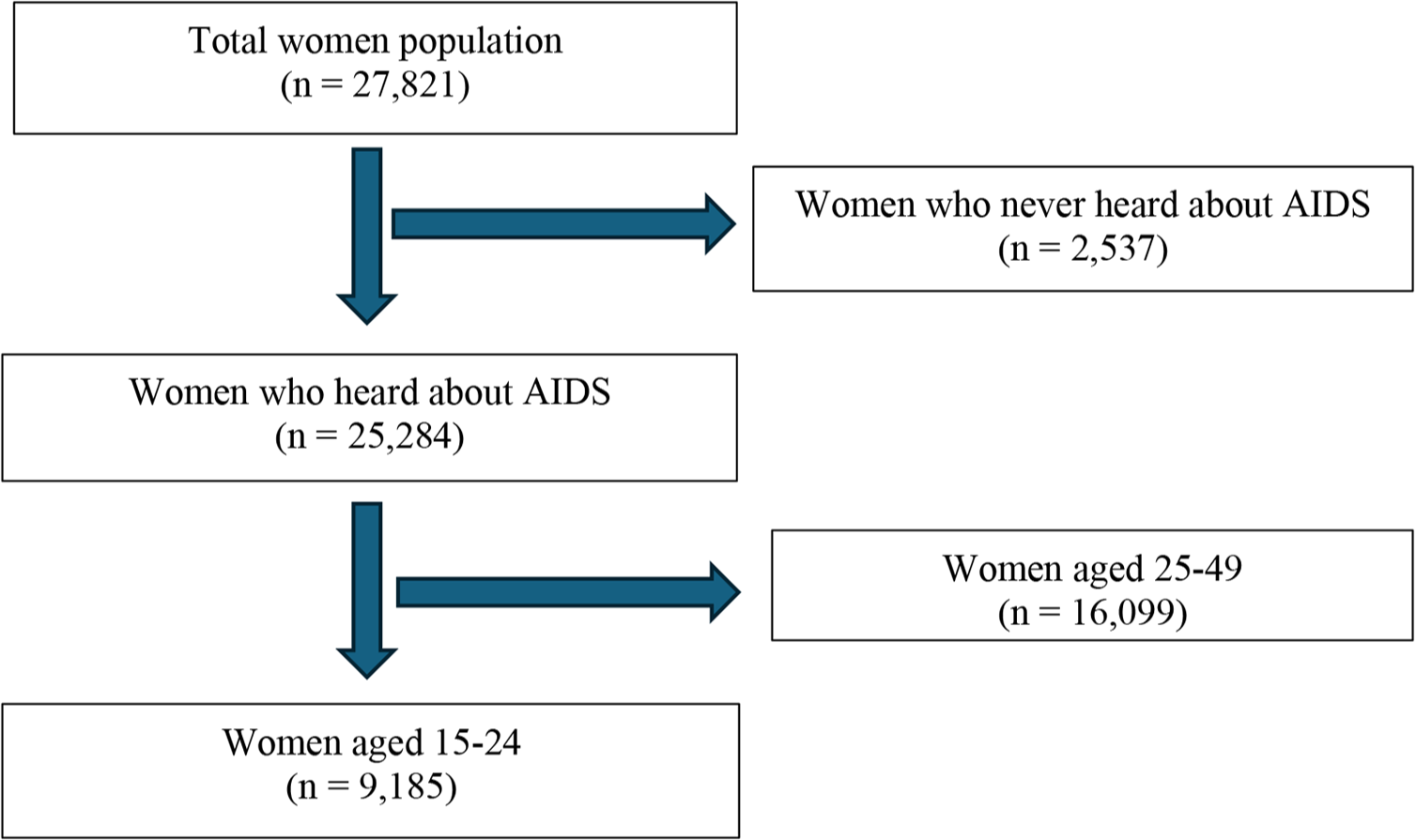
Methods: We utilized data of women aged 15–49 (n = 25,284) who heard about HIV from the Philippines’ 2022 Demographic and Health Survey. The dependent variable was HIV stigma. The covariates were sociodemographic characteristics (i.e., age, urban/rural, education level, wealth quintile, current employment status, and marital status), knowledge regarding HIV test kits, drugs to prevent MTCT, and ARV drugs. We calculated descriptive statistics, Pearson’s Chi-square test of independence, and multivariable binary logistic regression, fitting covariates. Subgroup analysis was performed to understand the relationship between HIV stigma and HIV knowledge score among individuals aged 15–24 years. All analyses were performed using Stata 18.5.
Results: Approximately 65.7% of women reported HIV stigma. The logistic regression results indicated lower odds of HIV stigma among women who know test kits but never tested for HIV with test kits (adjusted odds ratio [aOR] = 0.87), those who heard about drugs to prevent MTCT (aOR = 0.75), and those who heard about ARV drugs (aOR = 0.85) compared to their counterparts. Higher odds of HIV stigma were observed among women currently in union (aOR = 1.46) and rural residents (aOR = 1.54) compared to their counterparts. Among women aged 15–24, having a higher HIV knowledge score, especially among those who scored 5, had lower odds of having HIV stigma (aOR = 0.04) than those who achieved a zero knowledge score. All p-values ≤ 0.05.
Conclusion and Global Health Implications: Findings suggest an urgent need to address stigma among women, especially those who lack knowledge of HIV test kits and ARV drugs. Further research should explore strategies to reduce HIV stigma, especially among young married rural women.
Downloads
Similar Articles
- Zenab I. Yusuf, Deepa Dongarwar, Rafeek A. Yusuf, Hamisu M. Salihu, Oral Health Problems among Children with Neurodevelopmental Disorders in the United States , Vol. 9 No. 1 (2020): International Journal of Maternal and Child Health and AIDS
- Yaw Owusu, Prerana Medakkar, Elizabeth M. Akinnawo, Althea Stewart-Pyne, Eta E. Ashu, Emigration of skilled healthcare workers from developing countries: can team-based healthcare practice fill the gaps in maternal, newborn and child healthcare delivery? , Vol. 6 No. 2 (2017): International Journal of Maternal and Child Health and AIDS
- Elizabeth Armstrong-Mensah, Damilola Dada, Amber Bowers, Aruba Muhammad, Chisom Nnoli, Geographic, Health Care Access, Racial Discrimination, and Socioeconomic Determinants of Maternal Mortality in Georgia, United States , Vol. 10 No. 2 (2021): International Journal of Maternal and Child Health and AIDS
- Sara Rushwan, Tesfaye Tufa, Metin Gülmezoglu, Feasibility, Acceptability, and Appropriate Use of Novel and Lesser-Used Medicines for Prevention and Treatment of Postpartum Hemorrhage: Evidence from Implementation Research , Vol. 13 No. S1 (2024): International Journal of Maternal and Child Health and AIDS
- Anjali Pal, Sunil Kumar Panigrahi, Pragyan Paramita Parija, Sagarika Majumdar, Geospatial Analysis of Parental Healthcare-Seeking Behavior in the Vicinity of Multispecialty Hospital in India , Vol. 13 No. Continuous (2024): International Journal of Maternal and Child Health and AIDS
- Frankline Sevidzem Wirsiy, Claude Ngwayu Nkfusai, Denis Ebot Ako-Arrey, Esther Kenfack Dongmo, Florence Titu Manjong, Samuel Nambile Cumber, Acceptability of COVID-19 Vaccine in Africa , Vol. 10 No. 1 (2021): International Journal of Maternal and Child Health and AIDS
- Nemati Ali, Tazakori Zahra, Maryam Namadi Vosogh, Nazila Vosoghi, Maryam Zare, Afroz Mardi, Adham Davoud, Hamidzadeh Arbabi Yousef, Kazemzadeh Rafat, Effectiveness Comparison of Mothers’ In-person Versus Written Nutritional Education Intervention on Infant Growth in Iran , Vol. 3 No. 1 (2015): International Journal of Maternal and Child Health and AIDS
- Ranbir S Balgir, Population and Public Health Implications of Child Health and Reproductive Outcomes Among Carrier Couples of Sickle Cell Disorders in Madhya Pradesh, Central India , Vol. 2 No. 2 (2014): International Journal of Maternal and Child Health and AIDS
- Armand Duclaire Kemo, Bruno Kenfack, Jerome Ateudjieu, Maternal Deaths and Complications: Documentation of Parameters on the Partographs Used by Health Care Providers in Four Hospitals in West Cameroon , Vol. 14 No. Continuous (2025): International Journal of Maternal and Child Health and AIDS
- Kimberly Fryer, Chinyere N. Reid, Naciely Cabral, Jennifer Marshall, Usha Menon, Exploring Patients’ Needs and Desires for Quality Prenatal Care in Florida, United States , Vol. 12 No. 1 (2023): International Journal of Maternal and Child Health and AIDS
<< < 20 21 22 23 24 25 26 27 28 29 > >>
You may also start an advanced similarity search for this article.
Published
How to Cite
Issue
Section
License
Copyright © 2026 Wah Wah Myint. Published by Global Health and Education Projects, Inc., USA.

This is an open-access article distributed under the terms of the Creative Commons Attribution-NonCommercial-ShareAlike 4.0 International License , which permits others to remix, transform, and build upon the work non-commercially, provided the original author is credited and the new creations are licensed under the same terms.