
Human Immunodeficiency Virus (HIV) Knowledge and Stigma: Findings from a Cross-sectional Survey
DOI:
https://doi.org/10.21106/IJMA_7_2025Keywords:
- Antiretroviral Drugs,
- Human Immunodeficiency Virus Stigma,
- Human Immunodeficiency Virus Test Kits,
- Human Immunodeficiency Virus Transmission and Risk Reduction,
- The Philippines
Abstract
Background and Objective: People living with human immunodeficiency virus (HIV) encounter HIV stigma that hinders HIV testing and subsequently linkage to care. This study evaluates the relationship between HIV stigma and awareness of HIV testing, drugs to prevent mother-to-child transmission (MTCT), antiretroviral (ARV) drugs, and HIV knowledge score among Filipino women.
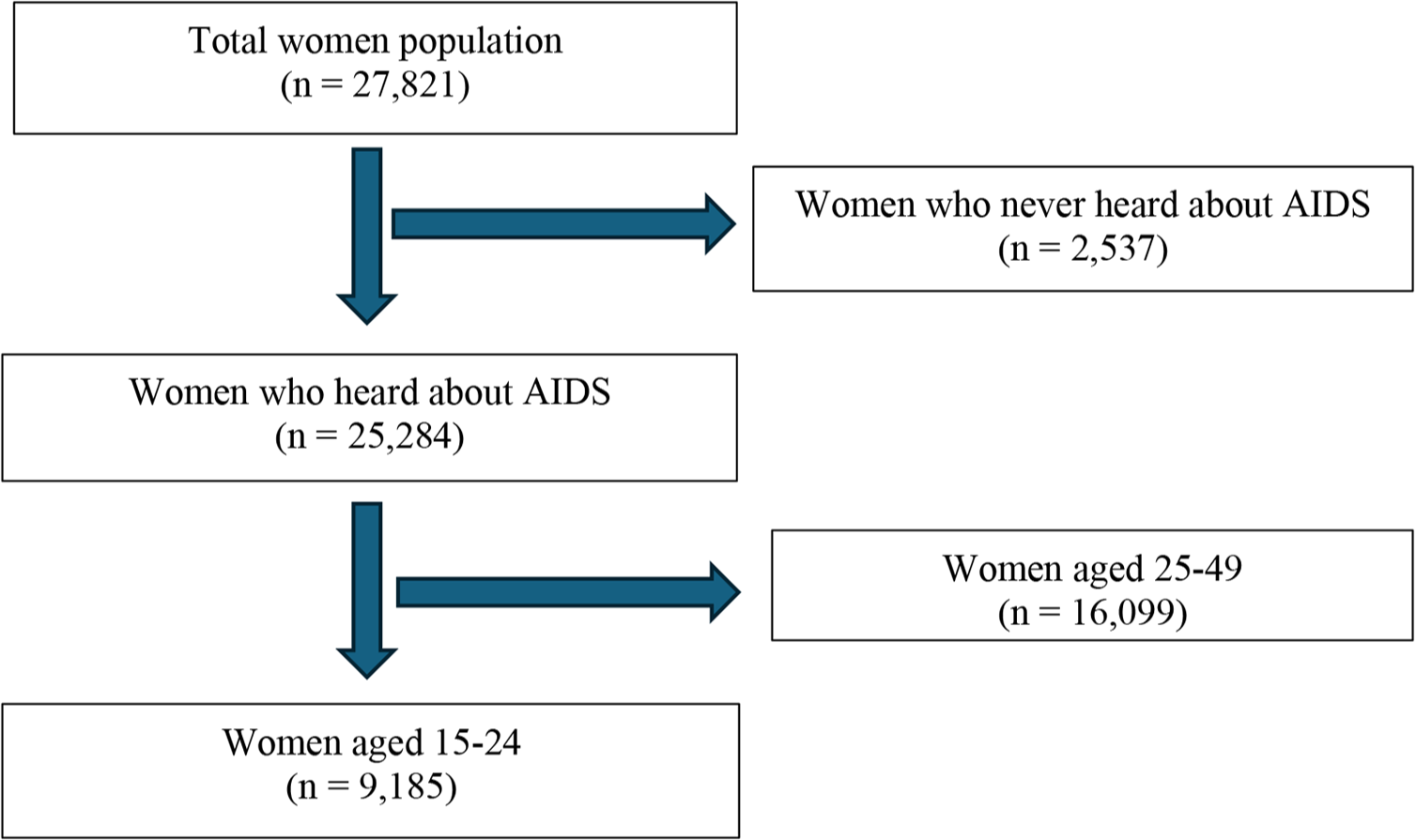
Methods: We utilized data of women aged 15–49 (n = 25,284) who heard about HIV from the Philippines’ 2022 Demographic and Health Survey. The dependent variable was HIV stigma. The covariates were sociodemographic characteristics (i.e., age, urban/rural, education level, wealth quintile, current employment status, and marital status), knowledge regarding HIV test kits, drugs to prevent MTCT, and ARV drugs. We calculated descriptive statistics, Pearson’s Chi-square test of independence, and multivariable binary logistic regression, fitting covariates. Subgroup analysis was performed to understand the relationship between HIV stigma and HIV knowledge score among individuals aged 15–24 years. All analyses were performed using Stata 18.5.
Results: Approximately 65.7% of women reported HIV stigma. The logistic regression results indicated lower odds of HIV stigma among women who know test kits but never tested for HIV with test kits (adjusted odds ratio [aOR] = 0.87), those who heard about drugs to prevent MTCT (aOR = 0.75), and those who heard about ARV drugs (aOR = 0.85) compared to their counterparts. Higher odds of HIV stigma were observed among women currently in union (aOR = 1.46) and rural residents (aOR = 1.54) compared to their counterparts. Among women aged 15–24, having a higher HIV knowledge score, especially among those who scored 5, had lower odds of having HIV stigma (aOR = 0.04) than those who achieved a zero knowledge score. All p-values ≤ 0.05.
Conclusion and Global Health Implications: Findings suggest an urgent need to address stigma among women, especially those who lack knowledge of HIV test kits and ARV drugs. Further research should explore strategies to reduce HIV stigma, especially among young married rural women.
Downloads
Similar Articles
- Chioma A Ikedionwu, Deepa Dongarwar, Korede K. Yusuf, Sitratullah O. Maiyegun, Sahra Ibrahimi, Hamisu M. Salihu, Using Nominal Group Technique to Elucidate a COVID-19 Research Agenda for Maternal and Child Health (MCH) Populations , Vol. 9 No. 3 (2020): International Journal of Maternal and Child Health and AIDS
- Danladi Abubakar, Yetunde B. Aremu-Kasumu, Musa Yakubu, Olaniyi T. Fasanu, Sophia O. Baidoo-Adeiza, Birth Preparedness and Complication Readiness among Antenatal Attendees in a Tertiary Hospital in Northern Nigeria , Vol. 13 No. Continuous (2024): International Journal of Maternal and Child Health and AIDS
- Olatunde A. Amode, Omaye V. Negedu, Jessica T. Joseph, Uchenna Igbokwe Igbokwe, Olajumoke Adekeye, Damilola K. Oyedele, Hadiza Salele, Lola Ameyan, Kayode Afolabi, Olufunke Fasawe, Owens Wiwa, An Implementation Research Study on Uterotonics Use Patterns and Heat-stable Carbetocin Acceptability and Safety for Prevention of Postpartum Hemorrhage in Nigeria , Vol. 13 No. S1 (2024): International Journal of Maternal and Child Health and AIDS
- Léonel Philibert, Judith Lapierre, Vulnerabilities and Strengths of Pregnant Haitian Adolescents and their Families During Transition to Motherhood , Vol. 11 No. 2 (2022): International Journal of Maternal and Child Health and AIDS
- Eren Oyungu, Anna Roose, Ananda R. Ombitsa, Rachel C. Vreeman, Megan S. McHenry, Child Development Monitoring in Well-baby Clinics in Kenya , Vol. 10 No. 1 (2021): International Journal of Maternal and Child Health and AIDS
- Mary Stokes, Amber Olson, Mtisunge Chan’gombe, Bakari Rajab, Rachel Pope, Carolyn Mwalwanda, Judy Levison, Isabel Janmey, Reinventing the Pregnancy Wheel to Improve Pregnancy Dating and Antenatal Care Visits: A Pilot Randomized Trial in Malawi , Vol. 10 No. 1 (2021): International Journal of Maternal and Child Health and AIDS
- Hamisu M. Salihu, Abraham A. Salinas-Miranda, Lindsey M. King, Deepa Dongarwar, Korede K. Yusuf, Sahra Ibrahimi, Chioma A. Ike dionwu, Estrellita Lo Berry, Racism, Psycho-Social Stress, and Health-related Quality of Life , Vol. 9 No. 1 (2020): International Journal of Maternal and Child Health and AIDS
- Folake Olukemi Samuel, Ebunoluwa Grace Ibidapo, Complementary Feeding Practices and Associated Factors Among Nursing Mothers in Southwestern Nigeria , Vol. 9 No. 2 (2020): International Journal of Maternal and Child Health and AIDS
- Liye Wang, Deepa Dongarwar, Hamisu M. Salihu, Temporal Trends in the Rates of Singletons, Twins and Higher-order Multiple Births Over Five Decades Across Racial Groups in the United States , Vol. 9 No. 3 (2020): International Journal of Maternal and Child Health and AIDS
- Phillips Edomwonyi Obasohan, Paul Gana, Mahmud A. Mustapha, Ahmed Egbako Umar, Audu Makada, Dorcas Nike Obasohan, Decision Making Autonomy and Maternal Healthcare Utilization among Nigerian Women , Vol. 8 No. 1 (2019): International Journal of Maternal and Child Health and AIDS
<< < 22 23 24 25 26 27 28 29 30 > >>
You may also start an advanced similarity search for this article.
Published
How to Cite
Issue
Section
License
Copyright © 2026 Wah Wah Myint. Published by Global Health and Education Projects, Inc., USA.

This is an open-access article distributed under the terms of the Creative Commons Attribution-NonCommercial-ShareAlike 4.0 International License , which permits others to remix, transform, and build upon the work non-commercially, provided the original author is credited and the new creations are licensed under the same terms.