
Human Immunodeficiency Virus (HIV) Knowledge and Stigma: Findings from a Cross-sectional Survey
DOI:
https://doi.org/10.21106/IJMA_7_2025Keywords:
- Antiretroviral Drugs,
- Human Immunodeficiency Virus Stigma,
- Human Immunodeficiency Virus Test Kits,
- Human Immunodeficiency Virus Transmission and Risk Reduction,
- The Philippines
Abstract
Background and Objective: People living with human immunodeficiency virus (HIV) encounter HIV stigma that hinders HIV testing and subsequently linkage to care. This study evaluates the relationship between HIV stigma and awareness of HIV testing, drugs to prevent mother-to-child transmission (MTCT), antiretroviral (ARV) drugs, and HIV knowledge score among Filipino women.
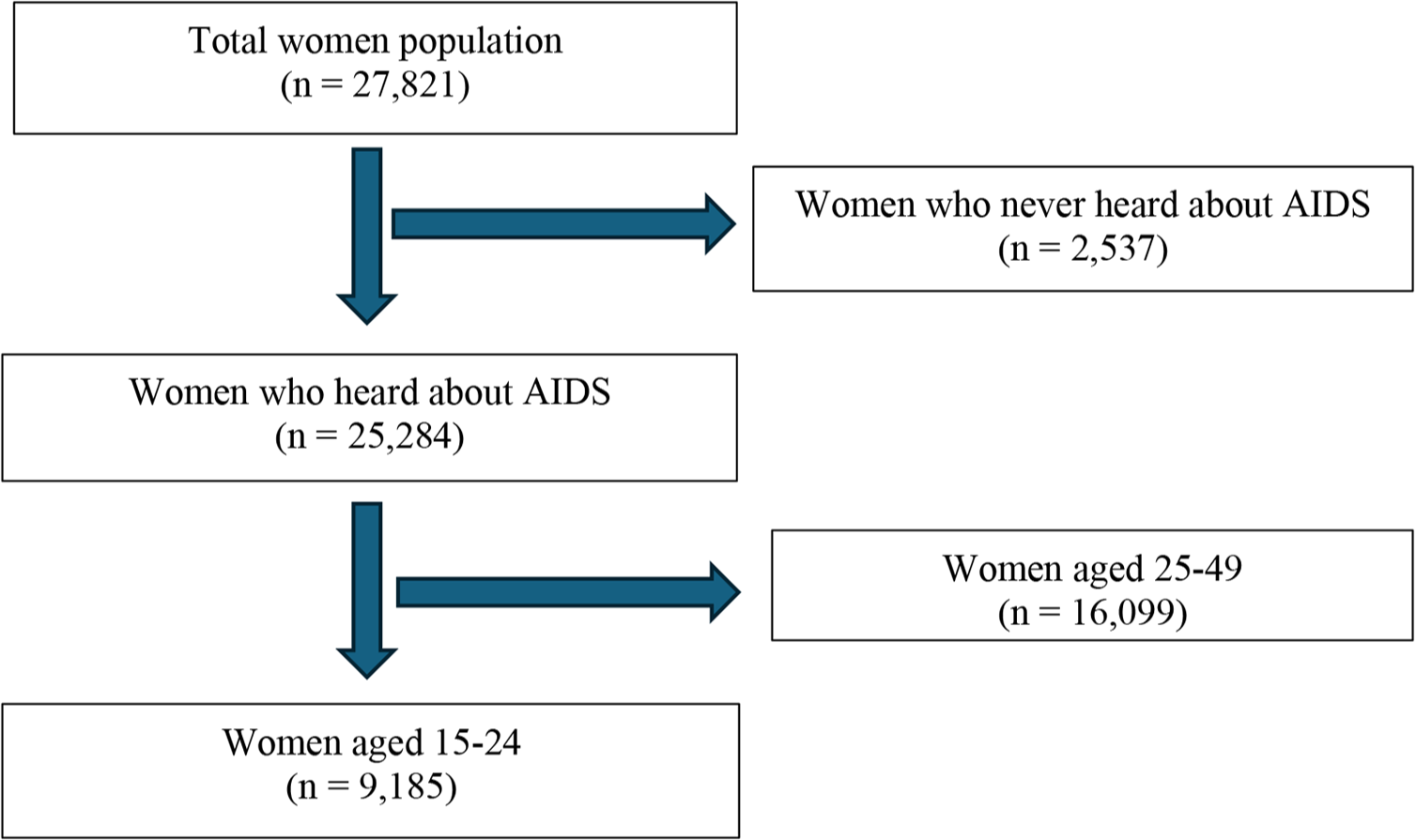
Methods: We utilized data of women aged 15–49 (n = 25,284) who heard about HIV from the Philippines’ 2022 Demographic and Health Survey. The dependent variable was HIV stigma. The covariates were sociodemographic characteristics (i.e., age, urban/rural, education level, wealth quintile, current employment status, and marital status), knowledge regarding HIV test kits, drugs to prevent MTCT, and ARV drugs. We calculated descriptive statistics, Pearson’s Chi-square test of independence, and multivariable binary logistic regression, fitting covariates. Subgroup analysis was performed to understand the relationship between HIV stigma and HIV knowledge score among individuals aged 15–24 years. All analyses were performed using Stata 18.5.
Results: Approximately 65.7% of women reported HIV stigma. The logistic regression results indicated lower odds of HIV stigma among women who know test kits but never tested for HIV with test kits (adjusted odds ratio [aOR] = 0.87), those who heard about drugs to prevent MTCT (aOR = 0.75), and those who heard about ARV drugs (aOR = 0.85) compared to their counterparts. Higher odds of HIV stigma were observed among women currently in union (aOR = 1.46) and rural residents (aOR = 1.54) compared to their counterparts. Among women aged 15–24, having a higher HIV knowledge score, especially among those who scored 5, had lower odds of having HIV stigma (aOR = 0.04) than those who achieved a zero knowledge score. All p-values ≤ 0.05.
Conclusion and Global Health Implications: Findings suggest an urgent need to address stigma among women, especially those who lack knowledge of HIV test kits and ARV drugs. Further research should explore strategies to reduce HIV stigma, especially among young married rural women.
Downloads
Similar Articles
- Amina P. Alio, Candace Sibley, Halimah S. Ouedraogo, Stephaun E. Wallace, Steven Wakefield, Damon L. Humes, Sheldon D. Fields, Michael C. Keefer, House Ball Community Leaders’ Perceptions of HIV and HIV Vaccine Research , Vol. 9 No. 1 (2020): International Journal of Maternal and Child Health and AIDS
- George Chidi Anwuri, Michael S. Dunn, Frederick Schulze, Determinants of Voluntary HIV/AIDS Counseling and Testing among Community College Students in the United States , Vol. 6 No. 2 (2017): International Journal of Maternal and Child Health and AIDS
- Deepa Dongarwar, Toi B. Harris, Hamisu M. Salihu, Fourth Annual Summer Research Summit on Health Equity Organized by the Center of Excellence in Health Equity, Training and Research, Baylor College of Medicine, Houston, Texas 77030, USA on May 20, 2021 , Vol. 10 No. S3 (2021): International Journal of Maternal and Child Health and AIDS
- Isaac Oludare Oluwayemi, Simeon Oladele Olatunya, Ezra Olatunde Ogundare, PCR Results and PMTCT Treatment Outcomes among HIV-Exposed Infants in a Tertiary Hospital in Nigeria, 2010-2014 , Vol. 3 No. 2 (2015): International Journal of Maternal and Child Health and AIDS
- Aridoss Santhakumar, Malathi Mathiyazhakan, Nagaraj Jaganathasamy, Balsubramanian Ganesh, N Manikandan, VM Padmapriya, Angel Monika, Joseph K David, Arvind Kumar, Elangovan Arumugam, Prevalence and Risk Factors Associated with HIV Infection among Pregnant Women in Odisha State, India , Vol. 9 No. 3 (2020): International Journal of Maternal and Child Health and AIDS
- Brianna L. Smith, Sara Zizzo, Anouk Amzel, Sarah Wiant, Molly C. Pezzulo, Sarah Konopka, Rachel Golin, Alexandra C. Vrazo, Integration of Neonatal and Child Health Interventions with Pediatric HIV Interventions in Global Health , Vol. 7 No. 1 (2018): International Journal of Maternal and Child Health and AIDS
- Margaret Omowaleola Akinwaare, Funmilayo A. Okanlawon, Monisola A. Popoola, Omotayo O. Adetunji, Birth Preparedness Plans and Status Disclosure Among Pregnant Women Living with HIV Who are Receiving Antiretroviral Therapy in Ibadan, Southwest, Nigeria , Vol. 12 No. 1 (2023): International Journal of Maternal and Child Health and AIDS
- Anays Murillo, Mary Bachman DeSilva, Lora L. Sabin, Nafisa Halim, Harriet Chemusto, Philip Aroda, Julia Gasuza, Davidson H. Hamer, Anna Larson Williams, Barbara Mukasa, Lisa J. Messersmith, Rachael Bonawitz, Impact of a Maternal Prevention of Mother-to-child Transmission of HIV (PMTCT) Intervention on HIV-exposed Infants in Uganda , Vol. 9 No. 3 (2020): International Journal of Maternal and Child Health and AIDS
- Katherine Magerko, John Humphrey, Julia Songok, Beverly Musick, Joy Marsha Alera, Bett Kipchumba, Wycliffe Kosgei, Winfred Mwangi, Ziyi Yang, Kara Wools-Kaloustian, Megan McHenry, Impact of Maternal Viral Suppression on Growth Patterns for HIV-Exposed Uninfected Infants in Kenya , Vol. 13 No. Continuous (2024): International Journal of Maternal and Child Health and AIDS
- Hyunjung Lee, Gopal K. Singh, Psychological Distress and Heart Disease Mortality in the United States: Results from the 1997-2014 NHIS-NDI Record Linkage Study , Vol. 9 No. 3 (2020): International Journal of Maternal and Child Health and AIDS
<< < 1 2 3 4 5 6 7 8 9 10 > >>
You may also start an advanced similarity search for this article.
Published
How to Cite
Issue
Section
License
Copyright © 2026 Wah Wah Myint. Published by Global Health and Education Projects, Inc., USA.

This is an open-access article distributed under the terms of the Creative Commons Attribution-NonCommercial-ShareAlike 4.0 International License , which permits others to remix, transform, and build upon the work non-commercially, provided the original author is credited and the new creations are licensed under the same terms.