
Human Immunodeficiency Virus (HIV) Knowledge and Stigma: Findings from a Cross-sectional Survey
DOI:
https://doi.org/10.21106/IJMA_7_2025Keywords:
- Antiretroviral Drugs,
- Human Immunodeficiency Virus Stigma,
- Human Immunodeficiency Virus Test Kits,
- Human Immunodeficiency Virus Transmission and Risk Reduction,
- The Philippines
Abstract
Background and Objective: People living with human immunodeficiency virus (HIV) encounter HIV stigma that hinders HIV testing and subsequently linkage to care. This study evaluates the relationship between HIV stigma and awareness of HIV testing, drugs to prevent mother-to-child transmission (MTCT), antiretroviral (ARV) drugs, and HIV knowledge score among Filipino women.
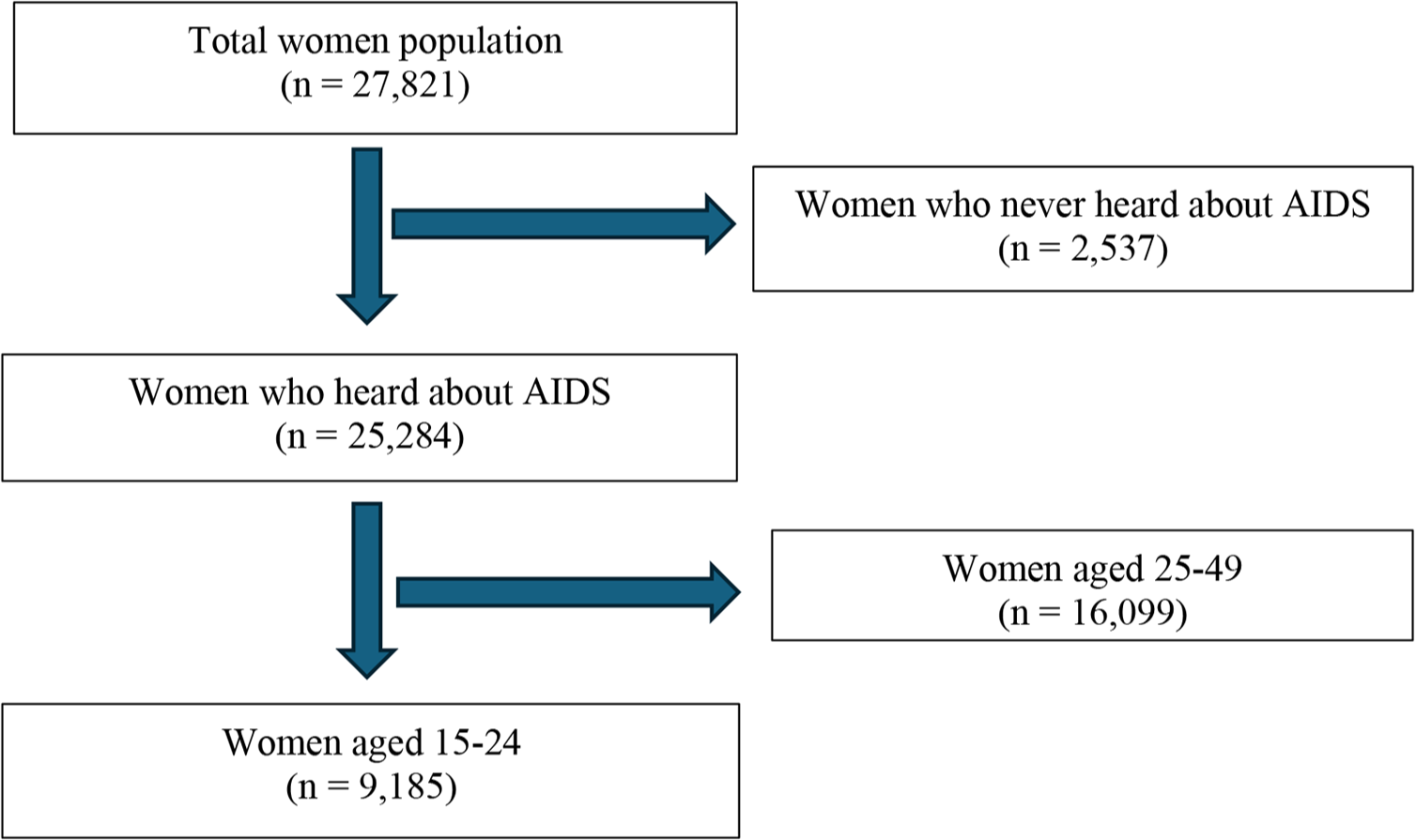
Methods: We utilized data of women aged 15–49 (n = 25,284) who heard about HIV from the Philippines’ 2022 Demographic and Health Survey. The dependent variable was HIV stigma. The covariates were sociodemographic characteristics (i.e., age, urban/rural, education level, wealth quintile, current employment status, and marital status), knowledge regarding HIV test kits, drugs to prevent MTCT, and ARV drugs. We calculated descriptive statistics, Pearson’s Chi-square test of independence, and multivariable binary logistic regression, fitting covariates. Subgroup analysis was performed to understand the relationship between HIV stigma and HIV knowledge score among individuals aged 15–24 years. All analyses were performed using Stata 18.5.
Results: Approximately 65.7% of women reported HIV stigma. The logistic regression results indicated lower odds of HIV stigma among women who know test kits but never tested for HIV with test kits (adjusted odds ratio [aOR] = 0.87), those who heard about drugs to prevent MTCT (aOR = 0.75), and those who heard about ARV drugs (aOR = 0.85) compared to their counterparts. Higher odds of HIV stigma were observed among women currently in union (aOR = 1.46) and rural residents (aOR = 1.54) compared to their counterparts. Among women aged 15–24, having a higher HIV knowledge score, especially among those who scored 5, had lower odds of having HIV stigma (aOR = 0.04) than those who achieved a zero knowledge score. All p-values ≤ 0.05.
Conclusion and Global Health Implications: Findings suggest an urgent need to address stigma among women, especially those who lack knowledge of HIV test kits and ARV drugs. Further research should explore strategies to reduce HIV stigma, especially among young married rural women.
Downloads
Similar Articles
- Rachael Bonawitz, Kathleen Lucy McGlasson, Jeanette L. Kaiser, Thandiwe Ngoma, Jody Lori, Carol Boyd, Godfrey Biemba, Davidson H. Hamer, Nancy A. Scott, Maternity Waiting Home Use by HIV-positive Pregnant Women in Zambia: Opportunity for Improved Prevention of Maternal to Child Transmission of HIV , Vol. 8 No. 1 (2019): International Journal of Maternal and Child Health and AIDS
- Emmanuel Numfor, Nkengafac Nyiawung Fobellah, Joel Noutakdie Tochie, Tsi Njim, Sylvester Atanga Ndesso, Oxytocin Versus Misoprostol Plus Oxytocin in the Prevention of Postpartum Hemorrhage at a Semi-Urban Hospital in sub-Saharan Africa: A Retrospective Cohort Study , Vol. 9 No. 3 (2020): International Journal of Maternal and Child Health and AIDS
- Anne Esther Njom Nlend, Mpox and Breastfeeding in Sub-Saharan Africa: Clinical, Program, and Policy Recommendations , Vol. 14 No. Continuous (2025): International Journal of Maternal and Child Health and AIDS
- Elangovan Arumugam, Joseph K. David, Santhakumar Aridoss, Nagaraj Jaganathasamy, Malathi Mathiyazhakan, Ganesh Balasubramanian, Manikandan Natesan, VM, Padmapriya, BK Kirubakaran, Sanjay Patel, Pradeep Kumar, Shobini Rajan, An Analysis of Levels and Trends in HIV Prevalence Among Pregnant Women Attending Antenatal Clinics in Karnataka, South India, 2003-2019 , Vol. 10 No. 2 (2021): International Journal of Maternal and Child Health and AIDS
- Nathan Isabirye, Amara E. Ezeamama, Rachel Kyeyune-Bakyayita, Danstan Bagenda, Wafaie W. Fawzi, David Guwatudde, Dietary Micronutrients and Gender, Body Mass Index and Viral Suppression Among HIV-Infected Patients in Kampala, Uganda , Vol. 9 No. 3 (2020): International Journal of Maternal and Child Health and AIDS
- Nidhi Fotedar, Nugehally Raju Ramesh Masthi, Burden of Fetal Anomalies among Antenatal Mothers Attending a Public Referral Hospital: A Mixed Cohort Study , Vol. 14 No. Continuous (2025): International Journal of Maternal and Child Health and AIDS
- Akosua A. Gyimah, Emmanuel K. Nakua, Ellis Owusu-Dabo, Easmon Otupiri, Contraceptive Characteristics of Women Living with HIV in the Kumasi Metropolis, Ghana , Vol. 2 No. 1 (2013): International Journal of Maternal and Child Health and AIDS
- Fatima M. Damagum, Zainab D. Ahmed, Rabiu I. Jalo, Hamisu M. Salihu, C. William Wester, Muktar H. Aliyu, Adapted Counseling Care Model for Management of Female Sexual Dysfunction Among Women Living With and Without HIV , Vol. 13 No. Continuous (2024): International Journal of Maternal and Child Health and AIDS
- Ornella Sybile D. Kouanfack, Charles Kouanfack, Serges Clotaire Billong, Samuel N. Cumber, Claude N. Nkfusai, Fala Bede, Emerson Wepngong, Chombong Hubert, Georges Nguefack-Tsague, Madeleine N. Singwe, Epidemiology of Opportunistic Infections in HIV Infected Patients on Treatment in Accredited HIV Treatment Centers in Cameroon , Vol. 8 No. 2 (2019): International Journal of Maternal and Child Health and AIDS
- Olawunmi R. Rabiu, Hannah Dada-Adegbola, Catherine O. Falade, Olatunbosun G. Arinola, Alexander B. Odaibo, Olusegun G. Ademowo, Malaria, Helminth Infections and Clinical Status Among HIV-Infected Pregnant Women , Vol. 10 No. 1 (2021): International Journal of Maternal and Child Health and AIDS
<< < 4 5 6 7 8 9 10 11 12 13 > >>
You may also start an advanced similarity search for this article.
Published
How to Cite
Issue
Section
License
Copyright © 2026 Wah Wah Myint. Published by Global Health and Education Projects, Inc., USA.

This is an open-access article distributed under the terms of the Creative Commons Attribution-NonCommercial-ShareAlike 4.0 International License , which permits others to remix, transform, and build upon the work non-commercially, provided the original author is credited and the new creations are licensed under the same terms.