
Human Immunodeficiency Virus (HIV) Knowledge and Stigma: Findings from a Cross-sectional Survey
DOI:
https://doi.org/10.21106/IJMA_7_2025Keywords:
- Antiretroviral Drugs,
- Human Immunodeficiency Virus Stigma,
- Human Immunodeficiency Virus Test Kits,
- Human Immunodeficiency Virus Transmission and Risk Reduction,
- The Philippines
Abstract
Background and Objective: People living with human immunodeficiency virus (HIV) encounter HIV stigma that hinders HIV testing and subsequently linkage to care. This study evaluates the relationship between HIV stigma and awareness of HIV testing, drugs to prevent mother-to-child transmission (MTCT), antiretroviral (ARV) drugs, and HIV knowledge score among Filipino women.
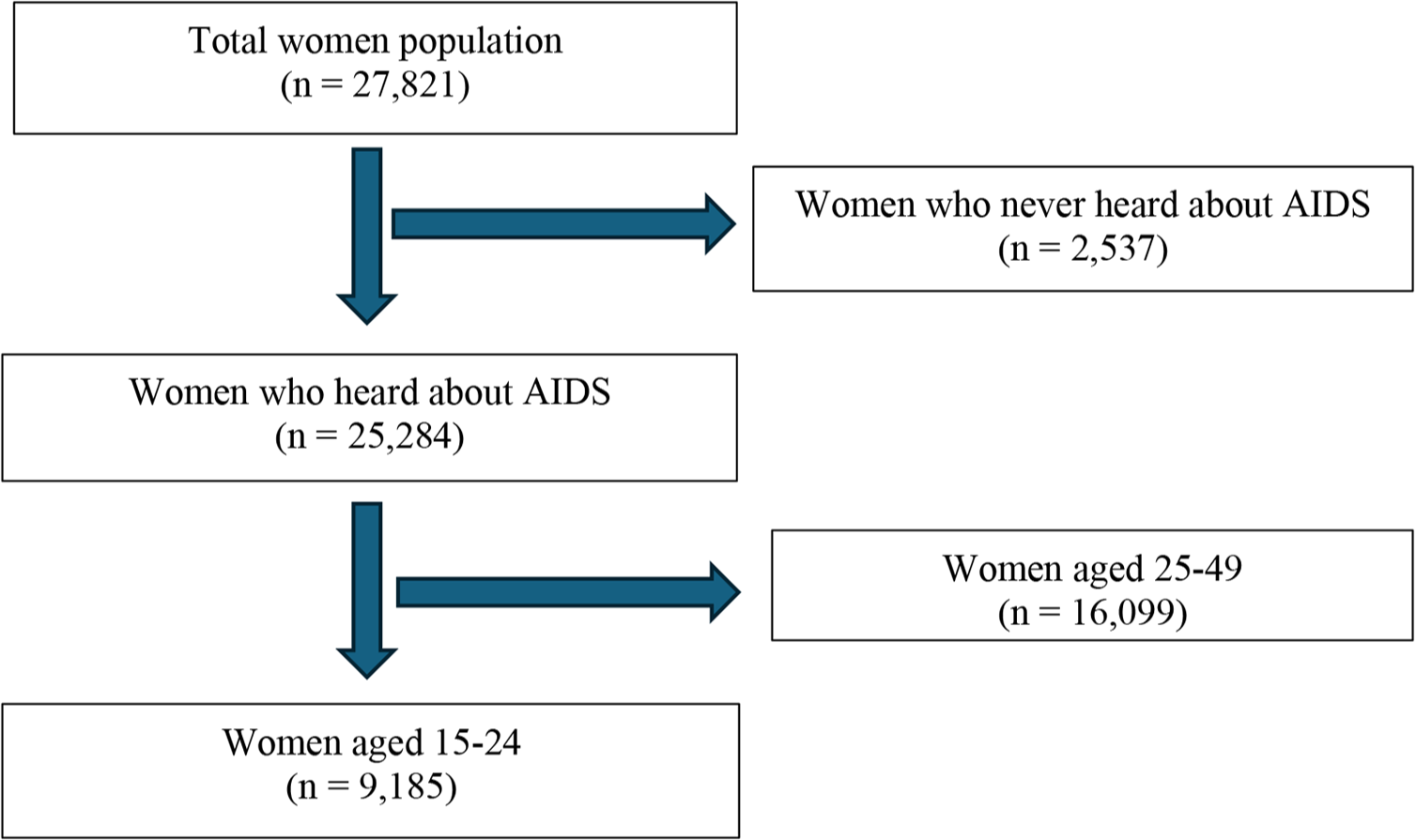
Methods: We utilized data of women aged 15–49 (n = 25,284) who heard about HIV from the Philippines’ 2022 Demographic and Health Survey. The dependent variable was HIV stigma. The covariates were sociodemographic characteristics (i.e., age, urban/rural, education level, wealth quintile, current employment status, and marital status), knowledge regarding HIV test kits, drugs to prevent MTCT, and ARV drugs. We calculated descriptive statistics, Pearson’s Chi-square test of independence, and multivariable binary logistic regression, fitting covariates. Subgroup analysis was performed to understand the relationship between HIV stigma and HIV knowledge score among individuals aged 15–24 years. All analyses were performed using Stata 18.5.
Results: Approximately 65.7% of women reported HIV stigma. The logistic regression results indicated lower odds of HIV stigma among women who know test kits but never tested for HIV with test kits (adjusted odds ratio [aOR] = 0.87), those who heard about drugs to prevent MTCT (aOR = 0.75), and those who heard about ARV drugs (aOR = 0.85) compared to their counterparts. Higher odds of HIV stigma were observed among women currently in union (aOR = 1.46) and rural residents (aOR = 1.54) compared to their counterparts. Among women aged 15–24, having a higher HIV knowledge score, especially among those who scored 5, had lower odds of having HIV stigma (aOR = 0.04) than those who achieved a zero knowledge score. All p-values ≤ 0.05.
Conclusion and Global Health Implications: Findings suggest an urgent need to address stigma among women, especially those who lack knowledge of HIV test kits and ARV drugs. Further research should explore strategies to reduce HIV stigma, especially among young married rural women.
Downloads
Similar Articles
- Olawunmi R. Rabiu, Hannah Dada-Adegbola, Catherine O. Falade, Olatunbosun G. Arinola, Alexander B. Odaibo, Olusegun G. Ademowo, Malaria, Helminth Infections and Clinical Status Among HIV-Infected Pregnant Women , Vol. 10 No. 1 (2021): International Journal of Maternal and Child Health and AIDS
- Charles Ikeanyionwu, Deepa Dongarwar, Zenab Yusuf, Rafeek Yusuf, Meishon Bell, Toi Harris, Hamisu M. Salihu, 2019 Health Equity Summer Research Summit Organized by the Center of Excellence in Health Equity, Training and Research, Baylor College of Medicine, Houston, Texas 77030, USA on June 18th, 2019 , Vol. 9 No. S1 (2020): International Journal of Maternal and Child Health and AIDS
- Mamour Gueye, Mame Diarra Ndiaye-Gueye, Serigne Modou Kane Gueye, Jean Charles Moreau, Fatal Cases of Gestational Trophoblastic Neoplasia in a National Trophoblastic Disease Reference Center in Dakar Senegal , Vol. 5 No. 1 (2016): International Journal of Maternal and Child Health and AIDS
- Fatemeh Bahreini, Rezvan Najafi, Razieh Amini, Salman Khazaei, Saeid Bashirian, Reducing False Negative PCR Test for COVID-19 , Vol. 9 No. 3 (2020): International Journal of Maternal and Child Health and AIDS
- Hamisu M. Salihu, Deepa Dongarwar, Toi B. Harris, Third Annual Summer Research Summit on Health Equity Organized by the Center of Excellence in Health Equity, Training and Research, Baylor College of Medicine, Houston, Texas 77030, USA on June 9, 2020: ABSTRACT: Advancing Health Equity Through Innovation , Vol. 9 No. S3 (2020): International Journal of Maternal and Child Health and AIDS
- Romuladus E. Azuine, Janna Murray, Noor Alsafi, Gopal K. Singh, Exclusive Breastfeeding and Under-Five Mortality, 2006-2014: A Cross-National Analysis of 57 Low- and-Middle Income Countries , Vol. 4 No. 1 (2015): International Journal of Maternal and Child Health and AIDS
- Alireza Ghannad Sabzevari, Mohsen Nikbakht, Considerations about Reducing False-Negative PCR Test for COVID-19 , Vol. 11 No. 2 (2022): International Journal of Maternal and Child Health and AIDS
- Michelle Berlacher, Timothy Mercer, Edith O. Apondi, Winfred Mwangi, Edwin Were, Megan S. McHenry, Integrating Prevention of Mother-to-Child Transmission of HIV Care into General Maternal Child Health Care in Western Kenya , Vol. 10 No. 1 (2021): International Journal of Maternal and Child Health and AIDS
- Rajesh Narwal, Lu Gram, Has the Rate of Reduction in Infant Mortality Increased in India Since the Launch of National Rural Health Mission? Analysis of Time Trends 2000-2009 with Projection to 2015 , Vol. 2 No. 1 (2013): International Journal of Maternal and Child Health and AIDS
- Romuladus E. Azuine, Sussan E. Ekejiuba, Gopal K. Singh, Magnus A. Azuine, Ebola Virus Disease Epidemic: What Can the World Learn and Not Learn from West Africa? , Vol. 3 No. 1 (2015): International Journal of Maternal and Child Health and AIDS
<< < 5 6 7 8 9 10 11 12 13 14 > >>
You may also start an advanced similarity search for this article.
Published
How to Cite
Issue
Section
License
Copyright © 2026 Wah Wah Myint. Published by Global Health and Education Projects, Inc., USA.

This is an open-access article distributed under the terms of the Creative Commons Attribution-NonCommercial-ShareAlike 4.0 International License , which permits others to remix, transform, and build upon the work non-commercially, provided the original author is credited and the new creations are licensed under the same terms.