
Interbirth Intervals of Immigrant and Refugee Women in the United States: A Cross-Sectional Study
DOI:
https://doi.org/10.21106/ijma.621Keywords:
- African Immigrants,
- Birth Spacing,
- Immigrant Women,
- Interbirth Interval,
- Interpregnancy Interval,
- Maternal Health,
- Refugee Women
Abstract
Despite guidelines recommending an interval of at least 18–24 months between a live birth and the conception of the next pregnancy, nearly one-third of pregnancies in the United States are conceived within 18 months of a previous live birth. The purpose of this study was to examine the associations between multiple immigration-related variables and interbirth intervals among reproductive-aged immigrant and refugee women living in the United States.
Methods:This was a cross-sectional, quantitative study on the sexual and reproductive health (SRH) of reproductive-aged immigrant and refugee women in the United States. The data were collected via an online survey administered by Lucid LLC. We included data on women who had complete information on nativity and birth history in the descriptive analysis (n = 653). The exposure variables were immigration pathway, length of time since immigration, and country/region of birth. The outcome variable was interbirth interval (≤18, 19–35, or ≥36 months). We used multivariable ordinal logistic regression, adjusted for confounders, to determine the factors associated with having a longer interbirth interval among women with second- or higher-order births (n = 245).
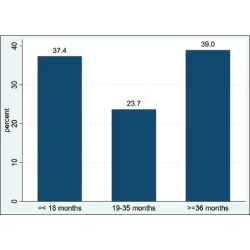
Results:Approximately 37.4% of study participants had a short interbirth interval. Women who immigrated to the United States for educational (aOR = 4.57; 95% CI, 1.57–9.58) or employment opportunities (aOR = 2.27; 95% CI, 1.07–5.31) had higher odds of reporting a longer interbirth interval (19–35 or ≥36 months) than women born in the United States. Women born in an African country had 0.79 times the odds (aOR = 0.79; 95% CI, 0.02–0.98) of being in a higher category of interbirth interval.
Conclusion and Global Health Implications:Although all birthing women should be counseled on optimal birth spacing through the use of postpartum contraception, immigrant and refugee women would benefit from further research and policy and program interventions to help them in achieving optimal birth spacing. SRH research in African immigrant and refugee communities is especially important for identifying ameliorable factors for improving birth spacing.
Downloads
Similar Articles
- Yaw Owusu, Prerana Medakkar, Elizabeth M. Akinnawo, Althea Stewart-Pyne, Eta E. Ashu, Emigration of skilled healthcare workers from developing countries: can team-based healthcare practice fill the gaps in maternal, newborn and child healthcare delivery? , Vol. 6 No. 2 (2017): International Journal of Maternal and Child Health and AIDS
- Joel M. Njah, Gregory E. Halle-Ekane, Sylvester N. Atanga, Edouard K. Tshimwanga, Felix Desembuin, Pius T. Muffih, From Option B+ to Universal “Test and Treat” in Cameroon: Identification and Evaluation of District-level Factors Associated with Retention in Care , Vol. 12 No. 2 (2023): International Journal of Maternal and Child Health and AIDS
- Michelle Berlacher, Timothy Mercer, Edith O. Apondi, Winfred Mwangi, Edwin Were, Megan S. McHenry, Integrating Prevention of Mother-to-Child Transmission of HIV Care into General Maternal Child Health Care in Western Kenya , Vol. 10 No. 1 (2021): International Journal of Maternal and Child Health and AIDS
- Phillips Edomwonyi Obasohan, Paul Gana, Mahmud A. Mustapha, Ahmed Egbako Umar, Audu Makada, Dorcas Nike Obasohan, Decision Making Autonomy and Maternal Healthcare Utilization among Nigerian Women , Vol. 8 No. 1 (2019): International Journal of Maternal and Child Health and AIDS
- María Isabel Roldós, Phaedra Corso, Justin Ingels, How much are Ecuadorians Willing to Pay to Reduce Maternal Mortality? Results from a Pilot Study on Contingent Valuation , Vol. 6 No. 1 (2017): International Journal of Maternal and Child Health and AIDS
- Yifru Berhan, Sinteyehu Abeba, Thirty Years of United Nations Inter-Agency Working Group’s Global, Regional, and National Maternal Mortality Estimates Revisited , Vol. 13 No. Continuous (2024): International Journal of Maternal and Child Health and AIDS
- Korede K Yusuf, Deepa Dongarwar, Sahra Ibrahimi, Chioma Ikedionwu, Sitratullah O. Maiyegun, Hamisu M. Salihu, Expected Surge in Maternal Mortality and Severe Morbidity among African-Americans in the Era of COVID-19 Pandemic , Vol. 9 No. 3 (2020): International Journal of Maternal and Child Health and AIDS
- Hyacinthe Zamané, Hyacinthe Euvrard Sow, Dantola Paul Kain, Brice Wilfried Bicaba, Sibraogo Kiemtoré, Issaka Yameogo, Blandine Bonané-Thieba, Mamadou Sawadogo, Maternal Mortality at the Dori Regional Hospital in Northern Burkina Faso, 2014-2016 , Vol. 7 No. 2 (2018): International Journal of Maternal and Child Health and AIDS
- Matiur Rahman, Kaoser Bin Siddique, Aminur Rahman, Rahidul Islam, Mohammad Mahbub Ur Rahim, Access to and Utilization of Maternal and Child Healthcare Services During COVID-19 Pandemic in Rural Bangladesh , Vol. 13 No. Continuous (2024): International Journal of Maternal and Child Health and AIDS
- Wah W. Myint, David J. Washburn, Brian Colwell, Jay E. Maddock, Determinants of HIV Testing Uptake among Women (aged 15-49 years) in the Philippines, Myanmar, and Cambodia , Vol. 10 No. 2 (2021): International Journal of Maternal and Child Health and AIDS
<< < 3 4 5 6 7 8 9 10 11 12 > >>
You may also start an advanced similarity search for this article.
Published
How to Cite
Issue
Section
License
Copyright © 2023 Comfort Z. Olorunsaiye, Larissa R. Brunner Huber, Samira P. Ouedraogo. Published by Global Health and Education Projects, Inc., USA.

This is an open-access article distributed under the terms of the Creative Commons Attribution-NonCommercial-ShareAlike 4.0 International License , which permits others to remix, transform, and build upon the work non-commercially, provided the original author is credited and the new creations are licensed under the same terms.