
Interbirth Intervals of Immigrant and Refugee Women in the United States: A Cross-Sectional Study
DOI:
https://doi.org/10.21106/ijma.621Keywords:
- African Immigrants,
- Birth Spacing,
- Immigrant Women,
- Interbirth Interval,
- Interpregnancy Interval,
- Maternal Health,
- Refugee Women
Abstract
Despite guidelines recommending an interval of at least 18–24 months between a live birth and the conception of the next pregnancy, nearly one-third of pregnancies in the United States are conceived within 18 months of a previous live birth. The purpose of this study was to examine the associations between multiple immigration-related variables and interbirth intervals among reproductive-aged immigrant and refugee women living in the United States.
Methods:This was a cross-sectional, quantitative study on the sexual and reproductive health (SRH) of reproductive-aged immigrant and refugee women in the United States. The data were collected via an online survey administered by Lucid LLC. We included data on women who had complete information on nativity and birth history in the descriptive analysis (n = 653). The exposure variables were immigration pathway, length of time since immigration, and country/region of birth. The outcome variable was interbirth interval (≤18, 19–35, or ≥36 months). We used multivariable ordinal logistic regression, adjusted for confounders, to determine the factors associated with having a longer interbirth interval among women with second- or higher-order births (n = 245).
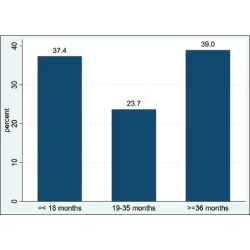
Results:Approximately 37.4% of study participants had a short interbirth interval. Women who immigrated to the United States for educational (aOR = 4.57; 95% CI, 1.57–9.58) or employment opportunities (aOR = 2.27; 95% CI, 1.07–5.31) had higher odds of reporting a longer interbirth interval (19–35 or ≥36 months) than women born in the United States. Women born in an African country had 0.79 times the odds (aOR = 0.79; 95% CI, 0.02–0.98) of being in a higher category of interbirth interval.
Conclusion and Global Health Implications:Although all birthing women should be counseled on optimal birth spacing through the use of postpartum contraception, immigrant and refugee women would benefit from further research and policy and program interventions to help them in achieving optimal birth spacing. SRH research in African immigrant and refugee communities is especially important for identifying ameliorable factors for improving birth spacing.
Downloads
Similar Articles
- Kolawole A. Fasakin, Christopher T. Omisakin, Idowu O. Adebara, Wasiu A. Ajetunmobi, Adebayo A. Adeniyi, Ayodele J. Esan, Olufunke B. Bolaji, Oluwafemi D. Ajayi, Abayomi J. Afe, Assessment of PMTCT Success Rates Based on Antiretroviral Interventions and Feeding Options: A Prospective Cohort Study , Vol. 7 No. 2 (2018): International Journal of Maternal and Child Health and AIDS
- Gopal K. Singh, Stella M. Yu, Infant Mortality in the United States, 1915-2017: Large Social Inequalities have Persisted for Over a Century , Vol. 8 No. 1 (2019): International Journal of Maternal and Child Health and AIDS
- Paul Kiondo, Annettee Nakimuli, Samuel Ononge, Julius N. Wandabwa, Milton W. Musaba, Predictors of Intrapartum Stillbirths among Women Delivering at Mulago Hospital, Kampala, Uganda , Vol. 10 No. 2 (2021): International Journal of Maternal and Child Health and AIDS
- Nemati Ali, Tazakori Zahra, Maryam Namadi Vosogh, Nazila Vosoghi, Maryam Zare, Afroz Mardi, Adham Davoud, Hamidzadeh Arbabi Yousef, Kazemzadeh Rafat, Effectiveness Comparison of Mothers’ In-person Versus Written Nutritional Education Intervention on Infant Growth in Iran , Vol. 3 No. 1 (2015): International Journal of Maternal and Child Health and AIDS
- Ranjan Kumar Prusty, Sayeed Unisa, Reproductive Tract Infections and Treatment Seeking Behavior among Married Adolescent Women 15-19 Years in India , Vol. 2 No. 1 (2013): International Journal of Maternal and Child Health and AIDS
- Janice Katherine Kopinak, Mental Health in Developing Countries: Challenges and Opportunities in Introducing Western Mental Health System in Uganda , Vol. 3 No. 1 (2015): International Journal of Maternal and Child Health and AIDS
- Ahmad Abdulhadi, Nasiru Abdullahi, Ibrahim Yusuf, Basheer I. Waziri, Kasimu Mamuda , Husna F. Ibrahim, Khadija Muhammad, Maryam M. Ibrahim , Aisha A. Abdullahi, Hassan A. Murtala, Muhammad A. Abbas, Hamisu M. Salihu, A Systematic Review and Meta-analysis on Innovative Approaches in Tuberculosis Diagnosis: Challenges and Future Directions , Vol. 15 (2026): International Journal of Maternal and Child Health and AIDS
- Nkechi Martina Odogwu, Chinedum A. C. Onebunne, Oladapo O. Olayemi, Akinyinka O. Omigbodun, Protocol for a Longitudinal Analysis of the Vaginal Microbiome from a Pregnant Cohort of African Women in Nigeria , Vol. 9 No. 2 (2020): International Journal of Maternal and Child Health and AIDS
- Vinay Kumar, Gunjan Arora, Ish Kumar Midha, Yogender Pal Gupta, Infant and Young Child Feeding Behaviors among Working Mothers in India: Implications for Global Health Policy and Practice , Vol. 3 No. 1 (2015): International Journal of Maternal and Child Health and AIDS
- Deepa Dongarwar, Morgan Lee, Christo Manikkuttiyil, Hamisu M. Salihu, Association Between Social Determinants of Health Issues and Maternal Obesity Among American Racial/Ethnic Groups , Vol. 12 No. 1 (2023): International Journal of Maternal and Child Health and AIDS
<< < 4 5 6 7 8 9 10 11 12 13 > >>
You may also start an advanced similarity search for this article.
Published
How to Cite
Issue
Section
License
Copyright © 2023 Comfort Z. Olorunsaiye, Larissa R. Brunner Huber, Samira P. Ouedraogo. Published by Global Health and Education Projects, Inc., USA.

This is an open-access article distributed under the terms of the Creative Commons Attribution-NonCommercial-ShareAlike 4.0 International License , which permits others to remix, transform, and build upon the work non-commercially, provided the original author is credited and the new creations are licensed under the same terms.