
Interbirth Intervals of Immigrant and Refugee Women in the United States: A Cross-Sectional Study
DOI:
https://doi.org/10.21106/ijma.621Keywords:
- African Immigrants,
- Birth Spacing,
- Immigrant Women,
- Interbirth Interval,
- Interpregnancy Interval,
- Maternal Health,
- Refugee Women
Abstract
Despite guidelines recommending an interval of at least 18–24 months between a live birth and the conception of the next pregnancy, nearly one-third of pregnancies in the United States are conceived within 18 months of a previous live birth. The purpose of this study was to examine the associations between multiple immigration-related variables and interbirth intervals among reproductive-aged immigrant and refugee women living in the United States.
Methods:This was a cross-sectional, quantitative study on the sexual and reproductive health (SRH) of reproductive-aged immigrant and refugee women in the United States. The data were collected via an online survey administered by Lucid LLC. We included data on women who had complete information on nativity and birth history in the descriptive analysis (n = 653). The exposure variables were immigration pathway, length of time since immigration, and country/region of birth. The outcome variable was interbirth interval (≤18, 19–35, or ≥36 months). We used multivariable ordinal logistic regression, adjusted for confounders, to determine the factors associated with having a longer interbirth interval among women with second- or higher-order births (n = 245).
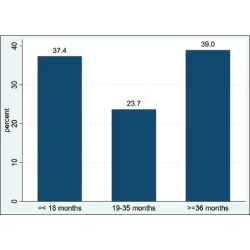
Results:Approximately 37.4% of study participants had a short interbirth interval. Women who immigrated to the United States for educational (aOR = 4.57; 95% CI, 1.57–9.58) or employment opportunities (aOR = 2.27; 95% CI, 1.07–5.31) had higher odds of reporting a longer interbirth interval (19–35 or ≥36 months) than women born in the United States. Women born in an African country had 0.79 times the odds (aOR = 0.79; 95% CI, 0.02–0.98) of being in a higher category of interbirth interval.
Conclusion and Global Health Implications:Although all birthing women should be counseled on optimal birth spacing through the use of postpartum contraception, immigrant and refugee women would benefit from further research and policy and program interventions to help them in achieving optimal birth spacing. SRH research in African immigrant and refugee communities is especially important for identifying ameliorable factors for improving birth spacing.
Downloads
Similar Articles
- Ashu Michael Agbor, Loyick Nguafack Zencha, Henri Essome, Che Bleck Ndikum, Pascal Foumane, Oral Health Status of Pregnant Women Attending Antenatal Clinic in Cameroon , Vol. 14 No. Continuous (2025): International Journal of Maternal and Child Health and AIDS
- Tamara H. Hussein, Melina Mgongo, Jacqueline G. Uriyo, Damian J. Damian, Babill Stray-Pedersen, Sia E. Msuya, Margareta Wandel, Exclusive Breastfeeding Rates and Factors Associated with Exclusive Breastfeeding Practices in Northern Tanzania: Measurement using Two Different Methodologies—24 Hours Recall and Recall Since Birth , Vol. 8 No. 1 (2019): International Journal of Maternal and Child Health and AIDS
- Kimberly Fryer, Chinyere N. Reid, Naciely Cabral, Jennifer Marshall, Usha Menon, Exploring Patients’ Needs and Desires for Quality Prenatal Care in Florida, United States , Vol. 12 No. 1 (2023): International Journal of Maternal and Child Health and AIDS
- Karen M. Hampanda, Lisa L. Abuogi, Yusuf Ahmed, HIV-Positive Women Taking Lifelong Antiretroviral Therapy Report Better Adherence Than Women Taking Short-Course Prophylaxis During and After Pregnancy Under PMTCT Program Option A in Lusaka, Zambia , Vol. 6 No. 1 (2017): International Journal of Maternal and Child Health and AIDS
- Ikenna J. Nwakamma, Amber Erinmwinhe, Arinzechukwu Ajogwu, Aniekan Udoh, Anne Ada-Ogoh, Mitigating Gender and Maternal and Child Health Injustices through Faith Community-Led Initiatives , Vol. 8 No. 2 (2019): International Journal of Maternal and Child Health and AIDS
- Romuladus Emeka Azuine, Gopal K Singh, Sussan E Ekejiuba, Eta Ashu, Magnus A Azuine, Global Health Donor Presence, Variations in HIV/AIDS Prevalence, and External Resources for Health in Developing Countries in Africa and Asia , Vol. 2 No. 2 (2014): International Journal of Maternal and Child Health and AIDS
- Justice Ajaari, Honorati Masanja, Renay Weiner, Shalom Akonvi Abokyi, Seth Owusu-Agyei, Impact of Place of Delivery on Neonatal Mortality in Rural Tanzania , Vol. 1 No. 1 (2012): International Journal of Maternal and Child Health and AIDS
- Brianna L. Smith, Sara Zizzo, Anouk Amzel, Sarah Wiant, Molly C. Pezzulo, Sarah Konopka, Rachel Golin, Alexandra C. Vrazo, Integration of Neonatal and Child Health Interventions with Pediatric HIV Interventions in Global Health , Vol. 7 No. 1 (2018): International Journal of Maternal and Child Health and AIDS
- John Humphrey, Esther Wanjama, James G. Carlucci, Violet Naanyu, Lindah Muli, Edwin Were, Alan McGuire, Winstone M. Nyandiko, Julia Songok, Gregory Zimet, Kara Wools-Kaloustian, Understanding Women’s Preferences for Prevention of Mother-to-Child HIV Transmission Services in Kenya , Vol. 13 No. Continuous (2024): International Journal of Maternal and Child Health and AIDS
- Yaw Owusu, Prerana Medakkar, Elizabeth M. Akinnawo, Althea Stewart-Pyne, Eta E. Ashu, Emigration of skilled healthcare workers from developing countries: can team-based healthcare practice fill the gaps in maternal, newborn and child healthcare delivery? , Vol. 6 No. 2 (2017): International Journal of Maternal and Child Health and AIDS
<< < 2 3 4 5 6 7 8 9 10 11 > >>
You may also start an advanced similarity search for this article.
Published
How to Cite
Issue
Section
License
Copyright © 2023 Comfort Z. Olorunsaiye, Larissa R. Brunner Huber, Samira P. Ouedraogo. Published by Global Health and Education Projects, Inc., USA.

This is an open-access article distributed under the terms of the Creative Commons Attribution-NonCommercial-ShareAlike 4.0 International License , which permits others to remix, transform, and build upon the work non-commercially, provided the original author is credited and the new creations are licensed under the same terms.