
Evaluation and Utility of a Family Information Table to Identify and Test Children at Risk for HIV in Kenya
DOI:
https://doi.org/10.21106/ijma.30Keywords:
- Family Information Table,
- Pediatrics,
- HIV/AIDS,
- Linkage,
- Kenya,
- HIV Testing
Abstract
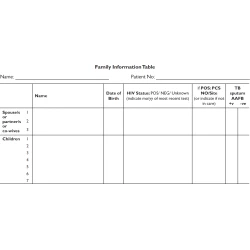
Background: Effective strategies to identify and screen children at risk for HIV are needed. The objectives of this study were to evaluate the utilization of a family information table (FIT) to identify and test at-risk children in Kenya and identify factors associated with child testing. Methods: A cross-sectional study was conducted among HIV-infected adults with children at five Kenyan clinics. HIV testing status for children aged ≤18 years was gathered from the patients’ FITs and compared to reports from in-person clinic visits as the gold standard. Generalized estimating equations were used to assess predictors for HIV testing of children adjusted for confounders and within parent correlation. Results: Our sample included 384 HIV-infected adults enrolled in care with 933 reported children. Overall, 323 FITs (84%) correctly listed all children in the family and 340 (89%) documented an HIV testing status (including untested) for all children. Seventy-five percent of parents verbally reported all children tested, compared to only 46% of FITs (OR=13.5, 95% CI 6.5-27.8). Verbal reports identified 739 (79%) children tested, with 55 (7.4%) HIV-positive and 17 (2.3%) HIV-exposed infants (HEI). Of 63 adults with HIV-positive children or HEI, 60 (95%) reported enrolling children into care. Likelihood that children had been tested was higher for younger children (≤4y vs. > 4y, aOR=2.0; 95% CI 1.4-2.9) and lower if the partner’s serostatus was unknown vs. seropositive (aOR=0.3; 95% CI: 0.1-0.8). Conclusions: Although the FIT may be a useful tool to identify children at risk for HIV, this study found underutilization by providers. To maximize impact of this tool, documentation of follow-up for untested and positive children is essential. Global Health Implications: Through early documentation of at-risk children and follow up of untested and infected children, the FIT may serve as an effective resource for improving HIV testing and linkage to care.
Downloads
Similar Articles
- Kolawole Solomon Oyedeji, Adeniyi Francis Fagbamigbe, Johnbull Sonny Ogboi, Adebobola Toluwalashe Bashorun, Kawu Bolakale Issa, Perpetua Amida, Adeniyi Ogundiran, Ezire Onoriode, Does Pre-Survey Training Impact Knowledge of Survey Administrators and Survey Outcomes in Developing Countries? Evaluation Findings of a Training of Trainers Workshop for National AIDS and Reproductive Health Survey-Plus in Nigeria , Vol. 2 No. 1 (2013): International Journal of Maternal and Child Health and AIDS
- Gregory Pappas, Forward to AIDS 2014: Now is the Time to Unite for the Global HIV/AIDS Epidemic , Vol. 2 No. 2 (2014): International Journal of Maternal and Child Health and AIDS
- Elizabeth Armstrong, Priya Srinivasan, Dawood Azeemy, Fayja Habib, Ernest Alema-Mensah, COVID-19 Stressors and Maternal Mental Health in Georgia, United States: Sources, Effects, and Recommendations , Vol. 14 No. Continuous (2025): International Journal of Maternal and Child Health and AIDS
- Hamisu M. Salihu, Deepa Dongarwar, Toi B. Harris, Third Annual Summer Research Summit on Health Equity Organized by the Center of Excellence in Health Equity, Training and Research, Baylor College of Medicine, Houston, Texas 77030, USA on June 9, 2020: ABSTRACT: Advancing Health Equity Through Innovation , Vol. 9 No. S3 (2020): International Journal of Maternal and Child Health and AIDS
- Daisy Ruto, Michael Muthamia, Edith Njeri, Freda Nyaga, Christine Muia, Morris Kiio, Jane Wausi, Introduction of Heat-Stable Carbetocin for Postpartum Hemorrhage Prevention in Public Sector Hospitals in Kenya: Provider Experience and Policy Insights , Vol. 13 No. S1 (2024): International Journal of Maternal and Child Health and AIDS
- Gopal K. Singh, Gem P. Daus, Michelle Allender, Christine T. Ramey, Elijah K. Martin, Chrisp Perry, Andrew A. De Los Reyes, Ivy P. Vedamuthu, Social Determinants of Health in the United States: Addressing Major Health Inequality Trends for the Nation, 1935-2016 , Vol. 6 No. 2 (2017): International Journal of Maternal and Child Health and AIDS
- Charles Kouanfack, Fala Bede, Claude Ngwayu Nkfusai, Emerson Wepngong, Mbinkar Adeline Venyuy, Chombong Hubert, Denise Movuh Sam, Samuel Nambile Cumber, Retention in HIV/AIDS Management Services: is it Really Poor? The Case of Yaounde Central Hospital in Cameroon , Vol. 9 No. 2 (2020): International Journal of Maternal and Child Health and AIDS
- Innocent Anayochukwu Ugwu, Calistus Obiora Nevo, Malachy Nwaeze Ezenwaeze, Antenatal Care Utilization and Delivery Location: Evidence from Postpartum Women in Enugu, South East Nigeria , Vol. 15 (2026): International Journal of Maternal and Child Health and AIDS
- Jayati Kusari Basu, Lawrence Chauke, Cert Maternal Fetal Medicine, Terrance Magoro, Clinical Features and Outcomes of COVID-19 Infection among Pregnant Women in South Africa , Vol. 10 No. 2 (2021): International Journal of Maternal and Child Health and AIDS
- Samantha A. Slinkard, Jennifer R. Pharr, Tamara Bruno, Dina Patel, Amaka Ogidi, Michael Obiefune, Echezona E. Ezeanolue, Determinants of Infant Mortality in Southeast Nigeria: Results from the Healthy Beginning Initiative, 2013-2014 , Vol. 7 No. 1 (2018): International Journal of Maternal and Child Health and AIDS
<< < 5 6 7 8 9 10 11 12 13 14 > >>
You may also start an advanced similarity search for this article.
Published
How to Cite
Issue
Section
License
Copyright © 2015 Michelle Meyer, Molly Elmer-DeWitt, Cinthia Blat, Starley B Shade, Ijaa Kapule, Elizabeth Bukusi, Craig R Cohen, Lisa Abuogi. Published by Global Health and Education Projects, Inc., USA.

This is an open-access article distributed under the terms of the Creative Commons Attribution-NonCommercial-ShareAlike 4.0 International License , which permits others to remix, transform, and build upon the work non-commercially, provided the original author is credited and the new creations are licensed under the same terms.