
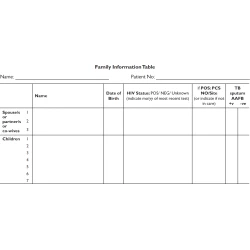
Evaluation and Utility of a Family Information Table to Identify and Test Children at Risk for HIV in Kenya
DOI:
https://doi.org/10.21106/ijma.30Keywords:
- Family Information Table,
- Pediatrics,
- HIV/AIDS,
- Linkage,
- Kenya,
- HIV Testing
Abstract
Background: Effective strategies to identify and screen children at risk for HIV are needed. The objectives of this study were to evaluate the utilization of a family information table (FIT) to identify and test at-risk children in Kenya and identify factors associated with child testing. Methods: A cross-sectional study was conducted among HIV-infected adults with children at five Kenyan clinics. HIV testing status for children aged ≤18 years was gathered from the patients’ FITs and compared to reports from in-person clinic visits as the gold standard. Generalized estimating equations were used to assess predictors for HIV testing of children adjusted for confounders and within parent correlation. Results: Our sample included 384 HIV-infected adults enrolled in care with 933 reported children. Overall, 323 FITs (84%) correctly listed all children in the family and 340 (89%) documented an HIV testing status (including untested) for all children. Seventy-five percent of parents verbally reported all children tested, compared to only 46% of FITs (OR=13.5, 95% CI 6.5-27.8). Verbal reports identified 739 (79%) children tested, with 55 (7.4%) HIV-positive and 17 (2.3%) HIV-exposed infants (HEI). Of 63 adults with HIV-positive children or HEI, 60 (95%) reported enrolling children into care. Likelihood that children had been tested was higher for younger children (≤4y vs. > 4y, aOR=2.0; 95% CI 1.4-2.9) and lower if the partner’s serostatus was unknown vs. seropositive (aOR=0.3; 95% CI: 0.1-0.8). Conclusions: Although the FIT may be a useful tool to identify children at risk for HIV, this study found underutilization by providers. To maximize impact of this tool, documentation of follow-up for untested and positive children is essential. Global Health Implications: Through early documentation of at-risk children and follow up of untested and infected children, the FIT may serve as an effective resource for improving HIV testing and linkage to care.
Downloads
Similar Articles
- Ahmad Abdulhadi, Nasiru Abdullahi, Ibrahim Yusuf, Basheer I. Waziri, Kasimu Mamuda , Husna F. Ibrahim, Khadija Muhammad, Maryam M. Ibrahim , Aisha A. Abdullahi, Hassan A. Murtala, Muhammad A. Abbas, Hamisu M. Salihu, A Systematic Review and Meta-analysis on Innovative Approaches in Tuberculosis Diagnosis: Challenges and Future Directions , Vol. 15 (2026): International Journal of Maternal and Child Health and AIDS
- Vatsla Dadhwal, Aparna Sharma, Kavita Khoiwal, Dipika Deka, Plaboni Sarkar, P. Vanamail, Pregnancy Outcomes in HIV-Infected Women: Experience from a Tertiary Care Center in India , Vol. 6 No. 1 (2017): International Journal of Maternal and Child Health and AIDS
- Mousumi Datta, Shamima Yasmin, Rahul Biswas, Immunization Status, Immunization Coverage, and Factors Associated with Immunization Service Utilization Among HIV-Exposed and HIV-Infected Children in India , Vol. 13 No. Continuous (2024): International Journal of Maternal and Child Health and AIDS
- Katherine Magerko, John Humphrey, Julia Songok, Beverly Musick, Joy Marsha Alera, Bett Kipchumba, Wycliffe Kosgei, Winfred Mwangi, Ziyi Yang, Kara Wools-Kaloustian, Megan McHenry, Impact of Maternal Viral Suppression on Growth Patterns for HIV-Exposed Uninfected Infants in Kenya , Vol. 13 No. Continuous (2024): International Journal of Maternal and Child Health and AIDS
- Charles Kouanfack, Hermine Meli, Samuel N. Cumber, Fala Bede, Claude N. Nkfusai, Patience Y. Ijang, Emerson Wepngong, Olga Yvonne M. Bassong, Benjamin-Alexandre Nkoum, Non-Occupational HIV Post-exposure Prophylaxis: A 10-Year Retrospective Review of Data Following Sexual Exposure From Yaounde Central Hospital, Cameroon , Vol. 8 No. 2 (2019): International Journal of Maternal and Child Health and AIDS
- Olawunmi R. Rabiu, Hannah Dada-Adegbola, Catherine O. Falade, Olatunbosun G. Arinola, Alexander B. Odaibo, Olusegun G. Ademowo, Malaria, Helminth Infections and Clinical Status Among HIV-Infected Pregnant Women , Vol. 10 No. 1 (2021): International Journal of Maternal and Child Health and AIDS
- Anne Esther Njom Nlend, Pascal Avenec, Jeannette Epée Ngoué, Arsène B. Sandie, Morbidity and Mortality of HIV-Exposed Uninfected Infants in a Tertiary Referral Facility in Yaoundé, Cameroon , Vol. 12 No. 2 (2023): International Journal of Maternal and Child Health and AIDS
- Akinyi E. Imbo, Elizabeth K. Mbuthia, Douglas N. Ngotho, Determinants of Neonatal Mortality in Kenya: Evidence from the Kenya Demographic and Health Survey 2014 , Vol. 10 No. 2 (2021): International Journal of Maternal and Child Health and AIDS
- Prakash R Ganesh, Rachel Mernoff, Renske Dikkers, William Nundwe, Rachel Pope, A Comparison of Postoperative Surgical Outcomes among Women Undergoing Obstetric Fistula Repair with and without HIV , Vol. 10 No. 2 (2021): International Journal of Maternal and Child Health and AIDS
- Fatima M. Damagum, Zainab D. Ahmed, Rabiu I. Jalo, Hamisu M. Salihu, C. William Wester, Muktar H. Aliyu, Adapted Counseling Care Model for Management of Female Sexual Dysfunction Among Women Living With and Without HIV , Vol. 13 No. Continuous (2024): International Journal of Maternal and Child Health and AIDS
<< < 2 3 4 5 6 7 8 9 10 11 > >>
You may also start an advanced similarity search for this article.
Published
How to Cite
Issue
Section
License
Copyright © 2015 Michelle Meyer, Molly Elmer-DeWitt, Cinthia Blat, Starley B Shade, Ijaa Kapule, Elizabeth Bukusi, Craig R Cohen, Lisa Abuogi. Published by Global Health and Education Projects, Inc., USA.

This is an open-access article distributed under the terms of the Creative Commons Attribution-NonCommercial-ShareAlike 4.0 International License , which permits others to remix, transform, and build upon the work non-commercially, provided the original author is credited and the new creations are licensed under the same terms.