
Evaluation and Utility of a Family Information Table to Identify and Test Children at Risk for HIV in Kenya
DOI:
https://doi.org/10.21106/ijma.30Keywords:
- Family Information Table,
- Pediatrics,
- HIV/AIDS,
- Linkage,
- Kenya,
- HIV Testing
Abstract
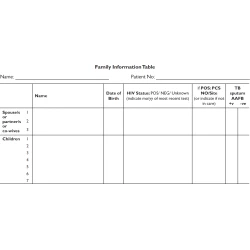
Background: Effective strategies to identify and screen children at risk for HIV are needed. The objectives of this study were to evaluate the utilization of a family information table (FIT) to identify and test at-risk children in Kenya and identify factors associated with child testing. Methods: A cross-sectional study was conducted among HIV-infected adults with children at five Kenyan clinics. HIV testing status for children aged ≤18 years was gathered from the patients’ FITs and compared to reports from in-person clinic visits as the gold standard. Generalized estimating equations were used to assess predictors for HIV testing of children adjusted for confounders and within parent correlation. Results: Our sample included 384 HIV-infected adults enrolled in care with 933 reported children. Overall, 323 FITs (84%) correctly listed all children in the family and 340 (89%) documented an HIV testing status (including untested) for all children. Seventy-five percent of parents verbally reported all children tested, compared to only 46% of FITs (OR=13.5, 95% CI 6.5-27.8). Verbal reports identified 739 (79%) children tested, with 55 (7.4%) HIV-positive and 17 (2.3%) HIV-exposed infants (HEI). Of 63 adults with HIV-positive children or HEI, 60 (95%) reported enrolling children into care. Likelihood that children had been tested was higher for younger children (≤4y vs. > 4y, aOR=2.0; 95% CI 1.4-2.9) and lower if the partner’s serostatus was unknown vs. seropositive (aOR=0.3; 95% CI: 0.1-0.8). Conclusions: Although the FIT may be a useful tool to identify children at risk for HIV, this study found underutilization by providers. To maximize impact of this tool, documentation of follow-up for untested and positive children is essential. Global Health Implications: Through early documentation of at-risk children and follow up of untested and infected children, the FIT may serve as an effective resource for improving HIV testing and linkage to care.
Downloads
Similar Articles
- Cho Sabastine Anye, Claude Ngwayu Nkfusai, Brenda Mbouamba Yankam, Frankline Sevidzem Wirsiy, Joyce Mahlako Tsoka-Gwegweni, Samuel Nambile Cumber, A Four-Year Hospital-Based Retrospective Study of the Predictors of Tuberculosis in People Living with HIV and Receiving Care at Bamenda Regional Hospital, Cameroon , Vol. 9 No. 2 (2020): International Journal of Maternal and Child Health and AIDS
- Karen M. Hampanda, Lisa L. Abuogi, Yusuf Ahmed, HIV-Positive Women Taking Lifelong Antiretroviral Therapy Report Better Adherence Than Women Taking Short-Course Prophylaxis During and After Pregnancy Under PMTCT Program Option A in Lusaka, Zambia , Vol. 6 No. 1 (2017): International Journal of Maternal and Child Health and AIDS
- Amos Kankponang Laar, Belynda Amankwa, Charlotte Asiedu, Prevention-of-Mother-To-Child-Transmission of HIV Services in Sub-Saharan Africa: A Qualitative Analysis of Healthcare Providers and Clients Challenges in Ghana , Vol. 2 No. 2 (2014): International Journal of Maternal and Child Health and AIDS
- Ekere James Essien, Osaro Mgbere, Long-acting Antiretroviral Agents in the Prevention and Treatment of HIV/AIDS: A Review of Recent Advances in Sub-Saharan Africa , Vol. 14 No. Continuous (2025): International Journal of Maternal and Child Health and AIDS
- Nazrul Islam Mondal, Monzur Morshad Nasir Ullah, Nuruzzaman Khan, Mohammad Zamirul Islam, Nurul Islam, Sabiha Yasmin Moni, Nazrul Hoque, Mashiur Rahman, Socioeconomic and Demographic Disparities in Knowledge of Reproductive Healthcare among Female University Students in Bangladesh , Vol. 4 No. 2 (2015): International Journal of Maternal and Child Health and AIDS
- Rasaki O Shittu, Baba A Issa, Ganiyu T Olanrewaju, Abdulraheem O Mahmoud, Louis O Odeigah, Abdullateef G Sule, Social Determinants of Depression: Social Cohesion, Negative Life Events, and Depression Among People Living with HIV/Aids in Nigeria, West Africa , Vol. 2 No. 2 (2014): International Journal of Maternal and Child Health and AIDS
- Chelsea E Modlin, Helga Naburi, Kristy M Hendricks, Goodluck Lyatuu, Josphine Kimaro, Lisa V Adams, Paul E Palumbo, C. Fordham von Reyn, Nutritional Deficiencies and Food Insecurity Among HIV-infected Children in Tanzania , Vol. 2 No. 2 (2014): International Journal of Maternal and Child Health and AIDS
- Olatunde Ayodele Amode, Damilola Kafayat Oyedele, Hadiza Salele, Olajumoke Adekeye, Uchenna Igbokwe, Lola Ameyan, Kayode Akin Afolabi, Olufunke Fasawe, Owens Wiwa, Cost-effectiveness and Budget Impact of Introducing Heat-stable Carbetocin for Postpartum Hemorrhage Prevention in Nigeria , Vol. 14 No. Continuous (2025): International Journal of Maternal and Child Health and AIDS
- Maxwell P. Dapar, Benjamin N. Joseph, Rotkangmwa C. Okunlola, Josiah Mutihir, Moses P. Chingle, Mathilda E. Banwat, Pregnancy and Birth Outcomes Among Women on Antiretroviral Therapy: A Long-term Retrospective Analysis of Data from a Major Tertiary Hospital in North Central Nigeria , Vol. 10 No. 2 (2021): International Journal of Maternal and Child Health and AIDS
- Hamisu M. Salihu, Global Reduction in HIV-related Maternal Mortality: ART as a Key Strategy , Vol. 4 No. 2 (2015): International Journal of Maternal and Child Health and AIDS
<< < 4 5 6 7 8 9 10 11 12 13 > >>
You may also start an advanced similarity search for this article.
Published
How to Cite
Issue
Section
License
Copyright © 2015 Michelle Meyer, Molly Elmer-DeWitt, Cinthia Blat, Starley B Shade, Ijaa Kapule, Elizabeth Bukusi, Craig R Cohen, Lisa Abuogi. Published by Global Health and Education Projects, Inc., USA.

This is an open-access article distributed under the terms of the Creative Commons Attribution-NonCommercial-ShareAlike 4.0 International License , which permits others to remix, transform, and build upon the work non-commercially, provided the original author is credited and the new creations are licensed under the same terms.