
Cervical Precancer Treatment Outcomes in Cameroon
DOI:
https://doi.org/10.25259/IJMA_8_2024Keywords:
- Cervical Precancer,
- Clinical Outcome,
- Ablative and Excisional Procedures,
- Cameroon
Abstract
The ablative and excision treatment procedures are effective, accessible, and affordable in resource-constrained settings, but the rollout and posttreatment follow-up are not remarkable. The outcomes of treatment procedures among women treated for precancerous lesions of the cervix have not been adequately studied in Cameroon. This study assessed the outcome of ablative and excisional treatment procedures.
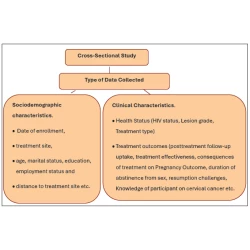
MethodsThis was a cross-sectional study that assessed the clinical outcome of 170 women treated for cervical precancers using ablative and excisional procedures in 2019 and 2020. Demographic and clinical data (treatment and posttreatment follow-up) were abstracted from the program registry. The data was analyzed to assess the clinical outcomes of cervical precancer treatment. The association between each independent variable and the dependent variable was examined in a simple logistic regression. All variables with p < 0.2 in the bivariate logistic regression model were subjected to a multivariable logistic model to get rid of cofounders and obtained adjustable odds ratios. The data was summarized using odds ratios, with p-value < 0.05 considered significant. All statistical analyses were performed using STATA version 17.
ResultsThe cervical precancer treatment effectiveness of 93.55% was disaggregated into 94.37% and 88.23% for ablative and excisional procedures, respectively, with less severe adverse clinical effects. Despite the high awareness of women on the importance and timing of posttreatment follow-up, its uptake was 54.71%. Most of the women who got pregnant after the procedures delivered live and healthy babies. Women who were HIV positive were 89% (0.89 times) [aOR = 0.11, 95%CI (0.01 0.85), p = 0.034] less likely to have effective treatment for cervical precancer when compared to HIV-negative women. Those with low-grade lesions were eight times [aOR = 8.39, 95%CI (1.10 64.06), p = 0.04] more likely to have effective treatment for cervical precancer treatment compared to those with high-grade lesions.
Conclusion and Global Health ImplicationsAblative and excisional treatment procedures for cervical precancer were effective with limited adverse effects in Cameroon. Women living with HIV and those with large lesions experienced lower treatment effectiveness. Most of the women who got pregnant after the procedures delivered live and healthy babies. Posttreatment follow-up which is highly recommended because of recurrent/persistent lesions was barely above average.
Downloads
Most read articles by the same author(s)
- Bestina Forkwa Ewang, Mathias Esum Eyong, Samuel Nambile Cumber, Claude Ngwayu Nkfusai, Brenda Mbouamba Yankam, Cho Sabastine Anye, Jacintha Rebang Achu, Bih Moki Suh, Mildred Njoache Nkeng, Rosette Boseme Nzoyom, Joyce Mahlako Tsoka-Gwegweni, Eric Achidi Akum, Vaccination Coverage Under the Expanded Program on Immunization in South West Cameroon , International Journal of Maternal and Child Health and AIDS: Vol. 9 No. 2 (2020): International Journal of Maternal and Child Health and AIDS
Similar Articles
- Chiluba Kabalika, David Mulenga, Mazyanga Lucy Mazaba, Seter Siziya, Acceptance of Cervical Cancer Screening and its Correlates Among Women of a Peri-Urban High-Density Residential Area in Ndola, Zambia , Vol. 7 No. 1 (2018): International Journal of Maternal and Child Health and AIDS
- Maria Vigil-Mallette, Daryle Pickens, Julliet Ogu, Deepa Dongarwar, Elizabeth Onugha, Hamisu M Salihu, Fifth Annual Summer Research Summit on Health Equity Organized by the Center of Excellence in Health Equity, Training and Research, Baylor College of Medicine, Houston, Texas 77030, USA on May 17, 2022 , Vol. 11 No. S2 (2022): International Journal of Maternal and Child Health and AIDS
- Amol Jamkhande, Bhagyashree P. Agre, Neelam Gavali, Anjali Rajesh Gaikwad, Sanpreet Singh Sachdev, Association Between Maternal Periodontitis and Preterm Low Birth Weight in Indian Populations: A Literature Review , Vol. 15 (2026): International Journal of Maternal and Child Health and AIDS
- Gopal K. Singh, Romuladus E. Azuine, Mohammad Siahpush, Global Inequalities in Cervical Cancer Incidence and Mortality are Linked to Deprivation, Low Socioeconomic Status, and Human Development , Vol. 1 No. 1 (2012): International Journal of Maternal and Child Health and AIDS
- Hamisu M. Salihu, Ronee E. Wilson, Lindsey M. King, Phillip J. Marty, Valerie E. Whiteman, Socio-ecological Model as a Framework for Overcoming Barriers and Challenges in Randomized Control Trials in Minority and Underserved Communities , Vol. 3 No. 1 (2015): International Journal of Maternal and Child Health and AIDS
- Joel M. Njah, Gregory E. Halle-Ekane, Sylvester N. Atanga, Edouard K. Tshimwanga, Felix Desembuin, Pius T. Muffih, From Option B+ to Universal “Test and Treat” in Cameroon: Identification and Evaluation of District-level Factors Associated with Retention in Care , Vol. 12 No. 2 (2023): International Journal of Maternal and Child Health and AIDS
- Ornella Sybile D. Kouanfack, Charles Kouanfack, Serges Clotaire Billong, Samuel N. Cumber, Claude N. Nkfusai, Fala Bede, Emerson Wepngong, Chombong Hubert, Georges Nguefack-Tsague, Madeleine N. Singwe, Epidemiology of Opportunistic Infections in HIV Infected Patients on Treatment in Accredited HIV Treatment Centers in Cameroon , Vol. 8 No. 2 (2019): International Journal of Maternal and Child Health and AIDS
- Romuladus E. Azuine, Sussan E. Ekejiuba, Overcoming Challenges in Conducting Clinical Trials in Minority Populations: Identifying and Testing What Works , Vol. 3 No. 1 (2015): International Journal of Maternal and Child Health and AIDS
- Idowu O Adebara, Damilola Ifarinola, Olumide Adewara, Adebayo Adeniyi, Ayobami O. Oni, Gabriel Alayode, Olusegun Busari, Kolawole Fasakin, A Comparison of Placental Alpha Microglobuliun-1 Rapid Immunoassay and Standard Clinical Method For Diagnosis of Premature Rupture of Membranes , Vol. 8 No. 2 (2019): International Journal of Maternal and Child Health and AIDS
- Emmanuel Numfor, Nkengafac Nyiawung Fobellah, Joel Noutakdie Tochie, Tsi Njim, Sylvester Atanga Ndesso, Oxytocin Versus Misoprostol Plus Oxytocin in the Prevention of Postpartum Hemorrhage at a Semi-Urban Hospital in sub-Saharan Africa: A Retrospective Cohort Study , Vol. 9 No. 3 (2020): International Journal of Maternal and Child Health and AIDS
You may also start an advanced similarity search for this article.
Published
How to Cite
Issue
Section
License
Copyright © 2025 Joseph F. Nkfusai, Simon M. Manga, Kathleen Nulah, Calvin Ngalla, Florence Manjuh, Claude Ngwayu Nkfusai, Tendongfor Nicholas, Halle Ekane Edie Gregory. Published by Global Health and Education Projects, Inc., USA.

This is an open-access article distributed under the terms of the Creative Commons Attribution-NonCommercial-ShareAlike 4.0 International License , which permits others to remix, transform, and build upon the work non-commercially, provided the original author is credited and the new creations are licensed under the same terms.