
From Option B+ to Universal “Test and Treat” in Cameroon: Identification and Evaluation of District-level Factors Associated with Retention in Care
DOI:
https://doi.org/10.21106/ijma.631Keywords:
- PMTCT,
- ANC,
- Option B+,
- Pregnant and Breastfeeding Women Living with HIV,
- Retention,
- sub-Saharan Africa,
- Cameroon
Abstract
Background and Objective: Retaining women in Option B+ services is crucial for eliminating new pediatric HIV infections. However, there are few studies on factors influencing retention at the district level. This study evaluates the factors associated with retention in two health districts of Cameroon.
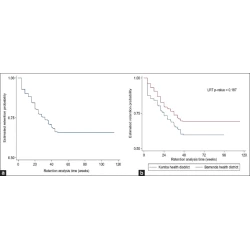
Methods: From September 1, 2015, to February 29, 2016, we reviewed the records of pregnant and breastfeeding women initiating Option B+, a lifelong approach to preventing mother-to-child transmission (PMTCT) of HIV, between October 2013 and July 2014. We abstracted sociodemographic and clinical data from registers in 22 health facilities in the Bamenda urban and Kumba rural districts into spreadsheets. Cox regression age-adjusted survival curves were used to compare retention probabilities at 6 and 12 months post-antiretroviral therapy (ART) initiation. Multivariable modified Poisson regressions were run to estimate adjusted relative risk (aRR) of factors associated with retention in PMTCT care at 12 months post-ART initiation. STATA software was used for the analyses.
Results: Of the 560 files reviewed, majority, 62.7% (n=351), were above 24 years of age and married, 68.9% (n=386). From the multivariable analysis, enrolling early in antenatal care (ANC) (aRR: 1.50, 95% CI: 1.17- 1.93) and knowing the male partner’s HIV-negative status (aRR: 1.16, 95% CI: 1.00-1.34) were significantly associated with higher retention in care, adjusting for maternal age, marital status, and distance from the health facility. By health district, knowing the male partner’s HIV-negative status (aRR: 1.30, 95% CI: 1.13-1.50) in the Bamenda urban and enrolling early in ANC (aRR: 2.03, 95% CI: 1.21-3.41) in the Kumba rural district, had significantly higher retention rates after adjusting for the same covariates.
Conclusion and Global Health Implications: Overall, factors influencing retention varied by urban or rural district. Therefore, tailored district-level interventions are needed to enhance early ANC enrollment in the rural and partner HIV status disclosure in the urban districts to improve retention in PMTCT care.
Downloads
Similar Articles
- Alireza Ghannad Sabzevari, Mohsen Nikbakht, Considerations about Reducing False-Negative PCR Test for COVID-19 , Vol. 11 No. 2 (2022): International Journal of Maternal and Child Health and AIDS
- Roneé E. Wilson, Renice Obure, Precious Omokaro Omokaro, Hamisu M. Salihu, Estrellita “Lo” Berry, Deborah A. Austin A. Austin, Jennifer G. Christner, Effectiveness of a 24/7 Dad® Curriculum in Improving Father Involvement: Profiles of Engagement , Vol. 9 No. 1 (2020): International Journal of Maternal and Child Health and AIDS
- Stella Yu, Sue Lin, Bonnie Strickland, Disparities in Health Care Quality Indicators among US Children with Special Health Care Needs According to Household Language Use , Vol. 4 No. 1 (2015): International Journal of Maternal and Child Health and AIDS
- Varun Alwadhi, Naresh Chandra Joshi, Prashant Kumar Saboth, Raghavendra Narayan Mishra, Kuldeep Martolia, Saurabh Bhargava, Sachin Gupta, Harish Kumar, Management of Newborn Respiratory Distress Using CPAP: Capacity and Readiness of Public Health Facilities in High-Focus Aspirational Districts of India , Vol. 14 No. Continuous (2025): International Journal of Maternal and Child Health and AIDS
- Carl Dowling, Factors Affecting Paramedic Personnel in the Assessment and Management of Emergency Pediatric Patients within the Prehospital Settings in the United Kingdom , Vol. 12 No. 1 (2023): International Journal of Maternal and Child Health and AIDS
- Wael Hafez, Sana Osman, Muneir Gador, Muhammad Aslam, Correlation Between Plasma Vitamin C Concentration and COVID-19 Outcomes among Patients Seen at a Major Hospital in the United Arab Emirates , Vol. 11 No. 2 (2022): International Journal of Maternal and Child Health and AIDS
- Hamisu M. Salihu, Abraham A. Salinas-Miranda, Lindsey M. King, Deepa Dongarwar, Korede K. Yusuf, Sahra Ibrahimi, Chioma A. Ike dionwu, Estrellita Lo Berry, Racism, Psycho-Social Stress, and Health-related Quality of Life , Vol. 9 No. 1 (2020): International Journal of Maternal and Child Health and AIDS
- Deepa Dongarwar, Anjali Aggarwal, Kenneth Barning, Hamisu Mohammed Salihu, Trends in Stillbirths and Stillbirth Phenotypes in the United States: An Analysis of 131.5 Million Births , Vol. 9 No. 1 (2020): International Journal of Maternal and Child Health and AIDS
- Deepa Dongarwar, Hamisu M. Salihu, COVID-19 Pandemic: Marked Global Disparities in Fatalities According to Geographic Location and Universal Health Care , Vol. 9 No. 2 (2020): International Journal of Maternal and Child Health and AIDS
- Isaac Omo-Ehiabhi Eranga, COVID-19 Pandemic in Nigeria: Palliative Measures and the Politics of Vulnerability , Vol. 9 No. 2 (2020): International Journal of Maternal and Child Health and AIDS
<< < 24 25 26 27 28 29 30 > >>
You may also start an advanced similarity search for this article.
Published
How to Cite
Issue
Section
License
Copyright © 2023 Joel M. Njah, Gregory E. Halle-Ekane, Sylvester N. Atanga, Edouard K. Tshimwanga, Felix Desembuin, Pius T. Muffih. Published by Global Health and Education Projects, Inc., USA.

This is an open-access article distributed under the terms of the Creative Commons Attribution-NonCommercial-ShareAlike 4.0 International License , which permits others to remix, transform, and build upon the work non-commercially, provided the original author is credited and the new creations are licensed under the same terms.