
From Option B+ to Universal “Test and Treat” in Cameroon: Identification and Evaluation of District-level Factors Associated with Retention in Care
DOI:
https://doi.org/10.21106/ijma.631Keywords:
- PMTCT,
- ANC,
- Option B+,
- Pregnant and Breastfeeding Women Living with HIV,
- Retention,
- sub-Saharan Africa,
- Cameroon
Abstract
Background and Objective: Retaining women in Option B+ services is crucial for eliminating new pediatric HIV infections. However, there are few studies on factors influencing retention at the district level. This study evaluates the factors associated with retention in two health districts of Cameroon.
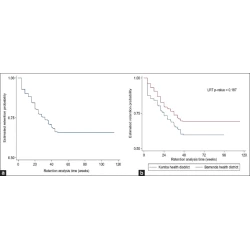
Methods: From September 1, 2015, to February 29, 2016, we reviewed the records of pregnant and breastfeeding women initiating Option B+, a lifelong approach to preventing mother-to-child transmission (PMTCT) of HIV, between October 2013 and July 2014. We abstracted sociodemographic and clinical data from registers in 22 health facilities in the Bamenda urban and Kumba rural districts into spreadsheets. Cox regression age-adjusted survival curves were used to compare retention probabilities at 6 and 12 months post-antiretroviral therapy (ART) initiation. Multivariable modified Poisson regressions were run to estimate adjusted relative risk (aRR) of factors associated with retention in PMTCT care at 12 months post-ART initiation. STATA software was used for the analyses.
Results: Of the 560 files reviewed, majority, 62.7% (n=351), were above 24 years of age and married, 68.9% (n=386). From the multivariable analysis, enrolling early in antenatal care (ANC) (aRR: 1.50, 95% CI: 1.17- 1.93) and knowing the male partner’s HIV-negative status (aRR: 1.16, 95% CI: 1.00-1.34) were significantly associated with higher retention in care, adjusting for maternal age, marital status, and distance from the health facility. By health district, knowing the male partner’s HIV-negative status (aRR: 1.30, 95% CI: 1.13-1.50) in the Bamenda urban and enrolling early in ANC (aRR: 2.03, 95% CI: 1.21-3.41) in the Kumba rural district, had significantly higher retention rates after adjusting for the same covariates.
Conclusion and Global Health Implications: Overall, factors influencing retention varied by urban or rural district. Therefore, tailored district-level interventions are needed to enhance early ANC enrollment in the rural and partner HIV status disclosure in the urban districts to improve retention in PMTCT care.
Downloads
Similar Articles
- Muhammad Adamu Abbas, Aisha A Abdullahi, Hassan A Murtala, Abubakar L Yusuf, Rahila A Mukhtar, Hamisu M Salihu, New Paradigm for Battling Hospital-Acquired Infections in Developing Countries , Vol. 14 No. Continuous (2025): International Journal of Maternal and Child Health and AIDS
- Mamour Gueye, Mame Diarra Ndiaye-Gueye, Serigne Modou Kane Gueye, Jean Charles Moreau, Fatal Cases of Gestational Trophoblastic Neoplasia in a National Trophoblastic Disease Reference Center in Dakar Senegal , Vol. 5 No. 1 (2016): International Journal of Maternal and Child Health and AIDS
- Ranbir S Balgir, Population and Public Health Implications of Child Health and Reproductive Outcomes Among Carrier Couples of Sickle Cell Disorders in Madhya Pradesh, Central India , Vol. 2 No. 2 (2014): International Journal of Maternal and Child Health and AIDS
- Gopal K. Singh, Hyunjung Lee, Lyoung Hee Kim, Shanita D. Williams, Social Determinants of Health Among American Indians and Alaska Natives and Tribal Communities: Comparison with Other Major Racial and Ethnic Groups in the United States, 1990–2022 , Vol. 13 No. Continuous (2024): International Journal of Maternal and Child Health and AIDS
- Alice Rosmini, Kidza Mugerwa, Awatta Walter Ochan, Sarah Muwanguzi, Jemelia Sake, Richard Mwesigwa, Okpwoku Sukere, Catrin Schulte-Hillen, Nguyen Toan Tran, Empowering Midwives in Humanitarian Settings: Integrating Heat-Stable Carbetocin and Tranexamic Acid into Postpartum Hemorrhage Training , Vol. 13 No. S1 (2024): International Journal of Maternal and Child Health and AIDS
- Fatimah Isma’il Tsiga-Ahmed, Taiwo Gboluwaga Amole, Baba Maiyaki Musa, Aishatu Muhammad Nalado, Omeiza Baba Agoyi, Hadiza Shehu Galadanci, Hamisu M. Salihu, COVID 19: Evaluating the Knowledge, Attitude and Preventive Practices of Healthcare Workers in Northern Nigeria , Vol. 10 No. 1 (2021): International Journal of Maternal and Child Health and AIDS
- Hamisu M. Salihu, Amina A. Umar, Romuladus E. Azuine, Special Collection: Implementation Research Evidence for Prevention and Treatment of Postpartum Hemorrhage in High-Burden Low- and Middle-Income Countries , Vol. 13 No. S1 (2024): International Journal of Maternal and Child Health and AIDS
- Sara Rushwan, Tesfaye Tufa, Metin Gülmezoglu, Feasibility, Acceptability, and Appropriate Use of Novel and Lesser-Used Medicines for Prevention and Treatment of Postpartum Hemorrhage: Evidence from Implementation Research , Vol. 13 No. S1 (2024): International Journal of Maternal and Child Health and AIDS
- Sybil S. Opoku Asiedu, Nana Abena Ansah Apatu, Rosemond Tetteh, Abraham Hodgson, Neonatal Cord Care Practices among Mothers and Caregivers in the Volta Region of Ghana , Vol. 8 No. 1 (2019): International Journal of Maternal and Child Health and AIDS
- Kamukwamba Mwale, Seter Siziya, Intestinal Infestations in Under-Five Children in Zambia , Vol. 4 No. 2 (2015): International Journal of Maternal and Child Health and AIDS
<< < 20 21 22 23 24 25 26 27 28 29 > >>
You may also start an advanced similarity search for this article.
Published
How to Cite
Issue
Section
License
Copyright © 2023 Joel M. Njah, Gregory E. Halle-Ekane, Sylvester N. Atanga, Edouard K. Tshimwanga, Felix Desembuin, Pius T. Muffih. Published by Global Health and Education Projects, Inc., USA.

This is an open-access article distributed under the terms of the Creative Commons Attribution-NonCommercial-ShareAlike 4.0 International License , which permits others to remix, transform, and build upon the work non-commercially, provided the original author is credited and the new creations are licensed under the same terms.