
From Option B+ to Universal “Test and Treat” in Cameroon: Identification and Evaluation of District-level Factors Associated with Retention in Care
DOI:
https://doi.org/10.21106/ijma.631Keywords:
- PMTCT,
- ANC,
- Option B+,
- Pregnant and Breastfeeding Women Living with HIV,
- Retention,
- sub-Saharan Africa,
- Cameroon
Abstract
Background and Objective: Retaining women in Option B+ services is crucial for eliminating new pediatric HIV infections. However, there are few studies on factors influencing retention at the district level. This study evaluates the factors associated with retention in two health districts of Cameroon.
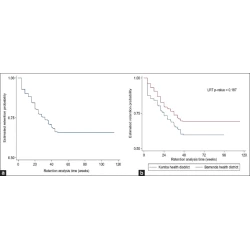
Methods: From September 1, 2015, to February 29, 2016, we reviewed the records of pregnant and breastfeeding women initiating Option B+, a lifelong approach to preventing mother-to-child transmission (PMTCT) of HIV, between October 2013 and July 2014. We abstracted sociodemographic and clinical data from registers in 22 health facilities in the Bamenda urban and Kumba rural districts into spreadsheets. Cox regression age-adjusted survival curves were used to compare retention probabilities at 6 and 12 months post-antiretroviral therapy (ART) initiation. Multivariable modified Poisson regressions were run to estimate adjusted relative risk (aRR) of factors associated with retention in PMTCT care at 12 months post-ART initiation. STATA software was used for the analyses.
Results: Of the 560 files reviewed, majority, 62.7% (n=351), were above 24 years of age and married, 68.9% (n=386). From the multivariable analysis, enrolling early in antenatal care (ANC) (aRR: 1.50, 95% CI: 1.17- 1.93) and knowing the male partner’s HIV-negative status (aRR: 1.16, 95% CI: 1.00-1.34) were significantly associated with higher retention in care, adjusting for maternal age, marital status, and distance from the health facility. By health district, knowing the male partner’s HIV-negative status (aRR: 1.30, 95% CI: 1.13-1.50) in the Bamenda urban and enrolling early in ANC (aRR: 2.03, 95% CI: 1.21-3.41) in the Kumba rural district, had significantly higher retention rates after adjusting for the same covariates.
Conclusion and Global Health Implications: Overall, factors influencing retention varied by urban or rural district. Therefore, tailored district-level interventions are needed to enhance early ANC enrollment in the rural and partner HIV status disclosure in the urban districts to improve retention in PMTCT care.
Downloads
Similar Articles
- Mary Jane Rotheram-Borus, Mark Tomlinson, Utilizing Principles of Private Enterprise to Improve Maternal and Child Health Programs , Vol. 9 No. 2 (2020): International Journal of Maternal and Child Health and AIDS
- Vaishali Alwadhi, Archana Mishra, Anil Nagendra, Devina Bajpayee, Naresh Chandra Joshi, Sachin Gupta, Harish Kumar, Introduction of Heat-Stable Carbetocin through a Public-Private Partnership Model in India: A Retrospective Study to Determine Feasibility and Its Optimal Use in Public Health Settings , Vol. 13 No. S1 (2024): International Journal of Maternal and Child Health and AIDS
- Nidhi Fotedar, Nugehally Raju Ramesh Masthi, Burden of Fetal Anomalies among Antenatal Mothers Attending a Public Referral Hospital: A Mixed Cohort Study , Vol. 14 No. Continuous (2025): International Journal of Maternal and Child Health and AIDS
- Romuladus E. Azuine, Sussan E. Ekejiuba, Overcoming Challenges in Conducting Clinical Trials in Minority Populations: Identifying and Testing What Works , Vol. 3 No. 1 (2015): International Journal of Maternal and Child Health and AIDS
- Arshiya Khan, Adarshlata Singh, Sugat Ambadas Jawade, Yash Kashikar, Extensive Intertrigo and Irritant Contact Dermatitis of Groins in Pregnant Female Due to Overuse of Feminine Hygiene Products , Vol. 13 No. Continuous (2024): International Journal of Maternal and Child Health and AIDS
- Liye Wang, Deepa Dongarwar, Hamisu M. Salihu, Temporal Trends in the Rates of Singletons, Twins and Higher-order Multiple Births Over Five Decades Across Racial Groups in the United States , Vol. 9 No. 3 (2020): International Journal of Maternal and Child Health and AIDS
- Gopal K. Singh, Isaac E. Kim, Mehrete Girmay, Chrisp Perry, Gem P. Daus, Ivy P. Vedamuthu, Andrew A. De Los Reyes, Christine T. Ramey, Elijah K. Martin, Michelle Allender, Opioid Epidemic in the United States: Empirical Trends, and A Literature Review of Social Determinants and Epidemiological, Pain Management, and Treatment Patterns , Vol. 8 No. 2 (2019): International Journal of Maternal and Child Health and AIDS
- Mamour Gueye, Mame D. Ndiaye-Gueye, Serigne M. Kane-Gueye, Omar Gassama, Moussa Diallo, Jean C. Moreau, Diagnosis, Treatment and Outcome of Gestational Trophoblastic Neoplasia in a Low Resource Income Country , Vol. 5 No. 2 (2016): International Journal of Maternal and Child Health and AIDS
- Olayinka A. Onasoga, Joel Adeleke Afolayan, Tariebi Florence Asamabiriowei, Umar Nda Jibril, Abubakar Ayinla Imam, Adolescents’ Knowledge, Attitude and Utilization of Emergency Contraceptive Pills in Nigeria’s Niger Delta Region , Vol. 5 No. 1 (2016): International Journal of Maternal and Child Health and AIDS
- María Isabel Roldós, Phaedra Corso, Justin Ingels, How much are Ecuadorians Willing to Pay to Reduce Maternal Mortality? Results from a Pilot Study on Contingent Valuation , Vol. 6 No. 1 (2017): International Journal of Maternal and Child Health and AIDS
<< < 19 20 21 22 23 24 25 26 27 28 > >>
You may also start an advanced similarity search for this article.
Published
How to Cite
Issue
Section
License
Copyright © 2023 Joel M. Njah, Gregory E. Halle-Ekane, Sylvester N. Atanga, Edouard K. Tshimwanga, Felix Desembuin, Pius T. Muffih. Published by Global Health and Education Projects, Inc., USA.

This is an open-access article distributed under the terms of the Creative Commons Attribution-NonCommercial-ShareAlike 4.0 International License , which permits others to remix, transform, and build upon the work non-commercially, provided the original author is credited and the new creations are licensed under the same terms.