
Women’s Empowerment and HIV Testing Uptake: A Meta-analysis of Demographic and Health Surveys from 33 Sub-Saharan African Countries
DOI:
https://doi.org/10.21106/ijma.372Keywords:
- HIV/AIDS prevention,
- Women,
- Empowerment,
- Gender equality,
- Global health,
- Sub-Saharan Africa
Abstract
Background: There is a growing body of evidence suggesting that women’s empowerment can help achieve better health behaviours and outcomes. However, few have looked at the impact of women’s empowerment on HIV testing in Sub-Saharan Africa (SSA). This study investigated the association between women’s empowerment and HIV testing among women in 33 countries across SSA.
Methods: Cross-sectional data from the most recent Demographic and Health Surveys (2005-2018) of 33 countries in SSA were used. Confounder adjusted logistic regression analysis was completed separately for each of the 33 DHS datasets to produce the adjusted Odds Ratio (OR) for the association between women empowerment and HIV testing. The regression analysis strictly accounted for the three design elements (weight, cluster and strata) to produce an estimate representative of the respective countries. Finally, an Individual Participant Data (IPD) meta-analysis approach was used to statistically pool the effect of women empowerment on HIV testing.
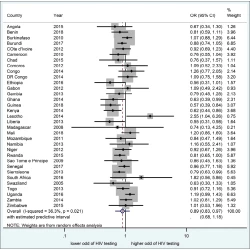
Results: There was a wide variation in the percentage of women who were empowered among the countries studied, with only a few countries such as South Africa, Angola and Ghana having a high prevalence of negative attitudes toward wife beating. HIV testing was higher in Angola, Lesotho, Uganda and South Africa. While participation in one or two of the three decisions had been marginally associated with lower odds of HIV testing across the SSA regions (0.89; 95%CI: 0.83, 0.97); the corresponding prediction interval crossed the null. Being involved in the three decisions (0.92; 95%CI: 0.84, 1.00) and disagreement to wife-beating (0.99; 95%CI: 0.94, 1.05) had no statistical relationship with HIV testing uptake.
Conclusion and Global Health Implications: The two indirect indicators of women empowerment could not predict HIV testing uptake. Further studies are recommended to establish the nature of the relationship between HIV testing and women’s empowerment that is measured through standard tools.
Downloads
Similar Articles
- Fulufhedzani C. Malindi, Maria S. Maputle, Involvement of Male Partners in Sustaining Interventions for Preventing Mother-to-Child Transmission of HIV Among Women with HIV , Vol. 13 No. Continuous (2024): International Journal of Maternal and Child Health and AIDS
- Linda Aurpibul, Fuanglada Tongprasert, Uraiwan Wichasilp, Arunrat Tangmunkongvorakul, Depressive Symptoms Associated with Low Quality of Life Among Pregnant and Postpartum Women Living with HIV in Chiang Mai, Thailand , Vol. 9 No. 3 (2020): International Journal of Maternal and Child Health and AIDS
- Andrew Walubo, Refuoe Baleni, Hillary Mukudu, Henry Kambafwile, Mukesh Dheda, Thanduxolo Thengwa, Tshepang Jiane, Clinical Characteristics of Children with HIV Initiated on Antiretroviral Treatment at HIV Clinics in Bloemfontein, South Africa , Vol. 10 No. 1 (2021): International Journal of Maternal and Child Health and AIDS
- Oluwasola Stephen Ayosanmi, Lorette Oden, Titilope Ayosanmi, Babatunde Y. Alli, Mei Wen Wen, Jamie Johnson, Acceptability of HIV Screening in a Sample of International Students in the United States , Vol. 9 No. 3 (2020): International Journal of Maternal and Child Health and AIDS
- Olawunmi R. Rabiu, Hannah Dada-Adegbola, Catherine O. Falade, Olatunbosun G. Arinola, Alexander B. Odaibo, Olusegun G. Ademowo, Malaria, Helminth Infections and Clinical Status Among HIV-Infected Pregnant Women , Vol. 10 No. 1 (2021): International Journal of Maternal and Child Health and AIDS
- Presley Chick Tayong, Herbert Afegenwi Mbunkah, Raphael Awah Abong, Sumelong Sharon Dione Akomoneh, Raoul Tuekam Kayo, Elvis Achondou Akomoneh, Incidence of Mother-to-Child Transmission of HIV and Associated Factors in Postpartum Women in Cameroon , Vol. 14 No. Continuous (2025): International Journal of Maternal and Child Health and AIDS
- Rafeek A. Yusuf, Deepa Dongarwar, Zenab I. Yusuf, Hamisu M. Salihu, Association between Intimate Partner Violence, Knowledge and Use of Contraception in Africa: Comparative Analysis across Five African Regions , Vol. 9 No. 1 (2020): International Journal of Maternal and Child Health and AIDS
- Ebenezer Ahenkan, Anastasia Asare-Bediako, Kingsley Adeoye Damilare, David Antwi-Agyei, Paul Atawuchugi, Frederick Osei-Owusu, Sarah Konadu Agyemang, Gifty Konadu, Richard Agyemang Opoku, Kofi Oduro Yeboah, Oumou Maiga-Ascofare, Eric Boakye-Gyasi, Newman Osafo, Prevalence and Predictors of Mother-to-Child Transmission of Human Immunodeficiency Virus (HIV) among HIV-exposed Infants , Vol. 14 No. Continuous (2025): International Journal of Maternal and Child Health and AIDS
- Constantin Tchakounté, Céline N. Nkenfou, Thibau F. Tchouangueu, Nicole M. Ngoufack, Salomon B. Tchuandom, Olivier D. Ngono, Jules-Rogers Kuiate, Alexis Ndjolo, HIV Serodiscordance among Couples in Cameroon: Effects on Sexual and Reproductive Health , Vol. 9 No. 3 (2020): International Journal of Maternal and Child Health and AIDS
- Jaleah D. Rutledge, Alexis Kiyanda, Christina Jean-Louis, Elizabeth Raskin, Joanne Gaillard, Morgan Maxwell, Tynetta Smith, Trace Kershaw, Jasmine Abrams, Recommendations for Integrating Traditional Birth Attendants to Improve Maternal Health Outcomes in Low- and Middle-Income Countries , Vol. 13 No. Continuous (2024): International Journal of Maternal and Child Health and AIDS
<< < 3 4 5 6 7 8 9 10 11 12 > >>
You may also start an advanced similarity search for this article.
Published
How to Cite
Issue
Section
License
Copyright © 2020 Sanni Yaya, Gebretsadik Shibre, Dina Idriss-Wheeler, Olalekan A Uthman. Published by Global Health and Education Projects, Inc., USA.

This is an open-access article distributed under the terms of the Creative Commons Attribution-NonCommercial-ShareAlike 4.0 International License , which permits others to remix, transform, and build upon the work non-commercially, provided the original author is credited and the new creations are licensed under the same terms.