
Women’s Empowerment and HIV Testing Uptake: A Meta-analysis of Demographic and Health Surveys from 33 Sub-Saharan African Countries
DOI:
https://doi.org/10.21106/ijma.372Keywords:
- HIV/AIDS prevention,
- Women,
- Empowerment,
- Gender equality,
- Global health,
- Sub-Saharan Africa
Abstract
Background: There is a growing body of evidence suggesting that women’s empowerment can help achieve better health behaviours and outcomes. However, few have looked at the impact of women’s empowerment on HIV testing in Sub-Saharan Africa (SSA). This study investigated the association between women’s empowerment and HIV testing among women in 33 countries across SSA.
Methods: Cross-sectional data from the most recent Demographic and Health Surveys (2005-2018) of 33 countries in SSA were used. Confounder adjusted logistic regression analysis was completed separately for each of the 33 DHS datasets to produce the adjusted Odds Ratio (OR) for the association between women empowerment and HIV testing. The regression analysis strictly accounted for the three design elements (weight, cluster and strata) to produce an estimate representative of the respective countries. Finally, an Individual Participant Data (IPD) meta-analysis approach was used to statistically pool the effect of women empowerment on HIV testing.
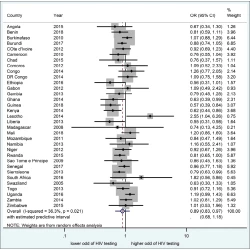
Results: There was a wide variation in the percentage of women who were empowered among the countries studied, with only a few countries such as South Africa, Angola and Ghana having a high prevalence of negative attitudes toward wife beating. HIV testing was higher in Angola, Lesotho, Uganda and South Africa. While participation in one or two of the three decisions had been marginally associated with lower odds of HIV testing across the SSA regions (0.89; 95%CI: 0.83, 0.97); the corresponding prediction interval crossed the null. Being involved in the three decisions (0.92; 95%CI: 0.84, 1.00) and disagreement to wife-beating (0.99; 95%CI: 0.94, 1.05) had no statistical relationship with HIV testing uptake.
Conclusion and Global Health Implications: The two indirect indicators of women empowerment could not predict HIV testing uptake. Further studies are recommended to establish the nature of the relationship between HIV testing and women’s empowerment that is measured through standard tools.
Downloads
Similar Articles
- Ekere James Essien, Osaro Mgbere, Sorochi Iloanusi, Susan M. Abughosh, COVID-19 Infection among People with HIV/AIDS in Africa: Knowledge Gaps, Public Health Preparedness and Research Priorities , Vol. 10 No. 1 (2021): International Journal of Maternal and Child Health and AIDS
- Zubairu Iliyasu, Fatimah Hassan-Hanga, Sadiq Isah Ajuji, Musa M. Bello, Safiyya S. Abdulkadir, Nafisa S. Nass, Hamisu M. Salihu, Muktar H. Aliyu, Correlates of Health Care Workers’ Knowledge and HIV-Exposed Infant Immunization Counseling Practice in Northern Nigeria , Vol. 10 No. 1 (2021): International Journal of Maternal and Child Health and AIDS
- Akosua A. Gyimah, Emmanuel K. Nakua, Ellis Owusu-Dabo, Easmon Otupiri, Contraceptive Characteristics of Women Living with HIV in the Kumasi Metropolis, Ghana , Vol. 2 No. 1 (2013): International Journal of Maternal and Child Health and AIDS
- Michelle Berlacher, Timothy Mercer, Edith O. Apondi, Winfred Mwangi, Edwin Were, Megan S. McHenry, Integrating Prevention of Mother-to-Child Transmission of HIV Care into General Maternal Child Health Care in Western Kenya , Vol. 10 No. 1 (2021): International Journal of Maternal and Child Health and AIDS
- Margaret Omowaleola Akinwaare, Funmilayo A. Okanlawon, Monisola A. Popoola, Omotayo O. Adetunji, Birth Preparedness Plans and Status Disclosure Among Pregnant Women Living with HIV Who are Receiving Antiretroviral Therapy in Ibadan, Southwest, Nigeria , Vol. 12 No. 1 (2023): International Journal of Maternal and Child Health and AIDS
- Karen M. Hampanda, Lisa L. Abuogi, Yusuf Ahmed, HIV-Positive Women Taking Lifelong Antiretroviral Therapy Report Better Adherence Than Women Taking Short-Course Prophylaxis During and After Pregnancy Under PMTCT Program Option A in Lusaka, Zambia , Vol. 6 No. 1 (2017): International Journal of Maternal and Child Health and AIDS
- Isabel Hernandez, Vinita Sharma, Miguel Reina-Ortiz, Carlos Rosas, Tatiana Ochoa, Ricardo Izurieta, Enrique Teran, HIV/AIDS-related Knowledge and Behavior among School-attending Afro-Descendant Youths in Ecuador , Vol. 9 No. 3 (2020): International Journal of Maternal and Child Health and AIDS
- San Hone, Li Li, W. Scott Comulada, Roger Detels, Progress and Challenges of Implementing Decentralized HIV Testing For Prevention of Mother-to-Child Transmission of HIV – Myanmar , Vol. 8 No. 1 (2019): International Journal of Maternal and Child Health and AIDS
- Amina Abdullahi, Hassan Adam Murtala, Aisha Adam Abdullahi, Amina Aminu, Muktar H. Aliyu, Sani H. Aliyu, Ololade D. Adeyemi, Deepa Dongarwar, Jordi B. Torrelles, Gambo Aliyu, Hamisu M. Salihu, Drivers of Human Immunodeficiency Virus among Pregnant Women in Conflict and Non-conflict Zones of Nigeria , Vol. 14 No. Continuous (2025): International Journal of Maternal and Child Health and AIDS
- Vatsla Dadhwal, Aparna Sharma, Kavita Khoiwal, Dipika Deka, Plaboni Sarkar, P. Vanamail, Pregnancy Outcomes in HIV-Infected Women: Experience from a Tertiary Care Center in India , Vol. 6 No. 1 (2017): International Journal of Maternal and Child Health and AIDS
<< < 1 2 3 4 5 6 7 8 9 10 > >>
You may also start an advanced similarity search for this article.
Published
How to Cite
Issue
Section
License
Copyright © 2020 Sanni Yaya, Gebretsadik Shibre, Dina Idriss-Wheeler, Olalekan A Uthman. Published by Global Health and Education Projects, Inc., USA.

This is an open-access article distributed under the terms of the Creative Commons Attribution-NonCommercial-ShareAlike 4.0 International License , which permits others to remix, transform, and build upon the work non-commercially, provided the original author is credited and the new creations are licensed under the same terms.