
Women’s Empowerment and HIV Testing Uptake: A Meta-analysis of Demographic and Health Surveys from 33 Sub-Saharan African Countries
DOI:
https://doi.org/10.21106/ijma.372Keywords:
- HIV/AIDS prevention,
- Women,
- Empowerment,
- Gender equality,
- Global health,
- Sub-Saharan Africa
Abstract
Background: There is a growing body of evidence suggesting that women’s empowerment can help achieve better health behaviours and outcomes. However, few have looked at the impact of women’s empowerment on HIV testing in Sub-Saharan Africa (SSA). This study investigated the association between women’s empowerment and HIV testing among women in 33 countries across SSA.
Methods: Cross-sectional data from the most recent Demographic and Health Surveys (2005-2018) of 33 countries in SSA were used. Confounder adjusted logistic regression analysis was completed separately for each of the 33 DHS datasets to produce the adjusted Odds Ratio (OR) for the association between women empowerment and HIV testing. The regression analysis strictly accounted for the three design elements (weight, cluster and strata) to produce an estimate representative of the respective countries. Finally, an Individual Participant Data (IPD) meta-analysis approach was used to statistically pool the effect of women empowerment on HIV testing.
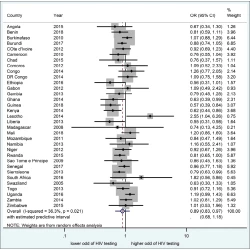
Results: There was a wide variation in the percentage of women who were empowered among the countries studied, with only a few countries such as South Africa, Angola and Ghana having a high prevalence of negative attitudes toward wife beating. HIV testing was higher in Angola, Lesotho, Uganda and South Africa. While participation in one or two of the three decisions had been marginally associated with lower odds of HIV testing across the SSA regions (0.89; 95%CI: 0.83, 0.97); the corresponding prediction interval crossed the null. Being involved in the three decisions (0.92; 95%CI: 0.84, 1.00) and disagreement to wife-beating (0.99; 95%CI: 0.94, 1.05) had no statistical relationship with HIV testing uptake.
Conclusion and Global Health Implications: The two indirect indicators of women empowerment could not predict HIV testing uptake. Further studies are recommended to establish the nature of the relationship between HIV testing and women’s empowerment that is measured through standard tools.
Downloads
Similar Articles
- Ikenna J. Nwakamma, Amber Erinmwinhe, Arinzechukwu Ajogwu, Aniekan Udoh, Anne Ada-Ogoh, Mitigating Gender and Maternal and Child Health Injustices through Faith Community-Led Initiatives , Vol. 8 No. 2 (2019): International Journal of Maternal and Child Health and AIDS
- Ebelechuku F. Ugochukwu, Chinyere U. Onubogu, Emeka S. Edokwe, Uchenna Ekwochi, Kenneth N. Okeke, Esther N. Umeadi, Stanley K. Onah, A Review and Analysis of Outcomes from Prevention of Mother-toChild Transmission of HIV Infant Follow-up Services at a Pediatric Infectious Diseases Unit of a Major Tertiary Hospital in Nigeria: 2007-2020 , Vol. 10 No. 2 (2021): International Journal of Maternal and Child Health and AIDS
- Comfort Z. Olorunsaiye, Larissa R. Brunner Huber, Samira P. Ouedraogo, Interbirth Intervals of Immigrant and Refugee Women in the United States: A Cross-Sectional Study , Vol. 12 No. 1 (2023): International Journal of Maternal and Child Health and AIDS
- Gopal K. Singh, Jihong Liu, Health Improvements Have Been More Rapid and Widespread in China than in India: A Comparative Analysis of Health and Socioeconomic Trends from 1960 to 2011 , Vol. 1 No. 1 (2012): International Journal of Maternal and Child Health and AIDS
- Ahmed Zohirul Islam, Nazrul Islam Mondal, Laily Khatun, Mosiur Rahman, Rafiqul Islam, Golam Mostofa, Nazrul Hoque, Prevalence and Determinants of Contraceptive use among Employed and Unemployed Women in Bangladesh , Vol. 5 No. 2 (2016): International Journal of Maternal and Child Health and AIDS
- Issaka Saouadogo, Douglas Mbang Massom, Soutongnoma Safiata Kabore, Ronny Kevin Fomete Djatsa, Josiane Seu, Patrice Ngangue, Perceived Benefits and Disadvantages Associated with the Use of the Electronic Consultation Register by Health Providers in the Health District of Toma, Burkina Faso , Vol. 13 No. Continuous (2024): International Journal of Maternal and Child Health and AIDS
- Prakash R Ganesh, Rachel Mernoff, Renske Dikkers, William Nundwe, Rachel Pope, A Comparison of Postoperative Surgical Outcomes among Women Undergoing Obstetric Fistula Repair with and without HIV , Vol. 10 No. 2 (2021): International Journal of Maternal and Child Health and AIDS
- Phillips Edomwonyi Obasohan, Religion, Ethnicity and Contraceptive Use among Reproductive age Women in Nigeria , Vol. 3 No. 1 (2015): International Journal of Maternal and Child Health and AIDS
- Fekadu Mazengia Alemu, Alemayehu Worku Yalew, Mesganaw Fantahun, Eta Ebasi Ashu, Antiretroviral Therapy and Pregnancy Outcomes in Developing Countries: A Systematic Review , Vol. 3 No. 1 (2015): International Journal of Maternal and Child Health and AIDS
- Barbara Burmen, Gregory Kurtzman, Anthony A Olashore, Leyla Baghirova Busang, Ohemaa Poku, Phenyo Morakanyane, Ontibile Tshume, Onkemetse Phoi, Mogomotsi Matshaba, Elizabeth D Lowenthal, Knashawn H Morales, Merrian J Brooks, HIV Virologic Suppression and Mental Well-being in Adolescents and Young Adults Living with HIV , Vol. 14 No. Continuous (2025): International Journal of Maternal and Child Health and AIDS
<< < 4 5 6 7 8 9 10 11 12 13 > >>
You may also start an advanced similarity search for this article.
Published
How to Cite
Issue
Section
License
Copyright © 2020 Sanni Yaya, Gebretsadik Shibre, Dina Idriss-Wheeler, Olalekan A Uthman. Published by Global Health and Education Projects, Inc., USA.

This is an open-access article distributed under the terms of the Creative Commons Attribution-NonCommercial-ShareAlike 4.0 International License , which permits others to remix, transform, and build upon the work non-commercially, provided the original author is credited and the new creations are licensed under the same terms.