
Women’s Empowerment and HIV Testing Uptake: A Meta-analysis of Demographic and Health Surveys from 33 Sub-Saharan African Countries
DOI:
https://doi.org/10.21106/ijma.372Keywords:
- HIV/AIDS prevention,
- Women,
- Empowerment,
- Gender equality,
- Global health,
- Sub-Saharan Africa
Abstract
Background: There is a growing body of evidence suggesting that women’s empowerment can help achieve better health behaviours and outcomes. However, few have looked at the impact of women’s empowerment on HIV testing in Sub-Saharan Africa (SSA). This study investigated the association between women’s empowerment and HIV testing among women in 33 countries across SSA.
Methods: Cross-sectional data from the most recent Demographic and Health Surveys (2005-2018) of 33 countries in SSA were used. Confounder adjusted logistic regression analysis was completed separately for each of the 33 DHS datasets to produce the adjusted Odds Ratio (OR) for the association between women empowerment and HIV testing. The regression analysis strictly accounted for the three design elements (weight, cluster and strata) to produce an estimate representative of the respective countries. Finally, an Individual Participant Data (IPD) meta-analysis approach was used to statistically pool the effect of women empowerment on HIV testing.
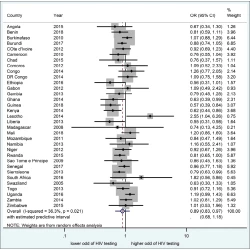
Results: There was a wide variation in the percentage of women who were empowered among the countries studied, with only a few countries such as South Africa, Angola and Ghana having a high prevalence of negative attitudes toward wife beating. HIV testing was higher in Angola, Lesotho, Uganda and South Africa. While participation in one or two of the three decisions had been marginally associated with lower odds of HIV testing across the SSA regions (0.89; 95%CI: 0.83, 0.97); the corresponding prediction interval crossed the null. Being involved in the three decisions (0.92; 95%CI: 0.84, 1.00) and disagreement to wife-beating (0.99; 95%CI: 0.94, 1.05) had no statistical relationship with HIV testing uptake.
Conclusion and Global Health Implications: The two indirect indicators of women empowerment could not predict HIV testing uptake. Further studies are recommended to establish the nature of the relationship between HIV testing and women’s empowerment that is measured through standard tools.
Downloads
Similar Articles
- Charles Ikeanyionwu, Deepa Dongarwar, Zenab Yusuf, Rafeek Yusuf, Meishon Bell, Toi Harris, Hamisu M. Salihu, 2019 Health Equity Summer Research Summit Organized by the Center of Excellence in Health Equity, Training and Research, Baylor College of Medicine, Houston, Texas 77030, USA on June 18th, 2019 , Vol. 9 No. S1 (2020): International Journal of Maternal and Child Health and AIDS
- Elizabeth Armstrong, Priya Srinivasan, Dawood Azeemy, Fayja Habib, Ernest Alema-Mensah, COVID-19 Stressors and Maternal Mental Health in Georgia, United States: Sources, Effects, and Recommendations , Vol. 14 No. Continuous (2025): International Journal of Maternal and Child Health and AIDS
- Elizabeth Armstrong-Mensah, Krystal Ruiz, Aminata Fofana, Victoria Hawley, Perinatal HIV Transmission Prevention: Challenges among Women Living with HIV in sub-Saharan Africa , Vol. 9 No. 3 (2020): International Journal of Maternal and Child Health and AIDS
- Bartholomew Boniface Ochonye, Paul Umoh, Olaniyi Felix Sanni, Abiye Kalaiwo, Roger Abang, Agboola Oguntonade, Paul Amechi, Godwin Emmanuel, Pre-Exposure Prophylaxis and HIV Prevention Among Key Populations in Nigeria , Vol. 13 No. Continuous (2024): International Journal of Maternal and Child Health and AIDS
- Esum Mathias Eyong, Nwana Yvette Ngwe, Claude Ngwayu Nfuksai, Loveline Lum Niba, Akoachere Jane-Francis, Prevalence of Occupational Exposure to HIV and Factors Associated with Compliance with Post-Exposure Prophylaxis Among Health Workers of the Biyem-Assi, Buea, and Limbe Health Districts of Cameroon Maternal and Child Health and AIDS , Vol. 11 No. 1 (2022): International Journal of Maternal and Child Health and AIDS
- Roger J. Chin, Domrongphol Sangmanee, Lisa Piergallini, PEPFAR Funding and Reduction in HIV Infection Rates in 12 Focus Sub-Saharan African Countries: A Quantitative Analysis , Vol. 3 No. 2 (2015): International Journal of Maternal and Child Health and AIDS
- Ahmad Abdulhadi, Nasiru Abdullahi, Ibrahim Yusuf, Basheer I. Waziri, Kasimu Mamuda , Husna F. Ibrahim, Khadija Muhammad, Maryam M. Ibrahim , Aisha A. Abdullahi, Hassan A. Murtala, Muhammad A. Abbas, Hamisu M. Salihu, A Systematic Review and Meta-analysis on Innovative Approaches in Tuberculosis Diagnosis: Challenges and Future Directions , Vol. 15 (2026): International Journal of Maternal and Child Health and AIDS
- Elizabeth Armstrong-Mensah, Damilola Dada, Amber Bowers, Aruba Muhammad, Chisom Nnoli, Geographic, Health Care Access, Racial Discrimination, and Socioeconomic Determinants of Maternal Mortality in Georgia, United States , Vol. 10 No. 2 (2021): International Journal of Maternal and Child Health and AIDS
- Joel M. Njah, Gregory E. Halle-Ekane, Sylvester N. Atanga, Edouard K. Tshimwanga, Felix Desembuin, Pius T. Muffih, From Option B+ to Universal “Test and Treat” in Cameroon: Identification and Evaluation of District-level Factors Associated with Retention in Care , Vol. 12 No. 2 (2023): International Journal of Maternal and Child Health and AIDS
- Elizabeth Armstrong-Mensah, Ato Kwamena Tetteh, Seung Choi, Utilization of Rapid Diagnostic Testing in sub-Saharan Africa: Challenges and Effects on HIV Prevention , Vol. 10 No. 1 (2021): International Journal of Maternal and Child Health and AIDS
<< < 1 2 3 4 5 6 7 8 9 10 > >>
You may also start an advanced similarity search for this article.
Published
How to Cite
Issue
Section
License
Copyright © 2020 Sanni Yaya, Gebretsadik Shibre, Dina Idriss-Wheeler, Olalekan A Uthman. Published by Global Health and Education Projects, Inc., USA.

This is an open-access article distributed under the terms of the Creative Commons Attribution-NonCommercial-ShareAlike 4.0 International License , which permits others to remix, transform, and build upon the work non-commercially, provided the original author is credited and the new creations are licensed under the same terms.