
Acceptance of Cervical Cancer Screening and its Correlates Among Women of a Peri-Urban High-Density Residential Area in Ndola, Zambia
DOI:
https://doi.org/10.21106/ijma.223Keywords:
- Knowledge,
- Cervical Cancer,
- Pap Smear,
- Screening,
- Zambia
Abstract
Background: Zambia has one of the highest cervical cancer incidence and mortality rates in the world. Cervical cancer screening leads to reduction in the incidence of invasive disease. The objectives of the study were to determine the level of acceptance of cervical cancer screening and its correlates among women of a peri-urban high-density residential area in Ndola, Zambia.
Methods: A cross sectional study was conducted. With a population size of 12,000 women in reproductive age and using an expected frequency of 50 + 5% and at 95% confidence interval, the required sample size was 372. A stratified sampling method was used to select participants. Independent factors that were associated with the outcome were established using multi-variate logistic regression. Adjusted odds ratios and their 95% confidence intervals are reported.
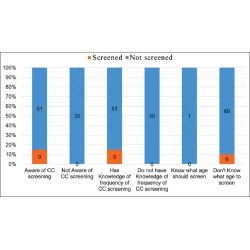
Results: In total, 355 out of 372 questionnaires were administered, achieving a response rate of 95.4%. Out of 355 participants, 9 (2.5%) had ever been screened for cervical cancer. In bivariate analyses, factors associated with screened were knowledge of body part affected, screening as a prevention tool, whether cervical cancer was curable in its early stages or not, awareness of cervical cancer screening, knowledge on frequency of screening and cervical cancer screening causing harm. However, in multivariate analysis, participants who knew that cervical cancer screening prevented cervical cancer were 3.58 (95% CI [1.49, 8.64]) times more likely to have been screened than those who did not have the knowledge. Participants who knew that cervical cancer is curable were 2.76 (95% CI [1.92, 8.31]) times more likely to have been screened than those who did not have the knowledge.
Conclusion and Global Health Implications: The uptake of screening was low. Interventions should be designed to increase uptake of screening for cervical cancer by considering factors that have been identified in the current study that are independently associated with cervical cancer screening among this population.
Downloads
Most read articles by the same author(s)
- Kamukwamba Mwale, Seter Siziya, Intestinal Infestations in Under-Five Children in Zambia , International Journal of Maternal and Child Health and AIDS: Vol. 4 No. 2 (2015): International Journal of Maternal and Child Health and AIDS
Similar Articles
- Faith Iretioluwa Olaniyi, Ayodele Ebenezer Owolabi, Gideon Temitope Olowe, Ololade Daniella Olunloyo, Eric Anuoluwapo Ogunleye, Ifeoluwapo Oluwafunke Kolawole, Perception, Pattern of Use, and Determinants of Family Planning Uptake Among Women of Childbearing Age in Ibadan, South West Nigeria , Vol. 15 (2026): International Journal of Maternal and Child Health and AIDS
- Kolawole A. Fasakin, Christopher T. Omisakin, Idowu O. Adebara, Wasiu A. Ajetunmobi, Adebayo A. Adeniyi, Ayodele J. Esan, Olufunke B. Bolaji, Oluwafemi D. Ajayi, Abayomi J. Afe, Assessment of PMTCT Success Rates Based on Antiretroviral Interventions and Feeding Options: A Prospective Cohort Study , Vol. 7 No. 2 (2018): International Journal of Maternal and Child Health and AIDS
- Brianna L. Smith, Sara Zizzo, Anouk Amzel, Sarah Wiant, Molly C. Pezzulo, Sarah Konopka, Rachel Golin, Alexandra C. Vrazo, Integration of Neonatal and Child Health Interventions with Pediatric HIV Interventions in Global Health , Vol. 7 No. 1 (2018): International Journal of Maternal and Child Health and AIDS
- George Chidi Anwuri, Michael S. Dunn, Frederick Schulze, Determinants of Voluntary HIV/AIDS Counseling and Testing among Community College Students in the United States , Vol. 6 No. 2 (2017): International Journal of Maternal and Child Health and AIDS
- Fatima M. Damagum, Zainab D. Ahmed, Rabiu I. Jalo, Hamisu M. Salihu, C. William Wester, Muktar H. Aliyu, Adapted Counseling Care Model for Management of Female Sexual Dysfunction Among Women Living With and Without HIV , Vol. 13 No. Continuous (2024): International Journal of Maternal and Child Health and AIDS
- Abhiruchi Galhotra, Sanjana Agrawal, Aditi Chandrakar, Effectiveness of Human Immunodeficiency Virus Index Testing: A Global Scoping Review , Vol. 14 No. Continuous (2025): International Journal of Maternal and Child Health and AIDS
- Charles Ikeanyionwu, Deepa Dongarwar, Zenab Yusuf, Rafeek Yusuf, Meishon Bell, Toi Harris, Hamisu M. Salihu, 2019 Health Equity Summer Research Summit Organized by the Center of Excellence in Health Equity, Training and Research, Baylor College of Medicine, Houston, Texas 77030, USA on June 18th, 2019 , Vol. 9 No. S1 (2020): International Journal of Maternal and Child Health and AIDS
- Ekere James Essien, Osaro Mgbere, Sorochi Iloanusi, Susan M. Abughosh, COVID-19 Infection among People with HIV/AIDS in Africa: Knowledge Gaps, Public Health Preparedness and Research Priorities , Vol. 10 No. 1 (2021): International Journal of Maternal and Child Health and AIDS
- Sara Rushwan, Fatu Forna, Ferid Abbas Abubeker, Tesfaye Tufa, Tieba Millogo, Miriam Nakalembe, Kwame Adu-Bonsaffoh, Francis L. Moses, Lester Chinery, Gilda Piaggio, Metin Gülmezoglu, Integrating Heat-Stable Carbetocin and Tranexamic Acid for Prevention and Management of Postpartum Hemorrhage in Sub-Saharan Africa: A Five-Country Pilot Implementation Study , Vol. 13 No. S1 (2024): International Journal of Maternal and Child Health and AIDS
- Romuladus Emeka Azuine, Gopal K Singh, Sussan E Ekejiuba, Eta Ashu, Magnus A Azuine, Global Health Donor Presence, Variations in HIV/AIDS Prevalence, and External Resources for Health in Developing Countries in Africa and Asia , Vol. 2 No. 2 (2014): International Journal of Maternal and Child Health and AIDS
<< < 4 5 6 7 8 9 10 11 12 13 > >>
You may also start an advanced similarity search for this article.
Published
How to Cite
Issue
Section
License
Copyright © 2018 Chiluba Kabalika, David Mulenga, Mazyanga Lucy Mazaba, Seter Siziya. Published by Global Health and Education Projects, Inc., USA.

This is an open-access article distributed under the terms of the Creative Commons Attribution-NonCommercial-ShareAlike 4.0 International License , which permits others to remix, transform, and build upon the work non-commercially, provided the original author is credited and the new creations are licensed under the same terms.