
Acceptance of Cervical Cancer Screening and its Correlates Among Women of a Peri-Urban High-Density Residential Area in Ndola, Zambia
DOI:
https://doi.org/10.21106/ijma.223Keywords:
- Knowledge,
- Cervical Cancer,
- Pap Smear,
- Screening,
- Zambia
Abstract
Background: Zambia has one of the highest cervical cancer incidence and mortality rates in the world. Cervical cancer screening leads to reduction in the incidence of invasive disease. The objectives of the study were to determine the level of acceptance of cervical cancer screening and its correlates among women of a peri-urban high-density residential area in Ndola, Zambia.
Methods: A cross sectional study was conducted. With a population size of 12,000 women in reproductive age and using an expected frequency of 50 + 5% and at 95% confidence interval, the required sample size was 372. A stratified sampling method was used to select participants. Independent factors that were associated with the outcome were established using multi-variate logistic regression. Adjusted odds ratios and their 95% confidence intervals are reported.
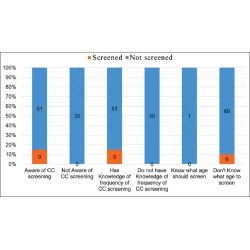
Results: In total, 355 out of 372 questionnaires were administered, achieving a response rate of 95.4%. Out of 355 participants, 9 (2.5%) had ever been screened for cervical cancer. In bivariate analyses, factors associated with screened were knowledge of body part affected, screening as a prevention tool, whether cervical cancer was curable in its early stages or not, awareness of cervical cancer screening, knowledge on frequency of screening and cervical cancer screening causing harm. However, in multivariate analysis, participants who knew that cervical cancer screening prevented cervical cancer were 3.58 (95% CI [1.49, 8.64]) times more likely to have been screened than those who did not have the knowledge. Participants who knew that cervical cancer is curable were 2.76 (95% CI [1.92, 8.31]) times more likely to have been screened than those who did not have the knowledge.
Conclusion and Global Health Implications: The uptake of screening was low. Interventions should be designed to increase uptake of screening for cervical cancer by considering factors that have been identified in the current study that are independently associated with cervical cancer screening among this population.
Downloads
Most read articles by the same author(s)
- Kamukwamba Mwale, Seter Siziya, Intestinal Infestations in Under-Five Children in Zambia , International Journal of Maternal and Child Health and AIDS: Vol. 4 No. 2 (2015): International Journal of Maternal and Child Health and AIDS
Similar Articles
- Tamara H. Hussein, Melina Mgongo, Jacqueline G. Uriyo, Damian J. Damian, Babill Stray-Pedersen, Sia E. Msuya, Margareta Wandel, Exclusive Breastfeeding Rates and Factors Associated with Exclusive Breastfeeding Practices in Northern Tanzania: Measurement using Two Different Methodologies—24 Hours Recall and Recall Since Birth , Vol. 8 No. 1 (2019): International Journal of Maternal and Child Health and AIDS
- Charles Kouanfack, Skinner Nguefack Lekelem, Fala Bede, Claude Ngwayu Nkfusai, Yvette Micha Nouafo, Christian Tchokonte, Nicaise Tsomo Zephirin, Pierre Joseph Fouda, Use of Trained Non-Medical Staff to Improve Access to HIV Testing Services in Africa: Implementation of the World Health Organization Opt-out Approach in Cameroon , Vol. 10 No. 1 (2021): International Journal of Maternal and Child Health and AIDS
- Armand Duclaire Kemo, Bruno Kenfack, Jerome Ateudjieu, Maternal Deaths and Complications: Documentation of Parameters on the Partographs Used by Health Care Providers in Four Hospitals in West Cameroon , Vol. 14 No. Continuous (2025): International Journal of Maternal and Child Health and AIDS
- Joel M. Njah, Gregory E. Halle-Ekane, Sylvester N. Atanga, Edouard K. Tshimwanga, Felix Desembuin, Pius T. Muffih, From Option B+ to Universal “Test and Treat” in Cameroon: Identification and Evaluation of District-level Factors Associated with Retention in Care , Vol. 12 No. 2 (2023): International Journal of Maternal and Child Health and AIDS
- Florence F. Kimario, Charles Festo, Josephine Shabani, Mwifadhi Mrisho, Determinants of Home Delivery among Women Aged 15-24 Years in Tanzania , Vol. 9 No. 2 (2020): International Journal of Maternal and Child Health and AIDS
- Kimberly Fryer, Chinyere N. Reid, Naciely Cabral, Jennifer Marshall, Usha Menon, Exploring Patients’ Needs and Desires for Quality Prenatal Care in Florida, United States , Vol. 12 No. 1 (2023): International Journal of Maternal and Child Health and AIDS
- Margaret Omowaleola Akinwaare, Jonah Musa, Chizoma Millicent Ndikom, Determinants of Digitalized Antenatal Education Use among Pregnant Women Living with Human Immunodeficiency Virus in Nigeria , Vol. 15 (2026): International Journal of Maternal and Child Health and AIDS
- Cabiria M. Barbosu, Lisette Alcántara, Saloni Sharma, Jahron Marriott, Oksana Babiy, Rebecca Deamer, Marcia Kindlon, Timothy Dye, The Implementation of a State-wide Rapid Initiation of Antiretroviral Therapy as a Best Practice in Primary Care Practices Using an Academic Detailing Approach: Lessons Learned from NewYork State, United States , Vol. 11 No. 1 (2022): International Journal of Maternal and Child Health and AIDS
- Carl Dowling, Factors Affecting Paramedic Personnel in the Assessment and Management of Emergency Pediatric Patients within the Prehospital Settings in the United Kingdom , Vol. 12 No. 1 (2023): International Journal of Maternal and Child Health and AIDS
- Isabel Griffin, Boubakari Ibrahimou, Natasha Navejar, Anjali Aggarwal, Kristopher Myers, Daniel Mauck, Korede K. Yusuf, Usman J. Wudil, Muktar H. Aliyu, Hamisu M. Salihu, Maternal Caffeine Consumption and Racial Disparities in Fetal Telomere Length , Vol. 9 No. 1 (2020): International Journal of Maternal and Child Health and AIDS
<< < 3 4 5 6 7 8 9 10 11 12 > >>
You may also start an advanced similarity search for this article.
Published
How to Cite
Issue
Section
License
Copyright © 2018 Chiluba Kabalika, David Mulenga, Mazyanga Lucy Mazaba, Seter Siziya. Published by Global Health and Education Projects, Inc., USA.

This is an open-access article distributed under the terms of the Creative Commons Attribution-NonCommercial-ShareAlike 4.0 International License , which permits others to remix, transform, and build upon the work non-commercially, provided the original author is credited and the new creations are licensed under the same terms.