
Acceptance of Cervical Cancer Screening and its Correlates Among Women of a Peri-Urban High-Density Residential Area in Ndola, Zambia
DOI:
https://doi.org/10.21106/ijma.223Keywords:
- Knowledge,
- Cervical Cancer,
- Pap Smear,
- Screening,
- Zambia
Abstract
Background: Zambia has one of the highest cervical cancer incidence and mortality rates in the world. Cervical cancer screening leads to reduction in the incidence of invasive disease. The objectives of the study were to determine the level of acceptance of cervical cancer screening and its correlates among women of a peri-urban high-density residential area in Ndola, Zambia.
Methods: A cross sectional study was conducted. With a population size of 12,000 women in reproductive age and using an expected frequency of 50 + 5% and at 95% confidence interval, the required sample size was 372. A stratified sampling method was used to select participants. Independent factors that were associated with the outcome were established using multi-variate logistic regression. Adjusted odds ratios and their 95% confidence intervals are reported.
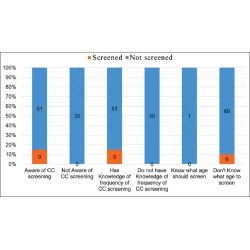
Results: In total, 355 out of 372 questionnaires were administered, achieving a response rate of 95.4%. Out of 355 participants, 9 (2.5%) had ever been screened for cervical cancer. In bivariate analyses, factors associated with screened were knowledge of body part affected, screening as a prevention tool, whether cervical cancer was curable in its early stages or not, awareness of cervical cancer screening, knowledge on frequency of screening and cervical cancer screening causing harm. However, in multivariate analysis, participants who knew that cervical cancer screening prevented cervical cancer were 3.58 (95% CI [1.49, 8.64]) times more likely to have been screened than those who did not have the knowledge. Participants who knew that cervical cancer is curable were 2.76 (95% CI [1.92, 8.31]) times more likely to have been screened than those who did not have the knowledge.
Conclusion and Global Health Implications: The uptake of screening was low. Interventions should be designed to increase uptake of screening for cervical cancer by considering factors that have been identified in the current study that are independently associated with cervical cancer screening among this population.
Downloads
Most read articles by the same author(s)
- Kamukwamba Mwale, Seter Siziya, Intestinal Infestations in Under-Five Children in Zambia , International Journal of Maternal and Child Health and AIDS: Vol. 4 No. 2 (2015): International Journal of Maternal and Child Health and AIDS
Similar Articles
- Kamukwamba Mwale, Seter Siziya, Intestinal Infestations in Under-Five Children in Zambia , Vol. 4 No. 2 (2015): International Journal of Maternal and Child Health and AIDS
- Ranjan Kumar Prusty, Sayeed Unisa, Reproductive Tract Infections and Treatment Seeking Behavior among Married Adolescent Women 15-19 Years in India , Vol. 2 No. 1 (2013): International Journal of Maternal and Child Health and AIDS
- Sue C. Lin, Stella M. Yu, Disparities in Healthcare Access and Utilization among Children with Autism Spectrum Disorder from Immigrant Non-English Primary Language Households in the United States , Vol. 3 No. 2 (2015): International Journal of Maternal and Child Health and AIDS
- Nidhi Fotedar, Nugehally Raju Ramesh Masthi, Burden of Fetal Anomalies among Antenatal Mothers Attending a Public Referral Hospital: A Mixed Cohort Study , Vol. 14 No. Continuous (2025): International Journal of Maternal and Child Health and AIDS
- Hamisu M. Salihu, Ronee E. Wilson, Lindsey M. King, Phillip J. Marty, Valerie E. Whiteman, Socio-ecological Model as a Framework for Overcoming Barriers and Challenges in Randomized Control Trials in Minority and Underserved Communities , Vol. 3 No. 1 (2015): International Journal of Maternal and Child Health and AIDS
- Alexander Suuk Laar, Veioshnee Govender, Individual and Community Perspectives, Attitudes, and Practices to Mother-to-Child-Transmission and Infant Feeding among HIV-Positive Mothers in Sub-Saharan Africa: A Systematic Literature Review , Vol. 2 No. 1 (2013): International Journal of Maternal and Child Health and AIDS
- Danladi Abubakar, Yetunde B. Aremu-Kasumu, Musa Yakubu, Olaniyi T. Fasanu, Sophia O. Baidoo-Adeiza, Birth Preparedness and Complication Readiness among Antenatal Attendees in a Tertiary Hospital in Northern Nigeria , Vol. 13 No. Continuous (2024): International Journal of Maternal and Child Health and AIDS
- Ajibola Idowu, Samson Ayo Deji, Olatayo Ayodele Aremu, Olumuyiwa Matthew Bojuwoye, Akinyemi David Ofakunrin, Birth Preparedness and Complication Readiness among Women Attending Antenatal Clinics in Ogbomoso, South West, Nigeria , Vol. 4 No. 1 (2015): International Journal of Maternal and Child Health and AIDS
- Gopal K. Singh, Mohammad Siahpush, Romuladus E. Azuine, Shanita D. Williams, Widening Socioeconomic and Racial Disparities in Cardiovascular Disease Mortality in the United States, 1969-2013 , Vol. 3 No. 2 (2015): International Journal of Maternal and Child Health and AIDS
- Samantha A. Slinkard, Jennifer R. Pharr, Tamara Bruno, Dina Patel, Amaka Ogidi, Michael Obiefune, Echezona E. Ezeanolue, Determinants of Infant Mortality in Southeast Nigeria: Results from the Healthy Beginning Initiative, 2013-2014 , Vol. 7 No. 1 (2018): International Journal of Maternal and Child Health and AIDS
<< < 1 2 3 4 5 6 7 8 9 10 > >>
You may also start an advanced similarity search for this article.
Published
How to Cite
Issue
Section
License
Copyright © 2018 Chiluba Kabalika, David Mulenga, Mazyanga Lucy Mazaba, Seter Siziya. Published by Global Health and Education Projects, Inc., USA.

This is an open-access article distributed under the terms of the Creative Commons Attribution-NonCommercial-ShareAlike 4.0 International License , which permits others to remix, transform, and build upon the work non-commercially, provided the original author is credited and the new creations are licensed under the same terms.