
Does Pre-Survey Training Impact Knowledge of Survey Administrators and Survey Outcomes in Developing Countries? Evaluation Findings of a Training of Trainers Workshop for National AIDS and Reproductive Health Survey-Plus in Nigeria
DOI:
https://doi.org/10.21106/ijma.18Keywords:
- Training,
- Survey,
- NARHS-Plus,
- State AIDS Program Coordinators,
- Reproductive Health Coordinators,
- State Laboratory Scientists,
- Lead Supervisors and Counselor Testers,
- Abuja,
- Nigeria
Abstract
Although, Nigeria had conducted various national surveys followed by central and state level trainings for survey administrators, prior pre-survey trainings have not been systematically evaluated to assess their impact on knowledge gain and final outcome of the survey. A central training of trainers' session was organized for master trainers on the conduct of the 2012 National AIDS and Reproductive Health Survey.
Objectives:To evaluate the impact of training on the quality of conduct of a national research survey in the 36 states and the Federal Capital Territory in Nigeria.
Method:A total of 185 participants consisting of State AIDS Program Coordinators, Reproductive Health Coordinators, State Laboratory Scientists, Lead Supervisors and Counselor Testers were invited from the 36 states in Nigeria and the FCT for the central training of trainers in Abuja. The training lasted 5 days and the trainees were grouped into two on the basis of behavioral epidemiology and laboratory components. Training tools such as the developed protocol, training power point slides, practical sessions such as role plays, and usage of HIV rapid test kits were utilized during the training. The facilitators were drawn from Federal Ministry of Health (FMoH), universities and research Institutions as well as Non-Governmental Organizations (NGOs). The facilitators prepared and administered 25 structured questions for the behavioral group and 28 questions for the laboratory group at the beginning of the training to assess the participants' knowledge of HIV and the survey. The same questions answered by Trainees responded to the same questions prior to the commencement and at the end of the trainings. Scores were aggregated to 100 for each test. We conducted paired t-test to determine statistically significant differences between pre-test and post-test results at 0.05 significance level and ANOVA to determine if there were differences in knowledge level among different groups.
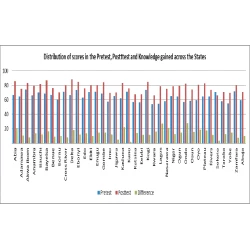
Result:The overall mean pre-test and post-test scores were 64.0% and 77.4% respectively indicating a 13.4% knowledge gain above what it was at the beginning of the training. The mean pre-test score and post-test score for the Southern states (SN) were 64.7% and 80.3% while that of the Northern states (NN) were 63.5% and 75.3% representing a knowledge gain of 15.6% and 11.8% respectively. There was statistical significant difference in the post-test scores between the two regions (p=0.001) and in knowledge gained after the training (p=0.017).
Conclusions and Public Health Implications:Comparison between the pre test and post test scores at the 5-day training showed a significant gain in knowledge of participants. The survey training contributed positively to the preparation and building of knowledge needed for the conduct of 2012 NARHS-plus.
Downloads
Similar Articles
- Charles Chibuisi Ehiemere, Ishaku Adamu Akyala, Bisayo Adetuyi Ogundipe, Chukwuebuka Clement Nri-Ezedi, Peter Joseph Anzaku, Waryit Esther Yonah, Efe Mary Imokhai, Isaac Onyebuchi Okohu, Idowu Olapemi Makinde, Ngozi Miriam Chimzobam-Nnalue, Beyond Access: Behavior Change and Gendered Realities in the Adoption of Digital Health Tools for Maternal, Newborn, and Child Health in Nigeria , Vol. 15 (2026): International Journal of Maternal and Child Health and AIDS
- Maria Vigil-Mallette, Daryle Pickens, Julliet Ogu, Deepa Dongarwar, Elizabeth Onugha, Hamisu M Salihu, Fifth Annual Summer Research Summit on Health Equity Organized by the Center of Excellence in Health Equity, Training and Research, Baylor College of Medicine, Houston, Texas 77030, USA on May 17, 2022 , Vol. 11 No. S2 (2022): International Journal of Maternal and Child Health and AIDS
- Margaret Omowaleola Akinwaare, Jonah Musa, Chizoma Millicent Ndikom, Determinants of Digitalized Antenatal Education Use among Pregnant Women Living with Human Immunodeficiency Virus in Nigeria , Vol. 15 (2026): International Journal of Maternal and Child Health and AIDS
- Amol Jamkhande, Bhagyashree P. Agre, Neelam Gavali, Anjali Rajesh Gaikwad, Sanpreet Singh Sachdev, Association Between Maternal Periodontitis and Preterm Low Birth Weight in Indian Populations: A Literature Review , Vol. 15 (2026): International Journal of Maternal and Child Health and AIDS
- Océane J. Parker, Duc Minh Duong, Thuy Thu Nguyen, Vui Thi Le, Utilization of Sexual and Reproductive Healthcare Services Among Young Women in Two Districts of Hanoi, Vietnam , Vol. 15 (2026): International Journal of Maternal and Child Health and AIDS
- Innocent Anayochukwu Ugwu, Calistus Obiora Nevo, Malachy Nwaeze Ezenwaeze, Antenatal Care Utilization and Delivery Location: Evidence from Postpartum Women in Enugu, South East Nigeria , Vol. 15 (2026): International Journal of Maternal and Child Health and AIDS
- Olatunde Ayodele Amode, Damilola Kafayat Oyedele, Hadiza Salele, Olajumoke Adekeye, Uchenna Igbokwe, Lola Ameyan, Kayode Akin Afolabi, Olufunke Fasawe, Owens Wiwa, Cost-effectiveness and Budget Impact of Introducing Heat-stable Carbetocin for Postpartum Hemorrhage Prevention in Nigeria , Vol. 14 No. Continuous (2025): International Journal of Maternal and Child Health and AIDS
- Deepa Dongarwar, Toi B. Harris, Hamisu M. Salihu, Fourth Annual Summer Research Summit on Health Equity Organized by the Center of Excellence in Health Equity, Training and Research, Baylor College of Medicine, Houston, Texas 77030, USA on May 20, 2021 , Vol. 10 No. S3 (2021): International Journal of Maternal and Child Health and AIDS
- Faith Iretioluwa Olaniyi, Ayodele Ebenezer Owolabi, Gideon Temitope Olowe, Ololade Daniella Olunloyo, Eric Anuoluwapo Ogunleye, Ifeoluwapo Oluwafunke Kolawole, Perception, Pattern of Use, and Determinants of Family Planning Uptake Among Women of Childbearing Age in Ibadan, South West Nigeria , Vol. 15 (2026): International Journal of Maternal and Child Health and AIDS
- Wah Wah Myint, Human Immunodeficiency Virus (HIV) Knowledge and Stigma: Findings from a Cross-sectional Survey , Vol. 15 (2026): International Journal of Maternal and Child Health and AIDS
You may also start an advanced similarity search for this article.
Published
How to Cite
Issue
Section
License
Copyright © 2015 Kolawole Solomon Oyedeji, Adeniyi Francis Fagbamigbe, Johnbull Sonny Ogboi, Adebobola Toluwalashe Bashorun, Kawu Bolakale Issa, Perpetua Amida, Adeniyi Ogundiran, Ezire Onoriode. Published by Global Health and Education Projects, Inc., USA.

This is an open-access article distributed under the terms of the Creative Commons Attribution-NonCommercial-ShareAlike 4.0 International License , which permits others to remix, transform, and build upon the work non-commercially, provided the original author is credited and the new creations are licensed under the same terms.