
Human Immunodeficiency Virus (HIV) Knowledge and Stigma: Findings from a Cross-sectional Survey
DOI:
https://doi.org/10.21106/IJMA_7_2025Keywords:
- Antiretroviral Drugs,
- Human Immunodeficiency Virus Stigma,
- Human Immunodeficiency Virus Test Kits,
- Human Immunodeficiency Virus Transmission and Risk Reduction,
- The Philippines
Abstract
Background and Objective: People living with human immunodeficiency virus (HIV) encounter HIV stigma that hinders HIV testing and subsequently linkage to care. This study evaluates the relationship between HIV stigma and awareness of HIV testing, drugs to prevent mother-to-child transmission (MTCT), antiretroviral (ARV) drugs, and HIV knowledge score among Filipino women.
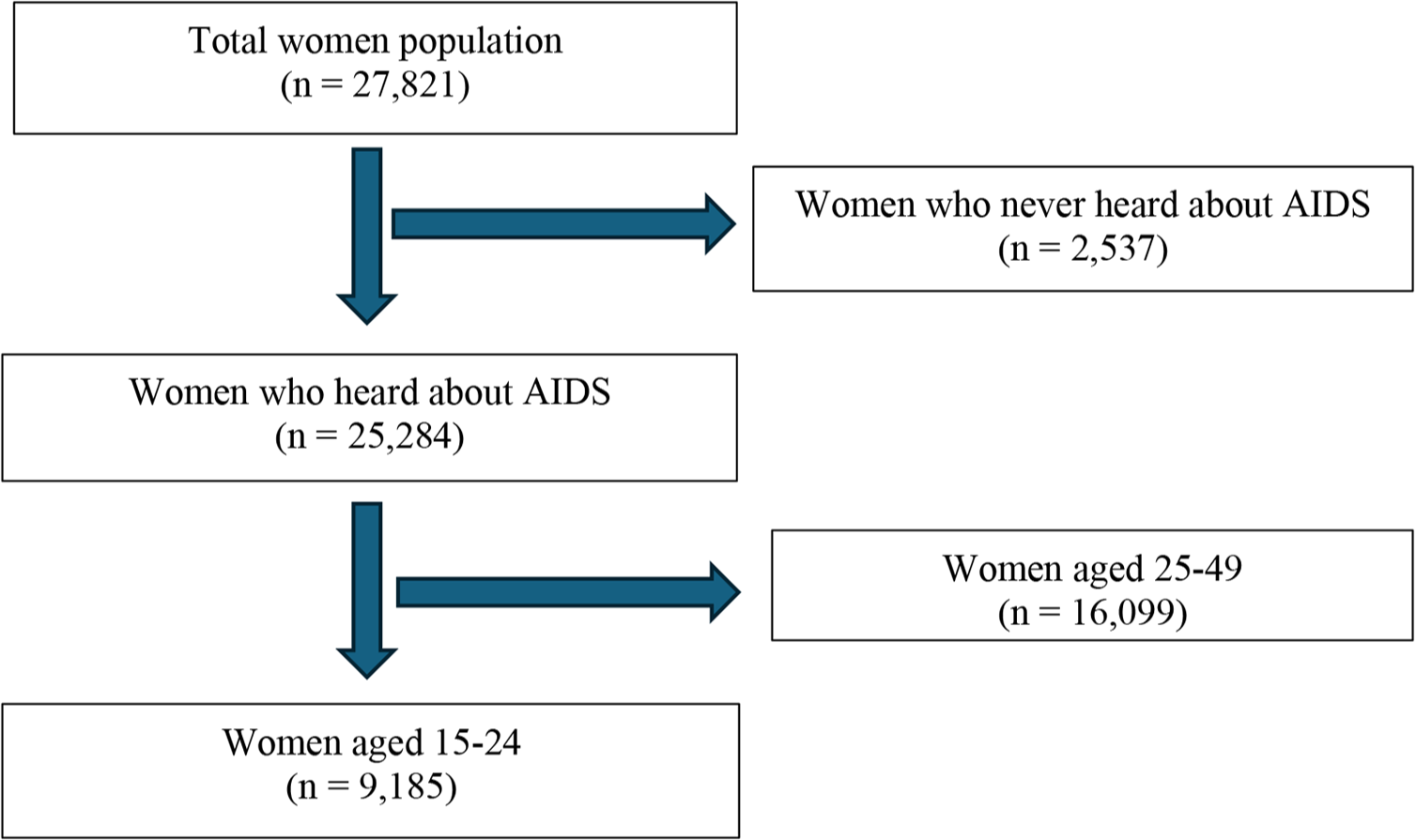
Methods: We utilized data of women aged 15–49 (n = 25,284) who heard about HIV from the Philippines’ 2022 Demographic and Health Survey. The dependent variable was HIV stigma. The covariates were sociodemographic characteristics (i.e., age, urban/rural, education level, wealth quintile, current employment status, and marital status), knowledge regarding HIV test kits, drugs to prevent MTCT, and ARV drugs. We calculated descriptive statistics, Pearson’s Chi-square test of independence, and multivariable binary logistic regression, fitting covariates. Subgroup analysis was performed to understand the relationship between HIV stigma and HIV knowledge score among individuals aged 15–24 years. All analyses were performed using Stata 18.5.
Results: Approximately 65.7% of women reported HIV stigma. The logistic regression results indicated lower odds of HIV stigma among women who know test kits but never tested for HIV with test kits (adjusted odds ratio [aOR] = 0.87), those who heard about drugs to prevent MTCT (aOR = 0.75), and those who heard about ARV drugs (aOR = 0.85) compared to their counterparts. Higher odds of HIV stigma were observed among women currently in union (aOR = 1.46) and rural residents (aOR = 1.54) compared to their counterparts. Among women aged 15–24, having a higher HIV knowledge score, especially among those who scored 5, had lower odds of having HIV stigma (aOR = 0.04) than those who achieved a zero knowledge score. All p-values ≤ 0.05.
Conclusion and Global Health Implications: Findings suggest an urgent need to address stigma among women, especially those who lack knowledge of HIV test kits and ARV drugs. Further research should explore strategies to reduce HIV stigma, especially among young married rural women.
Downloads
Similar Articles
- Kelsey A. Stewart, Sergio M. Navarro, Sriharsha Kambala, Gail Tan, Revanth Poondla, Sara Lederman, Kelli Barbour, Chris Lavy, Trends in Ultrasound Use in Low and Middle Income Countries: A Systematic Review , Vol. 9 No. 1 (2020): International Journal of Maternal and Child Health and AIDS
- Cabiria M. Barbosu, Lisette Alcántara, Saloni Sharma, Jahron Marriott, Oksana Babiy, Rebecca Deamer, Marcia Kindlon, Timothy Dye, The Implementation of a State-wide Rapid Initiation of Antiretroviral Therapy as a Best Practice in Primary Care Practices Using an Academic Detailing Approach: Lessons Learned from NewYork State, United States , Vol. 11 No. 1 (2022): International Journal of Maternal and Child Health and AIDS
- Samantha A. Slinkard, Jennifer R. Pharr, Tamara Bruno, Dina Patel, Amaka Ogidi, Michael Obiefune, Echezona E. Ezeanolue, Determinants of Infant Mortality in Southeast Nigeria: Results from the Healthy Beginning Initiative, 2013-2014 , Vol. 7 No. 1 (2018): International Journal of Maternal and Child Health and AIDS
- Chioma A. Ikedionwu, Deepa Dongarwar, Courtney Williams, Evelyn Odeh, Maylis Peguy Nkeng Peh, Hilliary Hooker, Stacey Wiseman, Tramauni Brock, Erinn Payne-Green, Chidinma Chukwudum, Grace Loudd, Andrea Shelton, Jonnae O. Atkinson, Kiara K. Spooner, Jason L. Salemi, Hamisu M. Salihu, Omonike A. Olaleye, Trends and Risk Factors for Leishmaniasis among Reproductive Aged Women in the United States , Vol. 10 No. 2 (2021): International Journal of Maternal and Child Health and AIDS
- Janel Mendoza, Improving Health, Social Welfare, and Human Development Through Women’s Empowerment in Developing Countries: The 2016 Girl Up Leadership Summit, Washington, DC, USA , Vol. 5 No. 2 (2016): International Journal of Maternal and Child Health and AIDS
- Mary Stokes, Amber Olson, Clare Algeo, Bakari Rajab, Carolyn Mwalwanda, Deepa Dongarwar, Rachel Pope, Clinical and Sociodemographic Characteristics Associated with Emergency Peripartum Hysterectomy due to Puerperal Sepsis in Malawi , Vol. 11 No. 1 (2022): International Journal of Maternal and Child Health and AIDS
- Hasiya Tijjani Ismail, Taiwo G Amole, Fatima I Tsiga-Ahmed, Rabiu I Jalo, Aishatu L Adamu, Mahmoud U Sani, Hamisu M Salihu, William Wester, Muktar H Aliyu, Factors Associated with Utilization of Sexual and Reproductive Health Services among Married Adolescent Girls in Kano, Northern Nigeria , Vol. 13 No. Continuous (2024): International Journal of Maternal and Child Health and AIDS
- Xiaoxiao Lu, Hee-Soon Juon, Sunmin Lee, Do Recommendations by Healthcare Providers, Family-members, Friends, and Individual Self-Efficacy Increase Uptake of Hepatitis B Screening? Results of a Population-Based Study of Asian Americans , Vol. 6 No. 1 (2017): International Journal of Maternal and Child Health and AIDS
- Ahmed Zohirul Islam, Nazrul Islam Mondal, Laily Khatun, Mosiur Rahman, Rafiqul Islam, Golam Mostofa, Nazrul Hoque, Prevalence and Determinants of Contraceptive use among Employed and Unemployed Women in Bangladesh , Vol. 5 No. 2 (2016): International Journal of Maternal and Child Health and AIDS
- Janice Katherine Kopinak, Mental Health in Developing Countries: Challenges and Opportunities in Introducing Western Mental Health System in Uganda , Vol. 3 No. 1 (2015): International Journal of Maternal and Child Health and AIDS
<< < 9 10 11 12 13 14 15 16 17 18 > >>
You may also start an advanced similarity search for this article.
Published
How to Cite
Issue
Section
License
Copyright © 2026 Wah Wah Myint. Published by Global Health and Education Projects, Inc., USA.

This is an open-access article distributed under the terms of the Creative Commons Attribution-NonCommercial-ShareAlike 4.0 International License , which permits others to remix, transform, and build upon the work non-commercially, provided the original author is credited and the new creations are licensed under the same terms.