
Human Immunodeficiency Virus (HIV) Knowledge and Stigma: Findings from a Cross-sectional Survey
DOI:
https://doi.org/10.21106/IJMA_7_2025Keywords:
- Antiretroviral Drugs,
- Human Immunodeficiency Virus Stigma,
- Human Immunodeficiency Virus Test Kits,
- Human Immunodeficiency Virus Transmission and Risk Reduction,
- The Philippines
Abstract
Background and Objective: People living with human immunodeficiency virus (HIV) encounter HIV stigma that hinders HIV testing and subsequently linkage to care. This study evaluates the relationship between HIV stigma and awareness of HIV testing, drugs to prevent mother-to-child transmission (MTCT), antiretroviral (ARV) drugs, and HIV knowledge score among Filipino women.
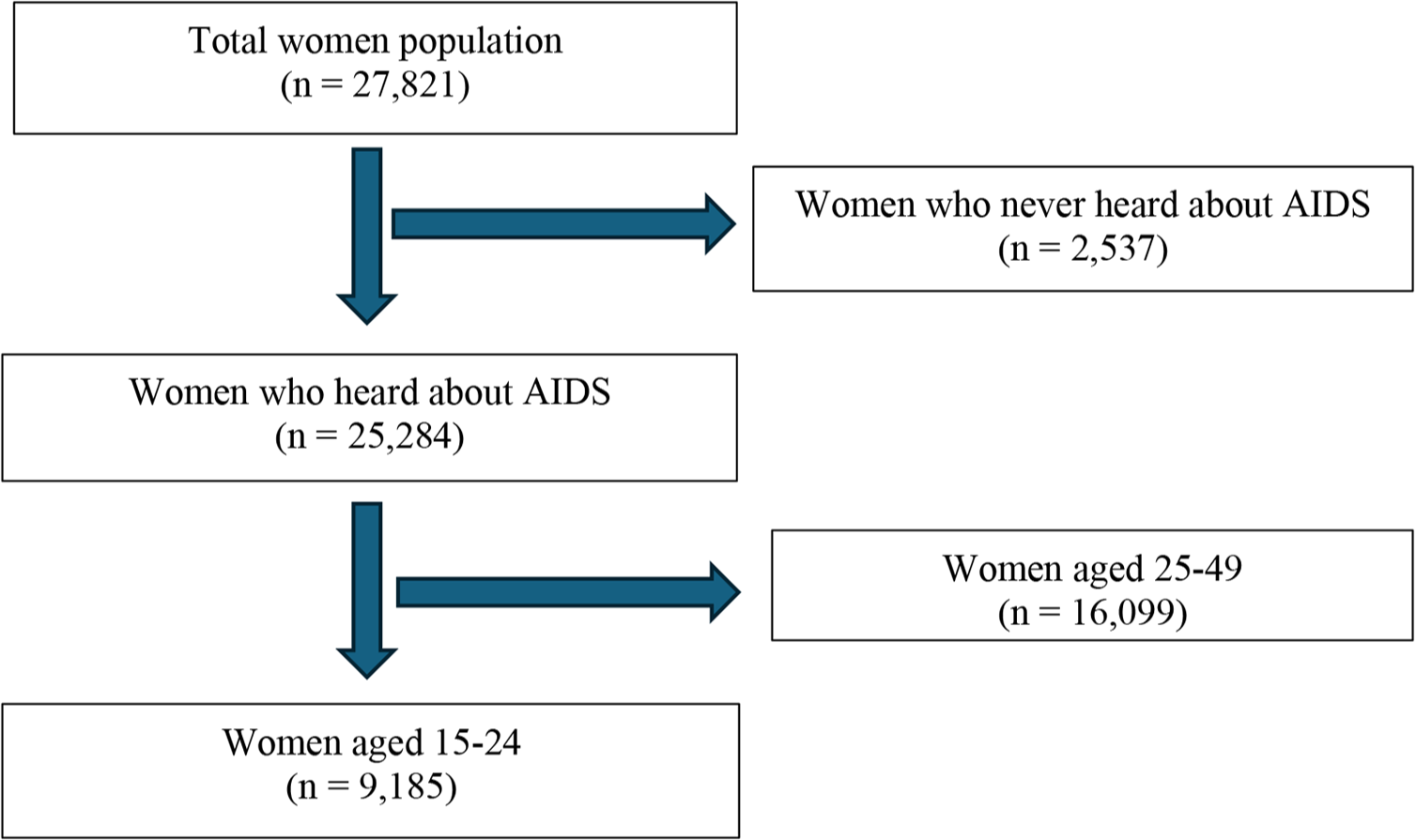
Methods: We utilized data of women aged 15–49 (n = 25,284) who heard about HIV from the Philippines’ 2022 Demographic and Health Survey. The dependent variable was HIV stigma. The covariates were sociodemographic characteristics (i.e., age, urban/rural, education level, wealth quintile, current employment status, and marital status), knowledge regarding HIV test kits, drugs to prevent MTCT, and ARV drugs. We calculated descriptive statistics, Pearson’s Chi-square test of independence, and multivariable binary logistic regression, fitting covariates. Subgroup analysis was performed to understand the relationship between HIV stigma and HIV knowledge score among individuals aged 15–24 years. All analyses were performed using Stata 18.5.
Results: Approximately 65.7% of women reported HIV stigma. The logistic regression results indicated lower odds of HIV stigma among women who know test kits but never tested for HIV with test kits (adjusted odds ratio [aOR] = 0.87), those who heard about drugs to prevent MTCT (aOR = 0.75), and those who heard about ARV drugs (aOR = 0.85) compared to their counterparts. Higher odds of HIV stigma were observed among women currently in union (aOR = 1.46) and rural residents (aOR = 1.54) compared to their counterparts. Among women aged 15–24, having a higher HIV knowledge score, especially among those who scored 5, had lower odds of having HIV stigma (aOR = 0.04) than those who achieved a zero knowledge score. All p-values ≤ 0.05.
Conclusion and Global Health Implications: Findings suggest an urgent need to address stigma among women, especially those who lack knowledge of HIV test kits and ARV drugs. Further research should explore strategies to reduce HIV stigma, especially among young married rural women.
Downloads
Similar Articles
- Paul Kiondo, Annettee Nakimuli, Samuel Ononge, Julius N. Wandabwa, Milton W. Musaba, Predictors of Intrapartum Stillbirths among Women Delivering at Mulago Hospital, Kampala, Uganda , Vol. 10 No. 2 (2021): International Journal of Maternal and Child Health and AIDS
- Gopal K. Singh, Hyunjung Lee, Lyoung Hee Kim, Shanita D. Williams, Social Determinants of Health Among American Indians and Alaska Natives and Tribal Communities: Comparison with Other Major Racial and Ethnic Groups in the United States, 1990–2022 , Vol. 13 No. Continuous (2024): International Journal of Maternal and Child Health and AIDS
- Gopal K. Singh, Hyunjung Lee, Lyoung Hee Kim, Housing and Inequalities in US Life Expectancy, Child and Youth Mortality, and All-Cause and Cause-Specific Mortality, 1979-2020: Results from the National Longitudinal Mortality Study and the National Vital Statistics System , Vol. 12 No. 2 (2023): International Journal of Maternal and Child Health and AIDS
- Wael Hafez, Sana Osman, Muneir Gador, Muhammad Aslam, Correlation Between Plasma Vitamin C Concentration and COVID-19 Outcomes among Patients Seen at a Major Hospital in the United Arab Emirates , Vol. 11 No. 2 (2022): International Journal of Maternal and Child Health and AIDS
- Md Nazrul Islam Mondai, Md Monzur Morshad Nasir Ullah, Md Rafiqul Islam, Md Shafiur Rahman, Md Nuruzzaman Khan, Kazi Mohiuddin Ahmed, Mohammad Shariful Islam, Sociodemographic and Health Determinants of Inequalities in Life Expectancy in Least Developed Countries , Vol. 4 No. 1 (2015): International Journal of Maternal and Child Health and AIDS
- Chelsea E Modlin, Helga Naburi, Kristy M Hendricks, Goodluck Lyatuu, Josphine Kimaro, Lisa V Adams, Paul E Palumbo, C. Fordham von Reyn, Nutritional Deficiencies and Food Insecurity Among HIV-infected Children in Tanzania , Vol. 2 No. 2 (2014): International Journal of Maternal and Child Health and AIDS
- Roneé E. Wilson, Renice Obure, Precious Omokaro Omokaro, Hamisu M. Salihu, Estrellita “Lo” Berry, Deborah A. Austin A. Austin, Jennifer G. Christner, Effectiveness of a 24/7 Dad® Curriculum in Improving Father Involvement: Profiles of Engagement , Vol. 9 No. 1 (2020): International Journal of Maternal and Child Health and AIDS
- Gopal K. Singh, Trends and Social Inequalities in Maternal Mortality in the United States, 1969-2018 , Vol. 10 No. 1 (2021): International Journal of Maternal and Child Health and AIDS
- Ashish Kumar Gupta, Kakoli Borkotoky, Amit Kumar, Household Headship and Infant Mortality in India: Evaluating the Determinants and Differentials , Vol. 3 No. 1 (2015): International Journal of Maternal and Child Health and AIDS
- Hyunjung Lee, Gopal K. Singh, Inequalities in Life Expectancy and All-Cause Mortality in the United States by Levels of Happiness and Life Satisfaction: A Longitudinal Study , Vol. 9 No. 3 (2020): International Journal of Maternal and Child Health and AIDS
<< < 7 8 9 10 11 12 13 14 15 16 > >>
You may also start an advanced similarity search for this article.
Published
How to Cite
Issue
Section
License
Copyright © 2026 Wah Wah Myint. Published by Global Health and Education Projects, Inc., USA.

This is an open-access article distributed under the terms of the Creative Commons Attribution-NonCommercial-ShareAlike 4.0 International License , which permits others to remix, transform, and build upon the work non-commercially, provided the original author is credited and the new creations are licensed under the same terms.