
Interbirth Intervals of Immigrant and Refugee Women in the United States: A Cross-Sectional Study
DOI:
https://doi.org/10.21106/ijma.621Keywords:
- African Immigrants,
- Birth Spacing,
- Immigrant Women,
- Interbirth Interval,
- Interpregnancy Interval,
- Maternal Health,
- Refugee Women
Abstract
Despite guidelines recommending an interval of at least 18–24 months between a live birth and the conception of the next pregnancy, nearly one-third of pregnancies in the United States are conceived within 18 months of a previous live birth. The purpose of this study was to examine the associations between multiple immigration-related variables and interbirth intervals among reproductive-aged immigrant and refugee women living in the United States.
Methods:This was a cross-sectional, quantitative study on the sexual and reproductive health (SRH) of reproductive-aged immigrant and refugee women in the United States. The data were collected via an online survey administered by Lucid LLC. We included data on women who had complete information on nativity and birth history in the descriptive analysis (n = 653). The exposure variables were immigration pathway, length of time since immigration, and country/region of birth. The outcome variable was interbirth interval (≤18, 19–35, or ≥36 months). We used multivariable ordinal logistic regression, adjusted for confounders, to determine the factors associated with having a longer interbirth interval among women with second- or higher-order births (n = 245).
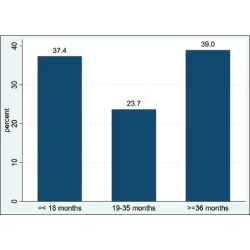
Results:Approximately 37.4% of study participants had a short interbirth interval. Women who immigrated to the United States for educational (aOR = 4.57; 95% CI, 1.57–9.58) or employment opportunities (aOR = 2.27; 95% CI, 1.07–5.31) had higher odds of reporting a longer interbirth interval (19–35 or ≥36 months) than women born in the United States. Women born in an African country had 0.79 times the odds (aOR = 0.79; 95% CI, 0.02–0.98) of being in a higher category of interbirth interval.
Conclusion and Global Health Implications:Although all birthing women should be counseled on optimal birth spacing through the use of postpartum contraception, immigrant and refugee women would benefit from further research and policy and program interventions to help them in achieving optimal birth spacing. SRH research in African immigrant and refugee communities is especially important for identifying ameliorable factors for improving birth spacing.
Downloads
Similar Articles
- Deepa Dongarwar, Toi B. Harris, Hamisu M. Salihu, Fourth Annual Summer Research Summit on Health Equity Organized by the Center of Excellence in Health Equity, Training and Research, Baylor College of Medicine, Houston, Texas 77030, USA on May 20, 2021 , Vol. 10 No. S3 (2021): International Journal of Maternal and Child Health and AIDS
- Elizabeth Armstrong, Priya Srinivasan, Dawood Azeemy, Fayja Habib, Ernest Alema-Mensah, COVID-19 Stressors and Maternal Mental Health in Georgia, United States: Sources, Effects, and Recommendations , Vol. 14 No. Continuous (2025): International Journal of Maternal and Child Health and AIDS
- Ernest Tambo, Chidiebere E. Ugwu, Yayi Guan, Ding Wei, Xiao-Ning, Zhou Xiao-Nong, China-Africa Health Development Initiatives: Benefits and Implications for Shaping Innovative and Evidence-informed National Health Policies and Programs in Sub-saharan African Countries , Vol. 5 No. 2 (2016): International Journal of Maternal and Child Health and AIDS
- Jaleah D. Rutledge, Alexis Kiyanda, Christina Jean-Louis, Elizabeth Raskin, Joanne Gaillard, Morgan Maxwell, Tynetta Smith, Trace Kershaw, Jasmine Abrams, Recommendations for Integrating Traditional Birth Attendants to Improve Maternal Health Outcomes in Low- and Middle-Income Countries , Vol. 13 No. Continuous (2024): International Journal of Maternal and Child Health and AIDS
- Faith Iretioluwa Olaniyi, Ayodele Ebenezer Owolabi, Gideon Temitope Olowe, Ololade Daniella Olunloyo, Eric Anuoluwapo Ogunleye, Ifeoluwapo Oluwafunke Kolawole, Perception, Pattern of Use, and Determinants of Family Planning Uptake Among Women of Childbearing Age in Ibadan, South West Nigeria , Vol. 15 (2026): International Journal of Maternal and Child Health and AIDS
- Hamisu M. Salihu, Deepa Dongarwar, Toi B. Harris, Third Annual Summer Research Summit on Health Equity Organized by the Center of Excellence in Health Equity, Training and Research, Baylor College of Medicine, Houston, Texas 77030, USA on June 9, 2020: ABSTRACT: Advancing Health Equity Through Innovation , Vol. 9 No. S3 (2020): International Journal of Maternal and Child Health and AIDS
- Gopal K. Singh, Gem P. Daus, Michelle Allender, Christine T. Ramey, Elijah K. Martin, Chrisp Perry, Andrew A. De Los Reyes, Ivy P. Vedamuthu, Social Determinants of Health in the United States: Addressing Major Health Inequality Trends for the Nation, 1935-2016 , Vol. 6 No. 2 (2017): International Journal of Maternal and Child Health and AIDS
- Olatunde Ayodele Amode, Damilola Kafayat Oyedele, Hadiza Salele, Olajumoke Adekeye, Uchenna Igbokwe, Lola Ameyan, Kayode Akin Afolabi, Olufunke Fasawe, Owens Wiwa, Cost-effectiveness and Budget Impact of Introducing Heat-stable Carbetocin for Postpartum Hemorrhage Prevention in Nigeria , Vol. 14 No. Continuous (2025): International Journal of Maternal and Child Health and AIDS
- Abdul-Wahab Inusa, Nana Asha Alhassan, Ana Maria Simono Charadan, Roy Rillera Marzo, Shamsu-Deen Ziblim, Influence of Sociodemographic Factors and Obstetric History on Choice of Place of Delivery: A Retrospective Study Among Post-Natal Women in Ghana , Vol. 12 No. 2 (2023): International Journal of Maternal and Child Health and AIDS
- Elizabeth Armstrong-Mensah, David-Praise Ebiringa, Kaleb Whitfield, Jake Coldiron, Genital Chlamydia Trachomatis Infection: Prevalence, Risk Factors and Adverse Pregnancy and Birth Outcomes in Children and Women in sub-Saharan Africa , Vol. 10 No. 2 (2021): International Journal of Maternal and Child Health and AIDS
<< < 1 2 3 4 5 6 7 8 9 10 > >>
You may also start an advanced similarity search for this article.
Published
How to Cite
Issue
Section
License
Copyright © 2023 Comfort Z. Olorunsaiye, Larissa R. Brunner Huber, Samira P. Ouedraogo. Published by Global Health and Education Projects, Inc., USA.

This is an open-access article distributed under the terms of the Creative Commons Attribution-NonCommercial-ShareAlike 4.0 International License , which permits others to remix, transform, and build upon the work non-commercially, provided the original author is credited and the new creations are licensed under the same terms.