
From Option B+ to Universal “Test and Treat” in Cameroon: Identification and Evaluation of District-level Factors Associated with Retention in Care
DOI:
https://doi.org/10.21106/ijma.631Keywords:
- PMTCT,
- ANC,
- Option B+,
- Pregnant and Breastfeeding Women Living with HIV,
- Retention,
- sub-Saharan Africa,
- Cameroon
Abstract
Background and Objective: Retaining women in Option B+ services is crucial for eliminating new pediatric HIV infections. However, there are few studies on factors influencing retention at the district level. This study evaluates the factors associated with retention in two health districts of Cameroon.
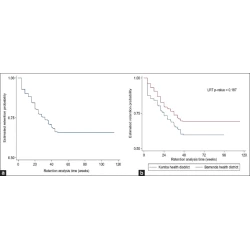
Methods: From September 1, 2015, to February 29, 2016, we reviewed the records of pregnant and breastfeeding women initiating Option B+, a lifelong approach to preventing mother-to-child transmission (PMTCT) of HIV, between October 2013 and July 2014. We abstracted sociodemographic and clinical data from registers in 22 health facilities in the Bamenda urban and Kumba rural districts into spreadsheets. Cox regression age-adjusted survival curves were used to compare retention probabilities at 6 and 12 months post-antiretroviral therapy (ART) initiation. Multivariable modified Poisson regressions were run to estimate adjusted relative risk (aRR) of factors associated with retention in PMTCT care at 12 months post-ART initiation. STATA software was used for the analyses.
Results: Of the 560 files reviewed, majority, 62.7% (n=351), were above 24 years of age and married, 68.9% (n=386). From the multivariable analysis, enrolling early in antenatal care (ANC) (aRR: 1.50, 95% CI: 1.17- 1.93) and knowing the male partner’s HIV-negative status (aRR: 1.16, 95% CI: 1.00-1.34) were significantly associated with higher retention in care, adjusting for maternal age, marital status, and distance from the health facility. By health district, knowing the male partner’s HIV-negative status (aRR: 1.30, 95% CI: 1.13-1.50) in the Bamenda urban and enrolling early in ANC (aRR: 2.03, 95% CI: 1.21-3.41) in the Kumba rural district, had significantly higher retention rates after adjusting for the same covariates.
Conclusion and Global Health Implications: Overall, factors influencing retention varied by urban or rural district. Therefore, tailored district-level interventions are needed to enhance early ANC enrollment in the rural and partner HIV status disclosure in the urban districts to improve retention in PMTCT care.
Downloads
Similar Articles
- Deepa Dongarwar, Veronica B. Ajewole, Emmanuella Oduguwa, Ahone Ngujede, Kiydra Harris, Theresa U. Ofili, Omonike A. Olaleye, Hamisu M. Salihu, Role of Social Determinants of Health in Widening Maternal and Child Health Disparities in the Era of Covid-19 Pandemic , Vol. 9 No. 3 (2020): International Journal of Maternal and Child Health and AIDS
- Aradhana Singh, Vibha Rani Pipal, Raj Kishore Singh, Preeti Bala Singh, Nidhi Singh, Anupama Singh, Incidence and Predictors of Uterine Rupture with Maternal and Perinatal Outcome: A Cross-sectional Study , Vol. 14 No. Continuous (2025): International Journal of Maternal and Child Health and AIDS
- Gerald J. Makuka, Moses M. Sango, Ayubu E. Mashambo, Abednego E. Mashambo, Sia E. Msuya, Sabina P. Mtweve, Clients’ Perspectives on Quality of Delivery Services in a Rural Setting in Tanzania: Findings from a Qualitative Action-Oriented Research , Vol. 6 No. 1 (2017): International Journal of Maternal and Child Health and AIDS
- Janel Mendoza, Improving Health, Social Welfare, and Human Development Through Women’s Empowerment in Developing Countries: The 2016 Girl Up Leadership Summit, Washington, DC, USA , Vol. 5 No. 2 (2016): International Journal of Maternal and Child Health and AIDS
- Deepa Dongarwar, Hamisu Mohammed Salihu, Risk of Stillbirth after Infertility Treatment in the United States: 2014-2017 , Vol. 9 No. 1 (2020): International Journal of Maternal and Child Health and AIDS
- Kelsey A. Stewart, Sergio M. Navarro, Sriharsha Kambala, Gail Tan, Revanth Poondla, Sara Lederman, Kelli Barbour, Chris Lavy, Trends in Ultrasound Use in Low and Middle Income Countries: A Systematic Review , Vol. 9 No. 1 (2020): International Journal of Maternal and Child Health and AIDS
- Manpreet Singh Khurmi, Felix Sayinzoga, Atakilt Berhe, Tatien Bucyana, Assumpta Kayinamura Mwali, Emmanuel Manzi, Maharajan Muthu, Newborn Survival Case Study in Rwanda - Bottleneck Analysis and Projections in Key Maternal and Child Mortality Rates Using Lives Saved Tool (LiST) , Vol. 6 No. 2 (2017): International Journal of Maternal and Child Health and AIDS
- Ashish Kumar Gupta, Kakoli Borkotoky, Amit Kumar, Household Headship and Infant Mortality in India: Evaluating the Determinants and Differentials , Vol. 3 No. 1 (2015): International Journal of Maternal and Child Health and AIDS
- Kolawole Solomon Oyedeji, Adeniyi Francis Fagbamigbe, Johnbull Sonny Ogboi, Adebobola Toluwalashe Bashorun, Kawu Bolakale Issa, Perpetua Amida, Adeniyi Ogundiran, Ezire Onoriode, Does Pre-Survey Training Impact Knowledge of Survey Administrators and Survey Outcomes in Developing Countries? Evaluation Findings of a Training of Trainers Workshop for National AIDS and Reproductive Health Survey-Plus in Nigeria , Vol. 2 No. 1 (2013): International Journal of Maternal and Child Health and AIDS
- Foluke Adenike Olatona, Jesupelumi Oreoluwa Adenihun, Sunday Adedeji Aderibigbe, Oluwafunmilayo Funke Adeniyi, Complementary Feeding Knowledge, Practices, and Dietary Diversity among Mothers of Under-Five Children in an Urban Community in Lagos State, Nigeria , Vol. 6 No. 1 (2017): International Journal of Maternal and Child Health and AIDS
<< < 15 16 17 18 19 20 21 22 23 24 > >>
You may also start an advanced similarity search for this article.
Published
How to Cite
Issue
Section
License
Copyright © 2023 Joel M. Njah, Gregory E. Halle-Ekane, Sylvester N. Atanga, Edouard K. Tshimwanga, Felix Desembuin, Pius T. Muffih. Published by Global Health and Education Projects, Inc., USA.

This is an open-access article distributed under the terms of the Creative Commons Attribution-NonCommercial-ShareAlike 4.0 International License , which permits others to remix, transform, and build upon the work non-commercially, provided the original author is credited and the new creations are licensed under the same terms.