
From Option B+ to Universal “Test and Treat” in Cameroon: Identification and Evaluation of District-level Factors Associated with Retention in Care
DOI:
https://doi.org/10.21106/ijma.631Keywords:
- PMTCT,
- ANC,
- Option B+,
- Pregnant and Breastfeeding Women Living with HIV,
- Retention,
- sub-Saharan Africa,
- Cameroon
Abstract
Background and Objective: Retaining women in Option B+ services is crucial for eliminating new pediatric HIV infections. However, there are few studies on factors influencing retention at the district level. This study evaluates the factors associated with retention in two health districts of Cameroon.
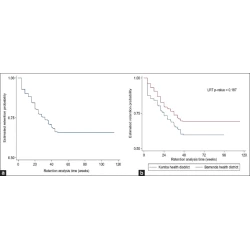
Methods: From September 1, 2015, to February 29, 2016, we reviewed the records of pregnant and breastfeeding women initiating Option B+, a lifelong approach to preventing mother-to-child transmission (PMTCT) of HIV, between October 2013 and July 2014. We abstracted sociodemographic and clinical data from registers in 22 health facilities in the Bamenda urban and Kumba rural districts into spreadsheets. Cox regression age-adjusted survival curves were used to compare retention probabilities at 6 and 12 months post-antiretroviral therapy (ART) initiation. Multivariable modified Poisson regressions were run to estimate adjusted relative risk (aRR) of factors associated with retention in PMTCT care at 12 months post-ART initiation. STATA software was used for the analyses.
Results: Of the 560 files reviewed, majority, 62.7% (n=351), were above 24 years of age and married, 68.9% (n=386). From the multivariable analysis, enrolling early in antenatal care (ANC) (aRR: 1.50, 95% CI: 1.17- 1.93) and knowing the male partner’s HIV-negative status (aRR: 1.16, 95% CI: 1.00-1.34) were significantly associated with higher retention in care, adjusting for maternal age, marital status, and distance from the health facility. By health district, knowing the male partner’s HIV-negative status (aRR: 1.30, 95% CI: 1.13-1.50) in the Bamenda urban and enrolling early in ANC (aRR: 2.03, 95% CI: 1.21-3.41) in the Kumba rural district, had significantly higher retention rates after adjusting for the same covariates.
Conclusion and Global Health Implications: Overall, factors influencing retention varied by urban or rural district. Therefore, tailored district-level interventions are needed to enhance early ANC enrollment in the rural and partner HIV status disclosure in the urban districts to improve retention in PMTCT care.
Downloads
Similar Articles
- Arlin Delgado, Chinyere N. Reid, Emma Hale, Jennifer Marshall, Kimberly Fryer, Evaluation of Virtual Prenatal Care for Obstetric Care Delivery During the COVID-19 Pandemic: A Mixed Method Research Study Using the Consolidated Framework in Implementation Research , Vol. 12 No. 2 (2023): International Journal of Maternal and Child Health and AIDS
- Idowu O Adebara, Damilola Ifarinola, Olumide Adewara, Adebayo Adeniyi, Ayobami O. Oni, Gabriel Alayode, Olusegun Busari, Kolawole Fasakin, A Comparison of Placental Alpha Microglobuliun-1 Rapid Immunoassay and Standard Clinical Method For Diagnosis of Premature Rupture of Membranes , Vol. 8 No. 2 (2019): International Journal of Maternal and Child Health and AIDS
- Kenneth N. Opara, Rebecca T. Akomalafe, Nsima I. Udoidung, Udeme U. Afia, Clement A. Yaro, Bassey E. Bassey, Urogenital Schistosomiasis among Primary School Children in Rural Communities in Obudu, Southern Nigeria , Vol. 10 No. 1 (2021): International Journal of Maternal and Child Health and AIDS
- Hadiza Galadanci, Deepa Dongarwar, Wolfgang Künzel, Oladapo Shittu, Murtala Yusuf, Sadiq Abdurrahman, Dolapo Lufadeju, Hamisu M. Salihu, Cesarean Section and Maternal-fetal Mortality Rates in Nigeria: An Ecological Lens into the Last Decade , Vol. 9 No. 1 (2020): International Journal of Maternal and Child Health and AIDS
- Gopal K. Singh, Jihong Liu, Health Improvements Have Been More Rapid and Widespread in China than in India: A Comparative Analysis of Health and Socioeconomic Trends from 1960 to 2011 , Vol. 1 No. 1 (2012): International Journal of Maternal and Child Health and AIDS
- Gopal K. Singh, Mohammad Siahpush, Romuladus E. Azuine, Shanita D. Williams, Increasing Area Deprivation and Socioeconomic Inequalities in Heart Disease, Stroke, and Cardiovascular Disease Mortality Among Working Age Populations, United States, 1969-2011 , Vol. 3 No. 2 (2015): International Journal of Maternal and Child Health and AIDS
- Romuladus E. Azuine, Sussan E. Ekejiuba, Gopal K. Singh, Magnus A. Azuine, Ebola Virus Disease Epidemic: What Can the World Learn and Not Learn from West Africa? , Vol. 3 No. 1 (2015): International Journal of Maternal and Child Health and AIDS
- Justice Ajaari, Honorati Masanja, Renay Weiner, Shalom Akonvi Abokyi, Seth Owusu-Agyei, Impact of Place of Delivery on Neonatal Mortality in Rural Tanzania , Vol. 1 No. 1 (2012): International Journal of Maternal and Child Health and AIDS
- Mehrete Girmay, Digital Health Divide: Opportunities for Reducing Health Disparities and Promoting Equitable Care for Maternal and Child Health Populations , Vol. 13 No. Continuous (2024): International Journal of Maternal and Child Health and AIDS
- Yifru Berhan, Sinteyehu Abeba, Thirty Years of United Nations Inter-Agency Working Group’s Global, Regional, and National Maternal Mortality Estimates Revisited , Vol. 13 No. Continuous (2024): International Journal of Maternal and Child Health and AIDS
<< < 16 17 18 19 20 21 22 23 24 25 > >>
You may also start an advanced similarity search for this article.
Published
How to Cite
Issue
Section
License
Copyright © 2023 Joel M. Njah, Gregory E. Halle-Ekane, Sylvester N. Atanga, Edouard K. Tshimwanga, Felix Desembuin, Pius T. Muffih. Published by Global Health and Education Projects, Inc., USA.

This is an open-access article distributed under the terms of the Creative Commons Attribution-NonCommercial-ShareAlike 4.0 International License , which permits others to remix, transform, and build upon the work non-commercially, provided the original author is credited and the new creations are licensed under the same terms.