
From Option B+ to Universal “Test and Treat” in Cameroon: Identification and Evaluation of District-level Factors Associated with Retention in Care
DOI:
https://doi.org/10.21106/ijma.631Keywords:
- PMTCT,
- ANC,
- Option B+,
- Pregnant and Breastfeeding Women Living with HIV,
- Retention,
- sub-Saharan Africa,
- Cameroon
Abstract
Background and Objective: Retaining women in Option B+ services is crucial for eliminating new pediatric HIV infections. However, there are few studies on factors influencing retention at the district level. This study evaluates the factors associated with retention in two health districts of Cameroon.
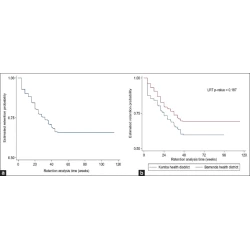
Methods: From September 1, 2015, to February 29, 2016, we reviewed the records of pregnant and breastfeeding women initiating Option B+, a lifelong approach to preventing mother-to-child transmission (PMTCT) of HIV, between October 2013 and July 2014. We abstracted sociodemographic and clinical data from registers in 22 health facilities in the Bamenda urban and Kumba rural districts into spreadsheets. Cox regression age-adjusted survival curves were used to compare retention probabilities at 6 and 12 months post-antiretroviral therapy (ART) initiation. Multivariable modified Poisson regressions were run to estimate adjusted relative risk (aRR) of factors associated with retention in PMTCT care at 12 months post-ART initiation. STATA software was used for the analyses.
Results: Of the 560 files reviewed, majority, 62.7% (n=351), were above 24 years of age and married, 68.9% (n=386). From the multivariable analysis, enrolling early in antenatal care (ANC) (aRR: 1.50, 95% CI: 1.17- 1.93) and knowing the male partner’s HIV-negative status (aRR: 1.16, 95% CI: 1.00-1.34) were significantly associated with higher retention in care, adjusting for maternal age, marital status, and distance from the health facility. By health district, knowing the male partner’s HIV-negative status (aRR: 1.30, 95% CI: 1.13-1.50) in the Bamenda urban and enrolling early in ANC (aRR: 2.03, 95% CI: 1.21-3.41) in the Kumba rural district, had significantly higher retention rates after adjusting for the same covariates.
Conclusion and Global Health Implications: Overall, factors influencing retention varied by urban or rural district. Therefore, tailored district-level interventions are needed to enhance early ANC enrollment in the rural and partner HIV status disclosure in the urban districts to improve retention in PMTCT care.
Downloads
Similar Articles
- Natalie C Frayer, Yeonsoo Kim, Caffeine Intake During Pregnancy and Risk of Childhood Obesity: A Systematic Review , Vol. 9 No. 3 (2020): International Journal of Maternal and Child Health and AIDS
- Smitha Kochukuttan, TK Sundari Ravindran, Suneeta Krishnan, Evaluating Birth Preparedness and Pregnancy Complications Readiness Knowledge and Skills of Accredited Social Health Activists in India , Vol. 2 No. 1 (2013): International Journal of Maternal and Child Health and AIDS
- Hamisu M. Salihu, Romuladus E. Azuine, Current and Emerging Issues in Global Health: An Introduction to Special Journal Collection , Vol. 9 No. 1 (2020): International Journal of Maternal and Child Health and AIDS
- Matiur Rahman, Kaoser Bin Siddique, Aminur Rahman, Rahidul Islam, Mohammad Mahbub Ur Rahim, Access to and Utilization of Maternal and Child Healthcare Services During COVID-19 Pandemic in Rural Bangladesh , Vol. 13 No. Continuous (2024): International Journal of Maternal and Child Health and AIDS
- Munyaradzi Muchacha, Edmos Mtetwa, Social and Economic Barriers to Exclusive Breast Feeding In Rural Zimbabwe , Vol. 3 No. 1 (2015): International Journal of Maternal and Child Health and AIDS
- Janice Katherine Kopinak, Mental Health in Developing Countries: Challenges and Opportunities in Introducing Western Mental Health System in Uganda , Vol. 3 No. 1 (2015): International Journal of Maternal and Child Health and AIDS
- Isabel Griffin, Boubakari Ibrahimou, Natasha Navejar, Anjali Aggarwal, Kristopher Myers, Daniel Mauck, Korede K. Yusuf, Usman J. Wudil, Muktar H. Aliyu, Hamisu M. Salihu, Maternal Caffeine Consumption and Racial Disparities in Fetal Telomere Length , Vol. 9 No. 1 (2020): International Journal of Maternal and Child Health and AIDS
- Eren Oyungu, Anna Roose, Ananda R. Ombitsa, Rachel C. Vreeman, Megan S. McHenry, Child Development Monitoring in Well-baby Clinics in Kenya , Vol. 10 No. 1 (2021): International Journal of Maternal and Child Health and AIDS
- Metin Gülmezoglu, Lester Chiner, Sara Rushwan, Anne Ammerdorffer, A Tale of Two Medicines: The Need for Ownership, End-to-End Planning and Execution for Development and Introduction of Maternal Health Medicines , Vol. 13 No. S1 (2024): International Journal of Maternal and Child Health and AIDS
- Muhammad Adamu Abbas, Hassan Adam Murtala, Fauziyya S. Abdullahi, Abubakar L. Yusuf, Aisha Adam Abdullahi, Amina Aminu, Aisha Mustapha, Eknath Naik, Hamisu M. Salihu, Intent to Receive Human Papillomavirus Vaccination among School-going Pre-teens and Adolescent Girls , Vol. 14 No. Continuous (2025): International Journal of Maternal and Child Health and AIDS
<< < 17 18 19 20 21 22 23 24 25 26 > >>
You may also start an advanced similarity search for this article.
Published
How to Cite
Issue
Section
License
Copyright © 2023 Joel M. Njah, Gregory E. Halle-Ekane, Sylvester N. Atanga, Edouard K. Tshimwanga, Felix Desembuin, Pius T. Muffih. Published by Global Health and Education Projects, Inc., USA.

This is an open-access article distributed under the terms of the Creative Commons Attribution-NonCommercial-ShareAlike 4.0 International License , which permits others to remix, transform, and build upon the work non-commercially, provided the original author is credited and the new creations are licensed under the same terms.