
From Option B+ to Universal “Test and Treat” in Cameroon: Identification and Evaluation of District-level Factors Associated with Retention in Care
DOI:
https://doi.org/10.21106/ijma.631Keywords:
- PMTCT,
- ANC,
- Option B+,
- Pregnant and Breastfeeding Women Living with HIV,
- Retention,
- sub-Saharan Africa,
- Cameroon
Abstract
Background and Objective: Retaining women in Option B+ services is crucial for eliminating new pediatric HIV infections. However, there are few studies on factors influencing retention at the district level. This study evaluates the factors associated with retention in two health districts of Cameroon.
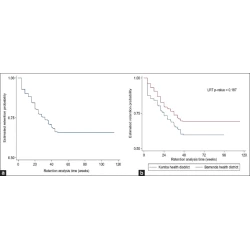
Methods: From September 1, 2015, to February 29, 2016, we reviewed the records of pregnant and breastfeeding women initiating Option B+, a lifelong approach to preventing mother-to-child transmission (PMTCT) of HIV, between October 2013 and July 2014. We abstracted sociodemographic and clinical data from registers in 22 health facilities in the Bamenda urban and Kumba rural districts into spreadsheets. Cox regression age-adjusted survival curves were used to compare retention probabilities at 6 and 12 months post-antiretroviral therapy (ART) initiation. Multivariable modified Poisson regressions were run to estimate adjusted relative risk (aRR) of factors associated with retention in PMTCT care at 12 months post-ART initiation. STATA software was used for the analyses.
Results: Of the 560 files reviewed, majority, 62.7% (n=351), were above 24 years of age and married, 68.9% (n=386). From the multivariable analysis, enrolling early in antenatal care (ANC) (aRR: 1.50, 95% CI: 1.17- 1.93) and knowing the male partner’s HIV-negative status (aRR: 1.16, 95% CI: 1.00-1.34) were significantly associated with higher retention in care, adjusting for maternal age, marital status, and distance from the health facility. By health district, knowing the male partner’s HIV-negative status (aRR: 1.30, 95% CI: 1.13-1.50) in the Bamenda urban and enrolling early in ANC (aRR: 2.03, 95% CI: 1.21-3.41) in the Kumba rural district, had significantly higher retention rates after adjusting for the same covariates.
Conclusion and Global Health Implications: Overall, factors influencing retention varied by urban or rural district. Therefore, tailored district-level interventions are needed to enhance early ANC enrollment in the rural and partner HIV status disclosure in the urban districts to improve retention in PMTCT care.
Downloads
Similar Articles
- Sorochi H. Iloanusi, Osaro O. Mgbere, Susan. M. Abughosh, Ekere J. Essien, HIV Non-Occupational Post Exposure Prophylaxis in Nigeria: A Systematic Review of Research Evidence and Practice , Vol. 8 No. 2 (2019): International Journal of Maternal and Child Health and AIDS
- Wah Myint, Aishatu Yusuf, Angela Nguyen, Elfreda Samman, HIV Testing, Household and Reproductive Health Decision-Making: The Role of Women Autonomy in a Nationally Representative Study in Cambodia , Vol. 14 No. Continuous (2025): International Journal of Maternal and Child Health and AIDS
- Brianna L. Smith, Sara Zizzo, Anouk Amzel, Sarah Wiant, Molly C. Pezzulo, Sarah Konopka, Rachel Golin, Alexandra C. Vrazo, Integration of Neonatal and Child Health Interventions with Pediatric HIV Interventions in Global Health , Vol. 7 No. 1 (2018): International Journal of Maternal and Child Health and AIDS
- Elizabeth Armstrong-Mensah, Krystal Ruiz, Aminata Fofana, Victoria Hawley, Perinatal HIV Transmission Prevention: Challenges among Women Living with HIV in sub-Saharan Africa , Vol. 9 No. 3 (2020): International Journal of Maternal and Child Health and AIDS
- San Hone, Li Li, W. Scott Comulada, Roger Detels, Progress and Challenges of Implementing Decentralized HIV Testing For Prevention of Mother-to-Child Transmission of HIV – Myanmar , Vol. 8 No. 1 (2019): International Journal of Maternal and Child Health and AIDS
- Akosua A. Gyimah, Emmanuel K. Nakua, Ellis Owusu-Dabo, Easmon Otupiri, Contraceptive Characteristics of Women Living with HIV in the Kumasi Metropolis, Ghana , Vol. 2 No. 1 (2013): International Journal of Maternal and Child Health and AIDS
- Céline N. Nkenfou, Marie-Nicole Ngoufack, Georges Nguefack-Tsague, Barbara T. Atogho, Constantin Tchakounte, Brian T. Bongwong, Carine N. Nguefeu-Tchinda, Elise Elong, Laeticia H. Yatchou, Joel K. Kameni, Aline Tiga, Wilfred F. Mbacham, Alexis Ndjolo, Maternal Socio-Demographic Factors and Mother-to-Child Transmission of HIV in the North Region of Cameroon , Vol. 12 No. 1 (2023): International Journal of Maternal and Child Health and AIDS
- Agnes Napyo, James K Tumwine, David Mukunya, Josephine Tumuhamye, Anna Agnes Ojok Arach, Grace Ndeezi, Paul Waako, Thorkild Tylleskär, Detectable HIV-RNA Viral Load Among HIV-Infected Pregnant Women on Treatment in Northern Uganda , Vol. 9 No. 2 (2020): International Journal of Maternal and Child Health and AIDS
- Vatsla Dadhwal, Aparna Sharma, Kavita Khoiwal, Dipika Deka, Plaboni Sarkar, P. Vanamail, Pregnancy Outcomes in HIV-Infected Women: Experience from a Tertiary Care Center in India , Vol. 6 No. 1 (2017): International Journal of Maternal and Child Health and AIDS
- Amina Abdullahi, Hassan Adam Murtala, Aisha Adam Abdullahi, Amina Aminu, Muktar H. Aliyu, Sani H. Aliyu, Ololade D. Adeyemi, Deepa Dongarwar, Jordi B. Torrelles, Gambo Aliyu, Hamisu M. Salihu, Drivers of Human Immunodeficiency Virus among Pregnant Women in Conflict and Non-conflict Zones of Nigeria , Vol. 14 No. Continuous (2025): International Journal of Maternal and Child Health and AIDS
<< < 1 2 3 4 5 6 7 8 9 10 > >>
You may also start an advanced similarity search for this article.
Published
How to Cite
Issue
Section
License
Copyright © 2023 Joel M. Njah, Gregory E. Halle-Ekane, Sylvester N. Atanga, Edouard K. Tshimwanga, Felix Desembuin, Pius T. Muffih. Published by Global Health and Education Projects, Inc., USA.

This is an open-access article distributed under the terms of the Creative Commons Attribution-NonCommercial-ShareAlike 4.0 International License , which permits others to remix, transform, and build upon the work non-commercially, provided the original author is credited and the new creations are licensed under the same terms.