
From Option B+ to Universal “Test and Treat” in Cameroon: Identification and Evaluation of District-level Factors Associated with Retention in Care
DOI:
https://doi.org/10.21106/ijma.631Keywords:
- PMTCT,
- ANC,
- Option B+,
- Pregnant and Breastfeeding Women Living with HIV,
- Retention,
- sub-Saharan Africa,
- Cameroon
Abstract
Background and Objective: Retaining women in Option B+ services is crucial for eliminating new pediatric HIV infections. However, there are few studies on factors influencing retention at the district level. This study evaluates the factors associated with retention in two health districts of Cameroon.
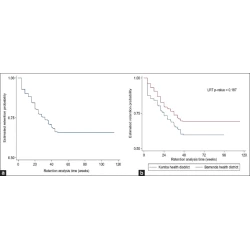
Methods: From September 1, 2015, to February 29, 2016, we reviewed the records of pregnant and breastfeeding women initiating Option B+, a lifelong approach to preventing mother-to-child transmission (PMTCT) of HIV, between October 2013 and July 2014. We abstracted sociodemographic and clinical data from registers in 22 health facilities in the Bamenda urban and Kumba rural districts into spreadsheets. Cox regression age-adjusted survival curves were used to compare retention probabilities at 6 and 12 months post-antiretroviral therapy (ART) initiation. Multivariable modified Poisson regressions were run to estimate adjusted relative risk (aRR) of factors associated with retention in PMTCT care at 12 months post-ART initiation. STATA software was used for the analyses.
Results: Of the 560 files reviewed, majority, 62.7% (n=351), were above 24 years of age and married, 68.9% (n=386). From the multivariable analysis, enrolling early in antenatal care (ANC) (aRR: 1.50, 95% CI: 1.17- 1.93) and knowing the male partner’s HIV-negative status (aRR: 1.16, 95% CI: 1.00-1.34) were significantly associated with higher retention in care, adjusting for maternal age, marital status, and distance from the health facility. By health district, knowing the male partner’s HIV-negative status (aRR: 1.30, 95% CI: 1.13-1.50) in the Bamenda urban and enrolling early in ANC (aRR: 2.03, 95% CI: 1.21-3.41) in the Kumba rural district, had significantly higher retention rates after adjusting for the same covariates.
Conclusion and Global Health Implications: Overall, factors influencing retention varied by urban or rural district. Therefore, tailored district-level interventions are needed to enhance early ANC enrollment in the rural and partner HIV status disclosure in the urban districts to improve retention in PMTCT care.
Downloads
Similar Articles
- Amol Jamkhande, Bhagyashree P. Agre, Neelam Gavali, Anjali Rajesh Gaikwad, Sanpreet Singh Sachdev, Association Between Maternal Periodontitis and Preterm Low Birth Weight in Indian Populations: A Literature Review , Vol. 15 (2026): International Journal of Maternal and Child Health and AIDS
- Charles Kouanfack, Hermine Meli, Samuel N. Cumber, Fala Bede, Claude N. Nkfusai, Patience Y. Ijang, Emerson Wepngong, Olga Yvonne M. Bassong, Benjamin-Alexandre Nkoum, Non-Occupational HIV Post-exposure Prophylaxis: A 10-Year Retrospective Review of Data Following Sexual Exposure From Yaounde Central Hospital, Cameroon , Vol. 8 No. 2 (2019): International Journal of Maternal and Child Health and AIDS
- Elizabeth Armstrong-Mensah, Damilola Dada, Amber Bowers, Aruba Muhammad, Chisom Nnoli, Geographic, Health Care Access, Racial Discrimination, and Socioeconomic Determinants of Maternal Mortality in Georgia, United States , Vol. 10 No. 2 (2021): International Journal of Maternal and Child Health and AIDS
- Florence F. Kimario, Charles Festo, Josephine Shabani, Mwifadhi Mrisho, Determinants of Home Delivery among Women Aged 15-24 Years in Tanzania , Vol. 9 No. 2 (2020): International Journal of Maternal and Child Health and AIDS
- Amina P. Alio, Candace Sibley, Halimah S. Ouedraogo, Stephaun E. Wallace, Steven Wakefield, Damon L. Humes, Sheldon D. Fields, Michael C. Keefer, House Ball Community Leaders’ Perceptions of HIV and HIV Vaccine Research , Vol. 9 No. 1 (2020): International Journal of Maternal and Child Health and AIDS
- Amos Kankponang Laar, Belynda Amankwa, Charlotte Asiedu, Prevention-of-Mother-To-Child-Transmission of HIV Services in Sub-Saharan Africa: A Qualitative Analysis of Healthcare Providers and Clients Challenges in Ghana , Vol. 2 No. 2 (2014): International Journal of Maternal and Child Health and AIDS
- Maria Vigil-Mallette, Daryle Pickens, Julliet Ogu, Deepa Dongarwar, Elizabeth Onugha, Hamisu M Salihu, Fifth Annual Summer Research Summit on Health Equity Organized by the Center of Excellence in Health Equity, Training and Research, Baylor College of Medicine, Houston, Texas 77030, USA on May 17, 2022 , Vol. 11 No. S2 (2022): International Journal of Maternal and Child Health and AIDS
- Phillips Edomwonyi Obasohan, Paul Gana, Mahmud A. Mustapha, Ahmed Egbako Umar, Audu Makada, Dorcas Nike Obasohan, Decision Making Autonomy and Maternal Healthcare Utilization among Nigerian Women , Vol. 8 No. 1 (2019): International Journal of Maternal and Child Health and AIDS
- Juliana Y. Enos, Richard D. Amoako, Innocent K. Doku, Utilization, Predictors and Gaps in the Continuum of Care for Maternal and Newborn Health in Ghana , Vol. 10 No. 1 (2021): International Journal of Maternal and Child Health and AIDS
- Temesgen Geta, Eskindir Israe, Buzuayehu Atinafu, Prevalence and Associated Factors of Client Satisfaction with Antenatal Care Services Among Antenatal Care Attendants in Ethiopia: A Systematic Review and Meta-Analysis , Vol. 13 No. Continuous (2024): International Journal of Maternal and Child Health and AIDS
<< < 4 5 6 7 8 9 10 11 12 13 > >>
You may also start an advanced similarity search for this article.
Published
How to Cite
Issue
Section
License
Copyright © 2023 Joel M. Njah, Gregory E. Halle-Ekane, Sylvester N. Atanga, Edouard K. Tshimwanga, Felix Desembuin, Pius T. Muffih. Published by Global Health and Education Projects, Inc., USA.

This is an open-access article distributed under the terms of the Creative Commons Attribution-NonCommercial-ShareAlike 4.0 International License , which permits others to remix, transform, and build upon the work non-commercially, provided the original author is credited and the new creations are licensed under the same terms.