
From Option B+ to Universal “Test and Treat” in Cameroon: Identification and Evaluation of District-level Factors Associated with Retention in Care
DOI:
https://doi.org/10.21106/ijma.631Keywords:
- PMTCT,
- ANC,
- Option B+,
- Pregnant and Breastfeeding Women Living with HIV,
- Retention,
- sub-Saharan Africa,
- Cameroon
Abstract
Background and Objective: Retaining women in Option B+ services is crucial for eliminating new pediatric HIV infections. However, there are few studies on factors influencing retention at the district level. This study evaluates the factors associated with retention in two health districts of Cameroon.
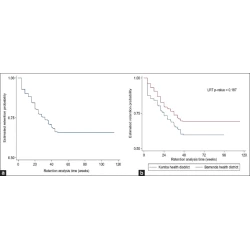
Methods: From September 1, 2015, to February 29, 2016, we reviewed the records of pregnant and breastfeeding women initiating Option B+, a lifelong approach to preventing mother-to-child transmission (PMTCT) of HIV, between October 2013 and July 2014. We abstracted sociodemographic and clinical data from registers in 22 health facilities in the Bamenda urban and Kumba rural districts into spreadsheets. Cox regression age-adjusted survival curves were used to compare retention probabilities at 6 and 12 months post-antiretroviral therapy (ART) initiation. Multivariable modified Poisson regressions were run to estimate adjusted relative risk (aRR) of factors associated with retention in PMTCT care at 12 months post-ART initiation. STATA software was used for the analyses.
Results: Of the 560 files reviewed, majority, 62.7% (n=351), were above 24 years of age and married, 68.9% (n=386). From the multivariable analysis, enrolling early in antenatal care (ANC) (aRR: 1.50, 95% CI: 1.17- 1.93) and knowing the male partner’s HIV-negative status (aRR: 1.16, 95% CI: 1.00-1.34) were significantly associated with higher retention in care, adjusting for maternal age, marital status, and distance from the health facility. By health district, knowing the male partner’s HIV-negative status (aRR: 1.30, 95% CI: 1.13-1.50) in the Bamenda urban and enrolling early in ANC (aRR: 2.03, 95% CI: 1.21-3.41) in the Kumba rural district, had significantly higher retention rates after adjusting for the same covariates.
Conclusion and Global Health Implications: Overall, factors influencing retention varied by urban or rural district. Therefore, tailored district-level interventions are needed to enhance early ANC enrollment in the rural and partner HIV status disclosure in the urban districts to improve retention in PMTCT care.
Downloads
Similar Articles
- Bartholomew Boniface Ochonye, Paul Umoh, Olaniyi Felix Sanni, Abiye Kalaiwo, Roger Abang, Agboola Oguntonade, Paul Amechi, Godwin Emmanuel, Pre-Exposure Prophylaxis and HIV Prevention Among Key Populations in Nigeria , Vol. 13 No. Continuous (2024): International Journal of Maternal and Child Health and AIDS
- Roger J. Chin, Domrongphol Sangmanee, Lisa Piergallini, PEPFAR Funding and Reduction in HIV Infection Rates in 12 Focus Sub-Saharan African Countries: A Quantitative Analysis , Vol. 3 No. 2 (2015): International Journal of Maternal and Child Health and AIDS
- Fatima M. Damagum, Zainab D. Ahmed, Rabiu I. Jalo, Hamisu M. Salihu, C. William Wester, Muktar H. Aliyu, Adapted Counseling Care Model for Management of Female Sexual Dysfunction Among Women Living With and Without HIV , Vol. 13 No. Continuous (2024): International Journal of Maternal and Child Health and AIDS
- Oluwasola Stephen Ayosanmi, Lorette Oden, Titilope Ayosanmi, Babatunde Y. Alli, Mei Wen Wen, Jamie Johnson, Acceptability of HIV Screening in a Sample of International Students in the United States , Vol. 9 No. 3 (2020): International Journal of Maternal and Child Health and AIDS
- Prakash R Ganesh, Rachel Mernoff, Renske Dikkers, William Nundwe, Rachel Pope, A Comparison of Postoperative Surgical Outcomes among Women Undergoing Obstetric Fistula Repair with and without HIV , Vol. 10 No. 2 (2021): International Journal of Maternal and Child Health and AIDS
- Johnbull Egharevba, Jennifer Pharr, Brian van Wyk, Echezona Ezeanolue, Factors Influencing the Choice of Child Delivery Location among Women Attending Antenatal Care Services and Immunization Clinic in Southeastern Nigeria , Vol. 6 No. 1 (2017): International Journal of Maternal and Child Health and AIDS
- Ashu Michael Agbor, Loyick Nguafack Zencha, Henri Essome, Che Bleck Ndikum, Pascal Foumane, Oral Health Status of Pregnant Women Attending Antenatal Clinic in Cameroon , Vol. 14 No. Continuous (2025): International Journal of Maternal and Child Health and AIDS
- Godwin Omokhagbo Emmanuel, Olaniyi Felix Sanni, Abang Roger, Paul Umoh, Ochonye Bartholomew Boniface, Amechi Paul, Ismaeel Mohammed Yahaya, Agie Muhmmad Auwal, Improving HIV Prevention for Key Populations in Nigeria: Insights on Access, Barriers, Stigma, and Service Utilization , Vol. 14 No. Continuous (2025): International Journal of Maternal and Child Health and AIDS
- May Soe Aung, Myint Moh Soe, Hla Hla Win, Kyaw Swa Mya, Assessing the Impact of an Intervention on Caregivers’ Awareness and Completion of Continuum of Care Among Pregnant Women , Vol. 13 No. Continuous (2024): International Journal of Maternal and Child Health and AIDS
- Andrew Walubo, Refuoe Baleni, Hillary Mukudu, Henry Kambafwile, Mukesh Dheda, Thanduxolo Thengwa, Tshepang Jiane, Clinical Characteristics of Children with HIV Initiated on Antiretroviral Treatment at HIV Clinics in Bloemfontein, South Africa , Vol. 10 No. 1 (2021): International Journal of Maternal and Child Health and AIDS
<< < 2 3 4 5 6 7 8 9 10 11 > >>
You may also start an advanced similarity search for this article.
Published
How to Cite
Issue
Section
License
Copyright © 2023 Joel M. Njah, Gregory E. Halle-Ekane, Sylvester N. Atanga, Edouard K. Tshimwanga, Felix Desembuin, Pius T. Muffih. Published by Global Health and Education Projects, Inc., USA.

This is an open-access article distributed under the terms of the Creative Commons Attribution-NonCommercial-ShareAlike 4.0 International License , which permits others to remix, transform, and build upon the work non-commercially, provided the original author is credited and the new creations are licensed under the same terms.