
From Option B+ to Universal “Test and Treat” in Cameroon: Identification and Evaluation of District-level Factors Associated with Retention in Care
DOI:
https://doi.org/10.21106/ijma.631Keywords:
- PMTCT,
- ANC,
- Option B+,
- Pregnant and Breastfeeding Women Living with HIV,
- Retention,
- sub-Saharan Africa,
- Cameroon
Abstract
Background and Objective: Retaining women in Option B+ services is crucial for eliminating new pediatric HIV infections. However, there are few studies on factors influencing retention at the district level. This study evaluates the factors associated with retention in two health districts of Cameroon.
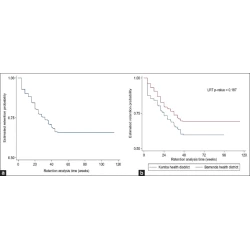
Methods: From September 1, 2015, to February 29, 2016, we reviewed the records of pregnant and breastfeeding women initiating Option B+, a lifelong approach to preventing mother-to-child transmission (PMTCT) of HIV, between October 2013 and July 2014. We abstracted sociodemographic and clinical data from registers in 22 health facilities in the Bamenda urban and Kumba rural districts into spreadsheets. Cox regression age-adjusted survival curves were used to compare retention probabilities at 6 and 12 months post-antiretroviral therapy (ART) initiation. Multivariable modified Poisson regressions were run to estimate adjusted relative risk (aRR) of factors associated with retention in PMTCT care at 12 months post-ART initiation. STATA software was used for the analyses.
Results: Of the 560 files reviewed, majority, 62.7% (n=351), were above 24 years of age and married, 68.9% (n=386). From the multivariable analysis, enrolling early in antenatal care (ANC) (aRR: 1.50, 95% CI: 1.17- 1.93) and knowing the male partner’s HIV-negative status (aRR: 1.16, 95% CI: 1.00-1.34) were significantly associated with higher retention in care, adjusting for maternal age, marital status, and distance from the health facility. By health district, knowing the male partner’s HIV-negative status (aRR: 1.30, 95% CI: 1.13-1.50) in the Bamenda urban and enrolling early in ANC (aRR: 2.03, 95% CI: 1.21-3.41) in the Kumba rural district, had significantly higher retention rates after adjusting for the same covariates.
Conclusion and Global Health Implications: Overall, factors influencing retention varied by urban or rural district. Therefore, tailored district-level interventions are needed to enhance early ANC enrollment in the rural and partner HIV status disclosure in the urban districts to improve retention in PMTCT care.
Downloads
Similar Articles
- Anne Esther Njom Nlend, Pascal Avenec, Jeannette Epée Ngoué, Arsène B. Sandie, Morbidity and Mortality of HIV-Exposed Uninfected Infants in a Tertiary Referral Facility in Yaoundé, Cameroon , Vol. 12 No. 2 (2023): International Journal of Maternal and Child Health and AIDS
- Ornella Sybile D. Kouanfack, Charles Kouanfack, Serges Clotaire Billong, Samuel N. Cumber, Claude N. Nkfusai, Fala Bede, Emerson Wepngong, Chombong Hubert, Georges Nguefack-Tsague, Madeleine N. Singwe, Epidemiology of Opportunistic Infections in HIV Infected Patients on Treatment in Accredited HIV Treatment Centers in Cameroon , Vol. 8 No. 2 (2019): International Journal of Maternal and Child Health and AIDS
- Joseph F. Nkfusai, Simon M. Manga, Kathleen Nulah, Calvin Ngalla, Florence Manjuh, Claude Ngwayu Nkfusai, Tendongfor Nicholas, Halle Ekane Edie Gregory, Cervical Precancer Treatment Outcomes in Cameroon , Vol. 13 No. Continuous (2024): International Journal of Maternal and Child Health and AIDS
- Phillips Edomwonyi Obasohan, Religion, Ethnicity and Contraceptive Use among Reproductive age Women in Nigeria , Vol. 3 No. 1 (2015): International Journal of Maternal and Child Health and AIDS
- Isaac Oludare Oluwayemi, Simeon Oladele Olatunya, Ezra Olatunde Ogundare, PCR Results and PMTCT Treatment Outcomes among HIV-Exposed Infants in a Tertiary Hospital in Nigeria, 2010-2014 , Vol. 3 No. 2 (2015): International Journal of Maternal and Child Health and AIDS
- Isabel Hernandez, Vinita Sharma, Miguel Reina-Ortiz, Carlos Rosas, Tatiana Ochoa, Ricardo Izurieta, Enrique Teran, HIV/AIDS-related Knowledge and Behavior among School-attending Afro-Descendant Youths in Ecuador , Vol. 9 No. 3 (2020): International Journal of Maternal and Child Health and AIDS
- Srijana Pandey, Supendra Karki, Socio-economic and Demographic Determinants of Antenatal Care Services Utilization in Central Nepal , Vol. 2 No. 2 (2014): International Journal of Maternal and Child Health and AIDS
- Tamara H. Hussein, Melina Mgongo, Jacqueline G. Uriyo, Damian J. Damian, Babill Stray-Pedersen, Sia E. Msuya, Margareta Wandel, Exclusive Breastfeeding Rates and Factors Associated with Exclusive Breastfeeding Practices in Northern Tanzania: Measurement using Two Different Methodologies—24 Hours Recall and Recall Since Birth , Vol. 8 No. 1 (2019): International Journal of Maternal and Child Health and AIDS
- Ashu Michael Agbor, Karpal Singh Sohal, Nguitewou Loith Nguimfack, Elvis Tarkang, Enow O’rock George, Sudeshni Naidoo, Oral Manifestations of HIV Infection and Dental Health Needs of Children with HIV Attending HIV Treatment Clinics in Western Cameroon , Vol. 13 No. Continuous (2024): International Journal of Maternal and Child Health and AIDS
- Rafeek A. Yusuf, Deepa Dongarwar, Zenab I. Yusuf, Hamisu M. Salihu, Association between Intimate Partner Violence, Knowledge and Use of Contraception in Africa: Comparative Analysis across Five African Regions , Vol. 9 No. 1 (2020): International Journal of Maternal and Child Health and AIDS
<< < 3 4 5 6 7 8 9 10 11 12 > >>
You may also start an advanced similarity search for this article.
Published
How to Cite
Issue
Section
License
Copyright © 2023 Joel M. Njah, Gregory E. Halle-Ekane, Sylvester N. Atanga, Edouard K. Tshimwanga, Felix Desembuin, Pius T. Muffih. Published by Global Health and Education Projects, Inc., USA.

This is an open-access article distributed under the terms of the Creative Commons Attribution-NonCommercial-ShareAlike 4.0 International License , which permits others to remix, transform, and build upon the work non-commercially, provided the original author is credited and the new creations are licensed under the same terms.