
Women’s Empowerment and HIV Testing Uptake: A Meta-analysis of Demographic and Health Surveys from 33 Sub-Saharan African Countries
DOI:
https://doi.org/10.21106/ijma.372Keywords:
- HIV/AIDS prevention,
- Women,
- Empowerment,
- Gender equality,
- Global health,
- Sub-Saharan Africa
Abstract
Background: There is a growing body of evidence suggesting that women’s empowerment can help achieve better health behaviours and outcomes. However, few have looked at the impact of women’s empowerment on HIV testing in Sub-Saharan Africa (SSA). This study investigated the association between women’s empowerment and HIV testing among women in 33 countries across SSA.
Methods: Cross-sectional data from the most recent Demographic and Health Surveys (2005-2018) of 33 countries in SSA were used. Confounder adjusted logistic regression analysis was completed separately for each of the 33 DHS datasets to produce the adjusted Odds Ratio (OR) for the association between women empowerment and HIV testing. The regression analysis strictly accounted for the three design elements (weight, cluster and strata) to produce an estimate representative of the respective countries. Finally, an Individual Participant Data (IPD) meta-analysis approach was used to statistically pool the effect of women empowerment on HIV testing.
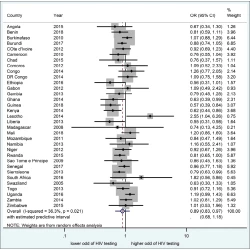
Results: There was a wide variation in the percentage of women who were empowered among the countries studied, with only a few countries such as South Africa, Angola and Ghana having a high prevalence of negative attitudes toward wife beating. HIV testing was higher in Angola, Lesotho, Uganda and South Africa. While participation in one or two of the three decisions had been marginally associated with lower odds of HIV testing across the SSA regions (0.89; 95%CI: 0.83, 0.97); the corresponding prediction interval crossed the null. Being involved in the three decisions (0.92; 95%CI: 0.84, 1.00) and disagreement to wife-beating (0.99; 95%CI: 0.94, 1.05) had no statistical relationship with HIV testing uptake.
Conclusion and Global Health Implications: The two indirect indicators of women empowerment could not predict HIV testing uptake. Further studies are recommended to establish the nature of the relationship between HIV testing and women’s empowerment that is measured through standard tools.
Downloads
Similar Articles
- Deepa Dongarwar, Toi B. Harris, Hamisu M. Salihu, Fourth Annual Summer Research Summit on Health Equity Organized by the Center of Excellence in Health Equity, Training and Research, Baylor College of Medicine, Houston, Texas 77030, USA on May 20, 2021 , Vol. 10 No. S3 (2021): International Journal of Maternal and Child Health and AIDS
- Elizabeth Armstrong-Mensah, David-Praise Ebiringa, Kaleb Whitfield, Jake Coldiron, Genital Chlamydia Trachomatis Infection: Prevalence, Risk Factors and Adverse Pregnancy and Birth Outcomes in Children and Women in sub-Saharan Africa , Vol. 10 No. 2 (2021): International Journal of Maternal and Child Health and AIDS
- Hamisu M. Salihu, Deepa Dongarwar, Toi B. Harris, Third Annual Summer Research Summit on Health Equity Organized by the Center of Excellence in Health Equity, Training and Research, Baylor College of Medicine, Houston, Texas 77030, USA on June 9, 2020: ABSTRACT: Advancing Health Equity Through Innovation , Vol. 9 No. S3 (2020): International Journal of Maternal and Child Health and AIDS
- Chaw Hay Thar, Young Hwa Lee, Young June Choe, Human Immunodeficiency Virus/Acquired Immunodeficiency Syndrome Knowledge and Attitude among Myanmar Women , Vol. 13 No. Continuous (2024): International Journal of Maternal and Child Health and AIDS
- Brianna L. Smith, Sara Zizzo, Anouk Amzel, Sarah Wiant, Molly C. Pezzulo, Sarah Konopka, Rachel Golin, Alexandra C. Vrazo, Integration of Neonatal and Child Health Interventions with Pediatric HIV Interventions in Global Health , Vol. 7 No. 1 (2018): International Journal of Maternal and Child Health and AIDS
- Wah Myint, Aishatu Yusuf, Angela Nguyen, Elfreda Samman, HIV Testing, Household and Reproductive Health Decision-Making: The Role of Women Autonomy in a Nationally Representative Study in Cambodia , Vol. 14 No. Continuous (2025): International Journal of Maternal and Child Health and AIDS
- Romuladus Emeka Azuine, Gopal K Singh, Sussan E Ekejiuba, Eta Ashu, Magnus A Azuine, Global Health Donor Presence, Variations in HIV/AIDS Prevalence, and External Resources for Health in Developing Countries in Africa and Asia , Vol. 2 No. 2 (2014): International Journal of Maternal and Child Health and AIDS
- Alana F. Hairston, Emily A. Bobrow, Christian S. Pitter, Towards the Elimination of Pediatric HIV: Enhancing Maternal, Sexual, and Reproductive Health Services , Vol. 1 No. 1 (2012): International Journal of Maternal and Child Health and AIDS
- Alexander Suuk Laar, Veioshnee Govender, Individual and Community Perspectives, Attitudes, and Practices to Mother-to-Child-Transmission and Infant Feeding among HIV-Positive Mothers in Sub-Saharan Africa: A Systematic Literature Review , Vol. 2 No. 1 (2013): International Journal of Maternal and Child Health and AIDS
- Rachael Bonawitz, Kathleen Lucy McGlasson, Jeanette L. Kaiser, Thandiwe Ngoma, Jody Lori, Carol Boyd, Godfrey Biemba, Davidson H. Hamer, Nancy A. Scott, Maternity Waiting Home Use by HIV-positive Pregnant Women in Zambia: Opportunity for Improved Prevention of Maternal to Child Transmission of HIV , Vol. 8 No. 1 (2019): International Journal of Maternal and Child Health and AIDS
<< < 1 2 3 4 5 6 7 8 9 10 > >>
You may also start an advanced similarity search for this article.
Published
How to Cite
Issue
Section
License
Copyright © 2020 Sanni Yaya, Gebretsadik Shibre, Dina Idriss-Wheeler, Olalekan A Uthman. Published by Global Health and Education Projects, Inc., USA.

This is an open-access article distributed under the terms of the Creative Commons Attribution-NonCommercial-ShareAlike 4.0 International License , which permits others to remix, transform, and build upon the work non-commercially, provided the original author is credited and the new creations are licensed under the same terms.