
Acceptance of Cervical Cancer Screening and its Correlates Among Women of a Peri-Urban High-Density Residential Area in Ndola, Zambia
DOI:
https://doi.org/10.21106/ijma.223Keywords:
- Knowledge,
- Cervical Cancer,
- Pap Smear,
- Screening,
- Zambia
Abstract
Background: Zambia has one of the highest cervical cancer incidence and mortality rates in the world. Cervical cancer screening leads to reduction in the incidence of invasive disease. The objectives of the study were to determine the level of acceptance of cervical cancer screening and its correlates among women of a peri-urban high-density residential area in Ndola, Zambia.
Methods: A cross sectional study was conducted. With a population size of 12,000 women in reproductive age and using an expected frequency of 50 + 5% and at 95% confidence interval, the required sample size was 372. A stratified sampling method was used to select participants. Independent factors that were associated with the outcome were established using multi-variate logistic regression. Adjusted odds ratios and their 95% confidence intervals are reported.
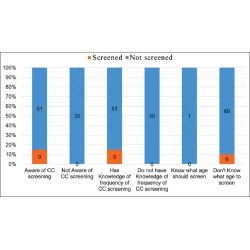
Results: In total, 355 out of 372 questionnaires were administered, achieving a response rate of 95.4%. Out of 355 participants, 9 (2.5%) had ever been screened for cervical cancer. In bivariate analyses, factors associated with screened were knowledge of body part affected, screening as a prevention tool, whether cervical cancer was curable in its early stages or not, awareness of cervical cancer screening, knowledge on frequency of screening and cervical cancer screening causing harm. However, in multivariate analysis, participants who knew that cervical cancer screening prevented cervical cancer were 3.58 (95% CI [1.49, 8.64]) times more likely to have been screened than those who did not have the knowledge. Participants who knew that cervical cancer is curable were 2.76 (95% CI [1.92, 8.31]) times more likely to have been screened than those who did not have the knowledge.
Conclusion and Global Health Implications: The uptake of screening was low. Interventions should be designed to increase uptake of screening for cervical cancer by considering factors that have been identified in the current study that are independently associated with cervical cancer screening among this population.
Downloads
Most read articles by the same author(s)
- Kamukwamba Mwale, Seter Siziya, Intestinal Infestations in Under-Five Children in Zambia , International Journal of Maternal and Child Health and AIDS: Vol. 4 No. 2 (2015): International Journal of Maternal and Child Health and AIDS
Similar Articles
- Rafeek A. Yusuf, Deepa Dongarwar, Zenab I. Yusuf, Hamisu M. Salihu, Association between Intimate Partner Violence, Knowledge and Use of Contraception in Africa: Comparative Analysis across Five African Regions , Vol. 9 No. 1 (2020): International Journal of Maternal and Child Health and AIDS
- Hamisu M. Salihu, Deepa Dongarwar, Toi B. Harris, Third Annual Summer Research Summit on Health Equity Organized by the Center of Excellence in Health Equity, Training and Research, Baylor College of Medicine, Houston, Texas 77030, USA on June 9, 2020: ABSTRACT: Advancing Health Equity Through Innovation , Vol. 9 No. S3 (2020): International Journal of Maternal and Child Health and AIDS
- Kolawole Solomon Oyedeji, Adeniyi Francis Fagbamigbe, Johnbull Sonny Ogboi, Adebobola Toluwalashe Bashorun, Kawu Bolakale Issa, Perpetua Amida, Adeniyi Ogundiran, Ezire Onoriode, Does Pre-Survey Training Impact Knowledge of Survey Administrators and Survey Outcomes in Developing Countries? Evaluation Findings of a Training of Trainers Workshop for National AIDS and Reproductive Health Survey-Plus in Nigeria , Vol. 2 No. 1 (2013): International Journal of Maternal and Child Health and AIDS
- Modupe Rebekah Akinyinka, Foluke Adenike Olatona, Esther Oluwakemi Oluwole, Breastfeeding Knowledge and Practices among Mothers of Children under 2 Years of Age Living in a Military Barrack in Southwest Nigeria , Vol. 5 No. 1 (2016): International Journal of Maternal and Child Health and AIDS
- Khadija Kofoworola Adeleye, Margaret Omowaleola Akinwaare, Prisca Olabisi Adejumo, Reproductive Plans And Utilization of Contraceptives Among Women Living With HIV , Vol. 8 No. 2 (2019): International Journal of Maternal and Child Health and AIDS
- Rachael Bonawitz, Kathleen Lucy McGlasson, Jeanette L. Kaiser, Thandiwe Ngoma, Jody Lori, Carol Boyd, Godfrey Biemba, Davidson H. Hamer, Nancy A. Scott, Maternity Waiting Home Use by HIV-positive Pregnant Women in Zambia: Opportunity for Improved Prevention of Maternal to Child Transmission of HIV , Vol. 8 No. 1 (2019): International Journal of Maternal and Child Health and AIDS
- Daisy Ruto, Michael Muthamia, Edith Njeri, Freda Nyaga, Christine Muia, Morris Kiio, Jane Wausi, Introduction of Heat-Stable Carbetocin for Postpartum Hemorrhage Prevention in Public Sector Hospitals in Kenya: Provider Experience and Policy Insights , Vol. 13 No. S1 (2024): International Journal of Maternal and Child Health and AIDS
- Esum Mathias Eyong, Nwana Yvette Ngwe, Claude Ngwayu Nfuksai, Loveline Lum Niba, Akoachere Jane-Francis, Prevalence of Occupational Exposure to HIV and Factors Associated with Compliance with Post-Exposure Prophylaxis Among Health Workers of the Biyem-Assi, Buea, and Limbe Health Districts of Cameroon Maternal and Child Health and AIDS , Vol. 11 No. 1 (2022): International Journal of Maternal and Child Health and AIDS
- Olayinka A. Onasoga, Joel Adeleke Afolayan, Tariebi Florence Asamabiriowei, Umar Nda Jibril, Abubakar Ayinla Imam, Adolescents’ Knowledge, Attitude and Utilization of Emergency Contraceptive Pills in Nigeria’s Niger Delta Region , Vol. 5 No. 1 (2016): International Journal of Maternal and Child Health and AIDS
- Olayinka Onasoga, Shittu B Muhammad, Shittu I.B Halimah, Umar N Jibril, Exploring Obstetric Analgesia in Labor Management: Assessing Knowledge and Usage Among Midwives in North-Central Nigeria , Vol. 14 No. Continuous (2025): International Journal of Maternal and Child Health and AIDS
<< < 1 2 3 4 5 6 7 8 9 10 > >>
You may also start an advanced similarity search for this article.
Published
How to Cite
Issue
Section
License
Copyright © 2018 Chiluba Kabalika, David Mulenga, Mazyanga Lucy Mazaba, Seter Siziya. Published by Global Health and Education Projects, Inc., USA.

This is an open-access article distributed under the terms of the Creative Commons Attribution-NonCommercial-ShareAlike 4.0 International License , which permits others to remix, transform, and build upon the work non-commercially, provided the original author is credited and the new creations are licensed under the same terms.