
Acceptance of Cervical Cancer Screening and its Correlates Among Women of a Peri-Urban High-Density Residential Area in Ndola, Zambia
DOI:
https://doi.org/10.21106/ijma.223Keywords:
- Knowledge,
- Cervical Cancer,
- Pap Smear,
- Screening,
- Zambia
Abstract
Background: Zambia has one of the highest cervical cancer incidence and mortality rates in the world. Cervical cancer screening leads to reduction in the incidence of invasive disease. The objectives of the study were to determine the level of acceptance of cervical cancer screening and its correlates among women of a peri-urban high-density residential area in Ndola, Zambia.
Methods: A cross sectional study was conducted. With a population size of 12,000 women in reproductive age and using an expected frequency of 50 + 5% and at 95% confidence interval, the required sample size was 372. A stratified sampling method was used to select participants. Independent factors that were associated with the outcome were established using multi-variate logistic regression. Adjusted odds ratios and their 95% confidence intervals are reported.
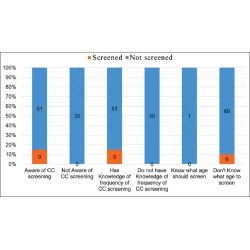
Results: In total, 355 out of 372 questionnaires were administered, achieving a response rate of 95.4%. Out of 355 participants, 9 (2.5%) had ever been screened for cervical cancer. In bivariate analyses, factors associated with screened were knowledge of body part affected, screening as a prevention tool, whether cervical cancer was curable in its early stages or not, awareness of cervical cancer screening, knowledge on frequency of screening and cervical cancer screening causing harm. However, in multivariate analysis, participants who knew that cervical cancer screening prevented cervical cancer were 3.58 (95% CI [1.49, 8.64]) times more likely to have been screened than those who did not have the knowledge. Participants who knew that cervical cancer is curable were 2.76 (95% CI [1.92, 8.31]) times more likely to have been screened than those who did not have the knowledge.
Conclusion and Global Health Implications: The uptake of screening was low. Interventions should be designed to increase uptake of screening for cervical cancer by considering factors that have been identified in the current study that are independently associated with cervical cancer screening among this population.
Downloads
Most read articles by the same author(s)
- Kamukwamba Mwale, Seter Siziya, Intestinal Infestations in Under-Five Children in Zambia , International Journal of Maternal and Child Health and AIDS: Vol. 4 No. 2 (2015): International Journal of Maternal and Child Health and AIDS
Similar Articles
- Nazrul Islam Mondal, Monzur Morshad Nasir Ullah, Nuruzzaman Khan, Mohammad Zamirul Islam, Nurul Islam, Sabiha Yasmin Moni, Nazrul Hoque, Mashiur Rahman, Socioeconomic and Demographic Disparities in Knowledge of Reproductive Healthcare among Female University Students in Bangladesh , Vol. 4 No. 2 (2015): International Journal of Maternal and Child Health and AIDS
- Veronica B. Ajewole-Mwema, Nkechi U. Ogboh, Dolores Ramirez, Olanike A. Shamonda, Kassie L. Thompson, Sneha George, Deepa Dongarwar, Polly Niravath, Mobile Mammography Outreach in Communities with Unmet Health Needs: Assessment of Appointment Outcomes and Operational Insights from Texas, United States , Vol. 14 No. Continuous (2025): International Journal of Maternal and Child Health and AIDS
- Isabel Hernandez, Vinita Sharma, Miguel Reina-Ortiz, Carlos Rosas, Tatiana Ochoa, Ricardo Izurieta, Enrique Teran, HIV/AIDS-related Knowledge and Behavior among School-attending Afro-Descendant Youths in Ecuador , Vol. 9 No. 3 (2020): International Journal of Maternal and Child Health and AIDS
- Armand Duclaire Kemo, Bruno Kenfack, Jérôme Ateudjieu, Partograph Utilization and its Determinant Factors among Healthcare Providers during Childbirth in West Cameroon , Vol. 14 No. Continuous (2025): International Journal of Maternal and Child Health and AIDS
- Océane J. Parker, Duc Minh Duong, Thuy Thu Nguyen, Vui Thi Le, Utilization of Sexual and Reproductive Healthcare Services Among Young Women in Two Districts of Hanoi, Vietnam , Vol. 15 (2026): International Journal of Maternal and Child Health and AIDS
- Fatimah Isma’il Tsiga-Ahmed, Taiwo Gboluwaga Amole, Baba Maiyaki Musa, Aishatu Muhammad Nalado, Omeiza Baba Agoyi, Hadiza Shehu Galadanci, Hamisu M. Salihu, COVID 19: Evaluating the Knowledge, Attitude and Preventive Practices of Healthcare Workers in Northern Nigeria , Vol. 10 No. 1 (2021): International Journal of Maternal and Child Health and AIDS
- Titilayo Olaoye, Oyewole O. Oyerinde, Oluwatoyin J. Elebuji, Oluwapelumi Ologun, Knowledge, Perception and Management of Pre-eclampsia among Health Care Providers in a Maternity Hospital , Vol. 8 No. 2 (2019): International Journal of Maternal and Child Health and AIDS
- Amol Jamkhande, Bhagyashree P. Agre, Neelam Gavali, Anjali Rajesh Gaikwad, Sanpreet Singh Sachdev, Association Between Maternal Periodontitis and Preterm Low Birth Weight in Indian Populations: A Literature Review , Vol. 15 (2026): International Journal of Maternal and Child Health and AIDS
- Zubairu Iliyasu, Fatimah Hassan-Hanga, Sadiq Isah Ajuji, Musa M. Bello, Safiyya S. Abdulkadir, Nafisa S. Nass, Hamisu M. Salihu, Muktar H. Aliyu, Correlates of Health Care Workers’ Knowledge and HIV-Exposed Infant Immunization Counseling Practice in Northern Nigeria , Vol. 10 No. 1 (2021): International Journal of Maternal and Child Health and AIDS
- Foluke Adenike Olatona, Jesupelumi Oreoluwa Adenihun, Sunday Adedeji Aderibigbe, Oluwafunmilayo Funke Adeniyi, Complementary Feeding Knowledge, Practices, and Dietary Diversity among Mothers of Under-Five Children in an Urban Community in Lagos State, Nigeria , Vol. 6 No. 1 (2017): International Journal of Maternal and Child Health and AIDS
<< < 1 2 3 4 5 6 7 8 9 10 > >>
You may also start an advanced similarity search for this article.
Published
How to Cite
Issue
Section
License
Copyright © 2018 Chiluba Kabalika, David Mulenga, Mazyanga Lucy Mazaba, Seter Siziya. Published by Global Health and Education Projects, Inc., USA.

This is an open-access article distributed under the terms of the Creative Commons Attribution-NonCommercial-ShareAlike 4.0 International License , which permits others to remix, transform, and build upon the work non-commercially, provided the original author is credited and the new creations are licensed under the same terms.