
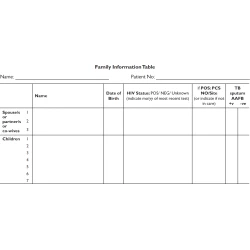
Evaluation and Utility of a Family Information Table to Identify and Test Children at Risk for HIV in Kenya
DOI:
https://doi.org/10.21106/ijma.30Keywords:
- Family Information Table,
- Pediatrics,
- HIV/AIDS,
- Linkage,
- Kenya,
- HIV Testing
Abstract
Background: Effective strategies to identify and screen children at risk for HIV are needed. The objectives of this study were to evaluate the utilization of a family information table (FIT) to identify and test at-risk children in Kenya and identify factors associated with child testing. Methods: A cross-sectional study was conducted among HIV-infected adults with children at five Kenyan clinics. HIV testing status for children aged ≤18 years was gathered from the patients’ FITs and compared to reports from in-person clinic visits as the gold standard. Generalized estimating equations were used to assess predictors for HIV testing of children adjusted for confounders and within parent correlation. Results: Our sample included 384 HIV-infected adults enrolled in care with 933 reported children. Overall, 323 FITs (84%) correctly listed all children in the family and 340 (89%) documented an HIV testing status (including untested) for all children. Seventy-five percent of parents verbally reported all children tested, compared to only 46% of FITs (OR=13.5, 95% CI 6.5-27.8). Verbal reports identified 739 (79%) children tested, with 55 (7.4%) HIV-positive and 17 (2.3%) HIV-exposed infants (HEI). Of 63 adults with HIV-positive children or HEI, 60 (95%) reported enrolling children into care. Likelihood that children had been tested was higher for younger children (≤4y vs. > 4y, aOR=2.0; 95% CI 1.4-2.9) and lower if the partner’s serostatus was unknown vs. seropositive (aOR=0.3; 95% CI: 0.1-0.8). Conclusions: Although the FIT may be a useful tool to identify children at risk for HIV, this study found underutilization by providers. To maximize impact of this tool, documentation of follow-up for untested and positive children is essential. Global Health Implications: Through early documentation of at-risk children and follow up of untested and infected children, the FIT may serve as an effective resource for improving HIV testing and linkage to care.
Downloads
Similar Articles
- Elangovan Arumugam, Joseph K. David, Santhakumar Aridoss, Nagaraj Jaganathasamy, Malathi Mathiyazhakan, Ganesh Balasubramanian, Manikandan Natesan, VM, Padmapriya, BK Kirubakaran, Sanjay Patel, Pradeep Kumar, Shobini Rajan, An Analysis of Levels and Trends in HIV Prevalence Among Pregnant Women Attending Antenatal Clinics in Karnataka, South India, 2003-2019 , Vol. 10 No. 2 (2021): International Journal of Maternal and Child Health and AIDS
- Sanni Yaya, Gebretsadik Shibre, Dina Idriss-Wheeler, Olalekan A Uthman, Women’s Empowerment and HIV Testing Uptake: A Meta-analysis of Demographic and Health Surveys from 33 Sub-Saharan African Countries , Vol. 9 No. 3 (2020): International Journal of Maternal and Child Health and AIDS
- Charles Kouanfack, Skinner Nguefack Lekelem, Fala Bede, Claude Ngwayu Nkfusai, Yvette Micha Nouafo, Christian Tchokonte, Nicaise Tsomo Zephirin, Pierre Joseph Fouda, Use of Trained Non-Medical Staff to Improve Access to HIV Testing Services in Africa: Implementation of the World Health Organization Opt-out Approach in Cameroon , Vol. 10 No. 1 (2021): International Journal of Maternal and Child Health and AIDS
- Abhiruchi Galhotra, Sanjana Agrawal, Aditi Chandrakar, Effectiveness of Human Immunodeficiency Virus Index Testing: A Global Scoping Review , Vol. 14 No. Continuous (2025): International Journal of Maternal and Child Health and AIDS
- San Hone, Li Li, W. Scott Comulada, Roger Detels, Progress and Challenges of Implementing Decentralized HIV Testing For Prevention of Mother-to-Child Transmission of HIV – Myanmar , Vol. 8 No. 1 (2019): International Journal of Maternal and Child Health and AIDS
- John Humphrey, Esther Wanjama, James G. Carlucci, Violet Naanyu, Lindah Muli, Edwin Were, Alan McGuire, Winstone M. Nyandiko, Julia Songok, Gregory Zimet, Kara Wools-Kaloustian, Understanding Women’s Preferences for Prevention of Mother-to-Child HIV Transmission Services in Kenya , Vol. 13 No. Continuous (2024): International Journal of Maternal and Child Health and AIDS
- Wah Myint, Aishatu Yusuf, Angela Nguyen, Elfreda Samman, HIV Testing, Household and Reproductive Health Decision-Making: The Role of Women Autonomy in a Nationally Representative Study in Cambodia , Vol. 14 No. Continuous (2025): International Journal of Maternal and Child Health and AIDS
- Elizabeth Armstrong-Mensah, Ato Kwamena Tetteh, Seung Choi, Utilization of Rapid Diagnostic Testing in sub-Saharan Africa: Challenges and Effects on HIV Prevention , Vol. 10 No. 1 (2021): International Journal of Maternal and Child Health and AIDS
- Alicia E. Hersey, Betty Norman, Rebecca Reece, Assessing Reproductive Decision-making Among HIV-Positive Women in Kumasi, Ghana , Vol. 8 No. 1 (2019): International Journal of Maternal and Child Health and AIDS
- Isabel Hernandez, Vinita Sharma, Miguel Reina-Ortiz, Carlos Rosas, Tatiana Ochoa, Ricardo Izurieta, Enrique Teran, HIV/AIDS-related Knowledge and Behavior among School-attending Afro-Descendant Youths in Ecuador , Vol. 9 No. 3 (2020): International Journal of Maternal and Child Health and AIDS
<< < 1 2 3 4 5 6 7 8 9 10 > >>
You may also start an advanced similarity search for this article.
Published
How to Cite
Issue
Section
License
Copyright © 2015 Michelle Meyer, Molly Elmer-DeWitt, Cinthia Blat, Starley B Shade, Ijaa Kapule, Elizabeth Bukusi, Craig R Cohen, Lisa Abuogi. Published by Global Health and Education Projects, Inc., USA.

This is an open-access article distributed under the terms of the Creative Commons Attribution-NonCommercial-ShareAlike 4.0 International License , which permits others to remix, transform, and build upon the work non-commercially, provided the original author is credited and the new creations are licensed under the same terms.